

























































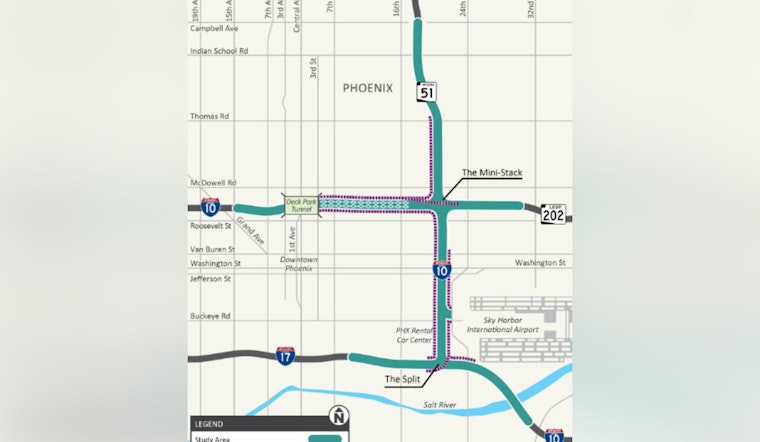
If your daily crawl through downtown Phoenix on I-10 feels like a part-time job, state officials say they want to hear from you. A new study and online survey are now live to gather public input on potential upgrades between the Deck Park Tunnel and the I-10/I-17 "Split" near Phoenix Sky Harbor International Airport, with an eye toward easing gridlock, improving safety and keeping access to downtown and the airport intact.
According to the Arizona Department of Transportation, the effort will produce a Design Concept Report and an Environmental Assessment under the National Environmental Policy Act to study possible changes along I-10 from the Deck Park Tunnel to the I-10/I-17 Split. The work also covers State Route 51 south of Thomas Road and the Loop 202 west of 24th Street. The environmental review is expected to end with either a Finding of No Significant Impact or a decision to prepare a full Environmental Impact Statement.
Background And Earlier Planning
Before this latest round of planning, the Maricopa Association of Governments released an I-10 Freeway Corridor Study in January 2025 that mapped out recommended operational fixes and design alternatives, as detailed by the Maricopa Association of Governments. That report zeroed in on the Mini-Stack interchange and nearby approaches and floated ideas such as maintaining continuous HOV lanes, reconfiguring ramps and adding collector-distributor road concepts to help traffic move more reliably.
Why Officials Say Change Is Needed
The Arizona Department of Transportation reports that traffic on I-10 in the study area is already heavily congested during peak hours, and without improvements, average delay at those times could climb by up to 60 percent by 2050. The agency also notes that from 2016 through 2021 the corridor averaged more than five crashes a day, with rear-end and sideswipe collisions making up most of the wrecks. To bring drivers into the conversation, the study team has launched an online survey that runs through June 30, with plans for a public meeting in fall 2026 and a public hearing on the draft Environmental Assessment in late 2027 or early 2028.
How To Weigh In
Commuters can take the short online survey, sign up for study updates, or send in comments by email, phone or regular mail. The study page has details on all of those options and will share dates and locations for public meetings as they are finalized. With local coverage already picking up as planners refine potential alternatives, officials say the feedback they receive will help determine which fixes move ahead into design work and future funding decisions.





