

























































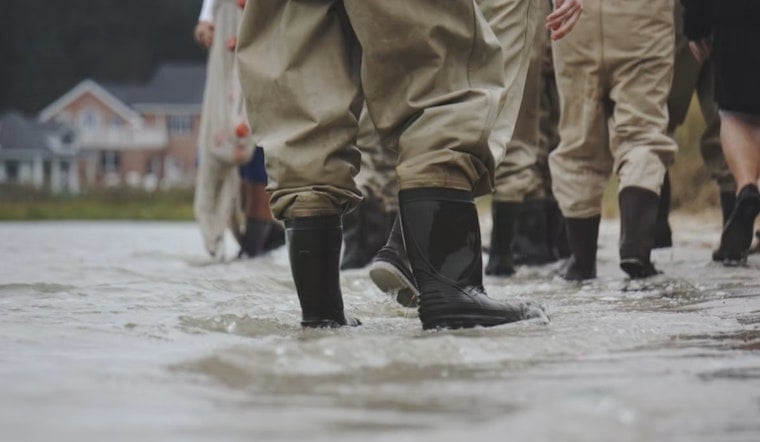
The tiny border town of Presidio is hauling the federal government into court, arguing that a planned stretch of border wall near Big Bend could literally undercut the levee that keeps the Rio Grande out of people’s living rooms.
On June 17, the Presidio Municipal Development District (PMDD) filed suit against the U.S. Department of Homeland Security and U.S. Customs and Border Protection, asking a federal judge to halt construction until engineers take a hard look at the project. The complaint says the government wants to build directly on the Presidio Flood Control Project levee that shields the village of roughly 3,000 residents. It warns that the work could compromise the town’s flood protection system.
According to the filing, defendants include DHS Secretary Markwayne Mullin and CBP Commissioner Rodney S. Scott. The government’s plan, the complaint says, would strip out the earthen slope of the existing levee and replace it with a concrete structure capped with 30-foot steel bollards. PMDD argues that changing a federally authorized flood-control project without the U.S. Army Corps of Engineers' sign-off violates the Rivers and Harbors Act (33 U.S.C. § 408) and the Administrative Procedure Act. The complaint and an emergency motion for relief are posted at Democracy Forward.
Local leaders say they first raised alarms after reviewing federal construction plans and have since hired an independent team to conduct a flood-risk study, aiming to understand how a concrete barrier could alter flow patterns where the Rio Grande meets nearby tributaries. The Presidio Valley Flood Control Project levee system, built and operated by the U.S. Section of the International Boundary and Water Commission, protects the town and about 52 square miles of surrounding urban and agricultural land, officials note. City and district officials began pressing federal agencies for engineering details after receiving notice of the planned work, according to the Midland Reporter-Telegram.
“The Trump-Vance administration cannot pick and choose which laws it wants to follow,” Skye Perryman said in a statement to the San Antonio Current. Perryman and PMDD contend that federal law requires the Army Corps to review and certify any changes to the Presidio levee before construction begins.
Waivers and contracts
The Big Bend project traces back to a February 17 determination by DHS that invoked statutory waivers to fast-track new barriers and infrastructure across the sector, a move that has already drawn lawsuits from conservation groups. As E&E News and policy trackers have reported, the administration’s waiver authority has been used to sidestep laws, including the National Environmental Policy Act and the Endangered Species Act.
A review by High Country News finds that major contractors and affiliates have received more than 7 billion dollars in border-construction contracts tied to recent projects in the region.
Legal issues
At the heart of PMDD’s lawsuit is Section 408 of the Rivers and Harbors Act, which requires Army Corps approval before any federal flood-control project is altered. The complaint argues that moving ahead without that review makes the Presidio plan unlawful. The district also claims violations of the Administrative Procedure Act and is asking the court for declaratory and injunctive relief that would block work until the required technical reviews and opportunities for public input are completed, according to the filing available from Democracy Forward.
Observers following the case have pointed to DHS’s February waiver for the Big Bend sector, which set aside multiple statutes to expedite construction, as noted by the Immigration Policy Tracking Project.
What is next
PMDD has asked the U.S. District Court for the District of Columbia for emergency relief to pause construction while the statutory review process plays out, a request laid out in its complaint and motion. The Presidio case joins a growing list of legal challenges to the Big Bend program, including an April lawsuit in West Texas by conservation groups that seeks to overturn DHS’s sector-wide waiver, according to the Civil Rights Litigation Clearinghouse. As the San Antonio Current reports, the new suit pulls a small border community’s flood-control worries into a much broader fight over the administration’s border buildout.
Presidio officials say they are not trying to block border security altogether. Instead, they argue, the federal government should follow existing law and show the engineering work before it pours concrete on top of the town’s main line of defense. With flood season arriving in July, local leaders say the dispute is anything but theoretical: the levee is Presidio’s primary safeguard against sudden Rio Grande surges. PMDD plans to keep pressing its case in court to protect that buffer, a stance the city reiterated when it commissioned its independent flood assessment, as reported by the Midland Reporter-Telegram.



