

























































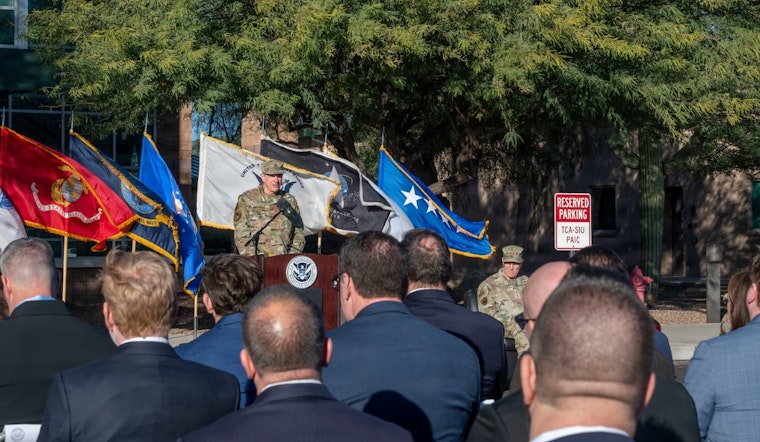
Wednesday at Fort Bliss, military leaders uncased new colors and retired an old name, formally pivoting a longtime Department of Defense unit to focus squarely on transnational drug cartels. Joint Task Force North has been rebranded as U.S. Northern Command's Joint Interagency Task Force-Counter Cartel, complete with a fresh motto: "Identify, disrupt, dismantle." Officials say the change is about concentrating military intelligence and other unique DoD capabilities into coordinated work with civilian law enforcement, targeting the networks that move fentanyl, methamphetamine, and other illegal drugs into U.S. communities.
New name, new mission
The ceremony at Fort Bliss follows a Pentagon push to bring counter-cartel work under a single interagency headquarters that U.S. Northern Command stood up in January, according to U.S. Northern Command. As reported by the El Paso Times, Maj. Gen. Henry Dixon presided over the event and cast the redesign as a nod to more than three decades of service by the task force, now given a sharper label to match the work it has already been doing.
Numbers that matter
The unit's own materials say Joint Task Force North has carried out more than 6,400 missions and helped law enforcement seize over $15.2 billion in illegal drugs, figures it highlights to underscore operational impact, according to Joint Task Force North. Maj. Gen. Dixon told attendees the reconstituted task force will "bring several agencies together for a unified strategy" so they can pursue multiple cartels at the same time, the El Paso Times reports. Leaders framed the rebrand as less of a radical reset and more of a doctrinal tune-up for an organization that has long operated in an interagency environment.
How this fits into a broader strategy
Defense reporting indicates the new Joint Interagency Task Force-Counter Cartel is already being used to fuse intelligence and back cross-border operations. Reuters reported that the task force provided information that was linked to a February operation targeting a top cartel leader. U.S. Northern Command has said the office was created to synchronize the work of the Department of Defense, Department of Homeland Security, Justice Department, and the intelligence community so that support to partner law enforcement agencies is more tightly coordinated and, at least in theory, more effective.
What it means for El Paso
Fort Bliss will remain the administrative hub for the revamped task force, hosting planners along with rotating units that bring specific DoD capabilities to bear in response to law enforcement requests, according to Joint Task Force North. The unit's materials stress interagency synchronization, cooperative defense, and regional partnerships, emphasizing that most operations still depend on civilian agencies and international partners to turn intelligence into actual arrests or prosecutions.
Officials also stress that the rebrand does not change legal limits on how the military can support civilian law enforcement. Instead, they say it is meant to sharpen planning, intelligence sharing, and interagency execution. Whether this new badge and structure translate into more arrests, more extraditions, or fewer drugs on the street will hinge on partner cooperation, legal constraints, and congressional oversight.


