

























































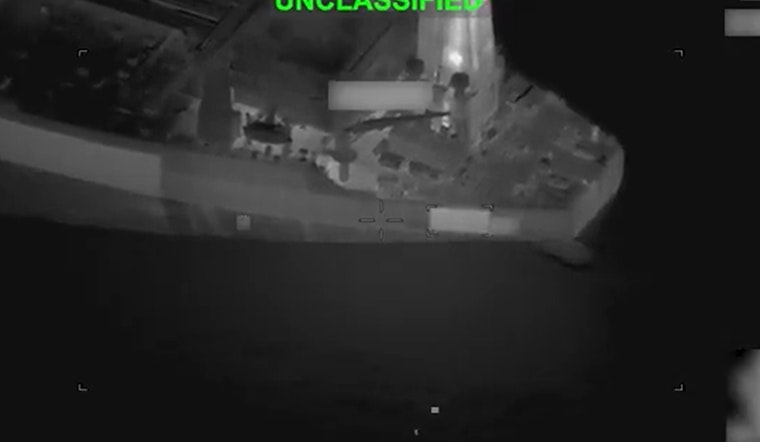
A U.S. military aircraft fired a Hellfire missile into the engine room of a Botswana-flagged tanker, disabling the ship as it moved toward Kharg Island in the northern Persian Gulf, U.S. military officials said. The vessel, identified by officials as the M/T Lexie, reportedly ignored repeated warnings over roughly 24 hours and did not comply with directions to alter course. The strike is one more episode in a U.S.-enforced maritime blockade of Iranian ports that was announced in mid-April.
What U.S. officials say
In a public post, U.S. Central Command said the Botswana-flagged M/T Lexie transited international waters toward Kharg Island and ignored repeated warnings and directions from U.S. forces. According to CENTCOM, a U.S. aircraft "ultimately disabled the vessel by firing a Hellfire missile into the ship’s engine room, preventing the tanker from reaching Iran." Local reporting by WOAI echoed the CENTCOM account and noted the ship was unladen at the time.
Blockade timeline and scope
The blockade was announced in April and, CENTCOM says, took effect on April 13 under a presidential proclamation. In a press statement describing the operation, U.S. forces said they have been redirecting commercial traffic and enforcing restrictions on vessels bound for or leaving Iranian ports, framing the measures as an effort to stop trade that would sustain Tehran’s war effort. The Lexie strike is the latest in a series of interdictions that U.S. officials have publicly described as part of that enforcement push.
Previous interdictions
U.S. forces have used a mix of tactics in recent weeks to stop ships they say were violating the restrictions, including disabling engine rooms with deck-gun fire and carrying out precision missile strikes. News outlets reported that earlier interdictions included U.S. strikes that disabled other vessels attempting to reach Iranian ports, and independent coverage of a May 29 incident says a Hellfire missile was used to halt the Gambia-flagged M/V Lian Star after the crew failed to answer repeated warnings. Reuters and the Associated Press have tracked those enforcement actions along with the broader pattern of redirected or stopped traffic in the Gulf.
Legal and diplomatic stakes
Legal experts say using force against commercial vessels in international waters raises complicated questions under the law of the sea and the law of naval warfare. Analysts at Just Security note that blockades and interdiction regimes must meet strict criteria to be lawful, and that enforcement beyond clearly defined geographic limits can be legally fraught. The United Nations Convention on the Law of the Sea also limits when warships may board or seize foreign merchant ships on the high seas (see Article 110), which shapes much of the debate over enforcement tactics.
Diplomacy and next steps
The strike landed amid ongoing and fragile talks aimed at a longer-term settlement between Washington and Tehran. President Trump said on social media that communications with Iran were continuing, according to WOAI. For now, U.S. officials present the blockade and these targeted strikes as calibrated pressure intended to keep Iran’s ports closed to normal trade while diplomats pursue a deal, even as legal scholars and some foreign governments warn that the tactics could complicate negotiations and raise broader maritime-law challenges.





