

























































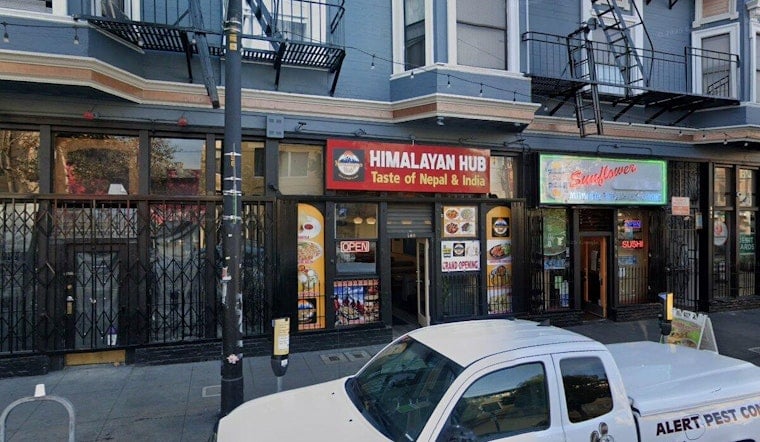
Himalayan Hub, the Nepali and Indian restaurant that took over a Valencia Street storefront roughly two years ago, is currently shuttered after a San Francisco Department of Public Health inspector found what the report describes as a "severe cockroach infestation" during a routine visit on Monday, June 22, 2026. The closure placard went up the same afternoon, and the eatery at 508 Valencia Street must remain dark until all conditions are corrected and a department inspector signs off on a reinspection — which is scheduled for no earlier than June 29.
What Inspectors Found
The four-page inspection report, available via the SF health department's inspection portal, paints a grim kitchen picture. Inspector Carlos Barragan documented live cockroaches crawling on dry food packaging in the storage area, cockroach feces on shelving in the food prep area and in overhead conduits, and a dead cockroach lodged inside a small appliance motor. The report calls for a professional pest "clean out" service, deep cleaning of all affected surfaces, and a pest control service report to be provided before any reinspection can happen.
Beyond the roach situation — which alone triggered the immediate permit suspension and closure — inspectors flagged six additional violations. An employee was observed touching their face and then continuing food prep without washing their hands. Hand-washing stations in the kitchen lacked paper towels and functioning soap dispensers. Sanitizer containers in the food prep area showed no measurable sanitizing solution. A large container of cooked onions was found thawing at room temperature. Cooking equipment had a heavy accumulation of grease and debris. And ice and rice scoops were stored with their handles making direct contact with the food — a cross-contamination risk. Several of those violations were corrected on the spot during the inspection.
The person in charge, identified in the report as Dilip, declined to sign the inspection acknowledgment. Certified Food Manager Ram Shrestha is listed as the permit holder for Himalayan Hub Inc., whose business license actually expired on March 31, 2026 — roughly three months before this inspection took place.
What It Takes to Reopen
Under Justia, California Health & Safety Code Sections 114405 and 114409 authorize local enforcement officers to immediately suspend a food facility's operating permit when an imminent public health hazard is present. The facility must cease all food handling and stay closed until every cited condition is resolved and the permit is formally reinstated by a department representative. Himalayan Hub has 15 calendar days from receiving the closure notice to request a hearing challenging the suspension — failing to do so is legally treated as a waiver of that right. Notably, an owner, manager, or operator who ignores the closure notice and keeps operating anyway can be found guilty of a misdemeanor, facing a fine of up to $1,000 and/or up to six months in jail per offense.
A Troubling Pattern for SF's Nepali Restaurant Scene
Himalayan Hub is not the first Nepali spot in San Francisco to run afoul of health inspectors over pest issues, and it's not even the first on or near Valencia Street. According to WhatNow, Dancing Yak — a popular Nepali restaurant at 280 Valencia, just a few blocks up the street — had its health permit suspended in August 2025 after inspectors found evidence of both rodent and cockroach infestations during a routine inspection. The restaurant was ordered closed pending correction of the violations.
Earlier in 2025, Base Camp, the well-regarded Nepali restaurant at 2400 Folsom Street in the Mission, also faced a health-related forced closure. As reported by WhatNow, inspectors found live cockroaches inside kitchen equipment, rat droppings, and dead flies contaminating food storage areas — as well as a missing handwashing station near the cook line. The pattern of pest-related closures among San Francisco's small, independently operated Nepali restaurants is hard to ignore, and suggests that the tight, often shared-building conditions that characterize the Mission's older commercial real estate stock may be presenting recurring pest control challenges that individual operators are struggling to get ahead of.
Cockroach closures are far from unique to Nepali establishments, of course. The SF health department has shuttered restaurants across every cuisine category for similar reasons in the past year, including a Korean restaurant in the summer of 2025, a Thai spot in March 2026, and a Vietnamese restaurant in November 2025, among others — all documented by WhatNow. But the concentration of closures among a small cluster of Mission-area Himalayan restaurants over a relatively short period is striking.
The Restaurant
Himalayan Hub opened at 508 Valencia in 2024, taking over the space formerly occupied by Indochine Vegan, as noted by WhatNow when the opening was first announced. The restaurant has attracted reasonably favorable early reviews, with diners on Yelp and food sites praising the momos, thali plates, and budget-friendly price point. The Infatuation noted the menu spans momos, chicken choila, curries, and fusion dishes like tikka masala wings. It's a casual, accessible spot that serves the kind of affordable, hearty Nepali-Indian comfort food that can be hard to find on a block that trends increasingly expensive.
The closure will sting, especially for a relatively young restaurant still trying to establish itself on a competitive strip. Valencia Street has seen plenty of restaurant turnover, and health-related closures — even temporary ones — can chip away at the goodwill that new spots work hard to build. Whether Himalayan Hub comes back quickly and cleanly will depend on how thoroughly ownership addresses the pest issue before requesting that reinspection.
What Happens Next
The clock is ticking. Before inspectors will consider a reinspection, Himalayan Hub must eliminate all cockroach activity using approved methods, provide a pest control service report from a licensed operator, remove all dead cockroaches and feces from food storage areas, and deep clean and degrease the cooking equipment. Sealed hard-surface food containers must be sanitized; all open containers and others that can't be effectively cleaned must be discarded.
If the restaurant clears those bars, an inspector can issue a new placard and reinstate the permit — and the momos can flow again. If they don't, or if they attempt to operate while the closure order is in place, things could get significantly worse for the ownership. Anyone with information about the restaurant's current status can contact the SF Department of Public Health's Environmental Health Branch at (415) 252-3800.



