

























































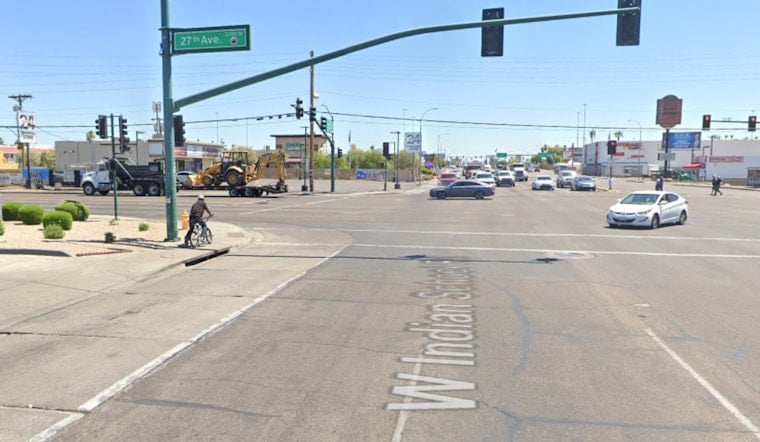
On Indian School Road in west Phoenix, walking across the street has quietly turned into one of the riskiest things a person can do in Arizona. The wide east-west arterial that cuts through the Maryvale and Alhambra neighborhoods has become the deadliest corridor for people on foot anywhere in the state, with parts of the roadway responsible for far more pedestrian deaths than almost any other surface street.
Decades of crash records tell the story. An investigation that compiled 25 years of federal and state data, summarized by the Phoenix New Times, found that 118 pedestrians were killed on portions of Indian School Road between 2000 and 2024. That total is higher than any other continuous stretch in Arizona, and five of the state's 12 deadliest half-kilometer segments are packed into roughly one square mile along this corridor.
City Documents Already Flagged The Danger
The city of Phoenix has known this road is a problem. Its own Road Safety Action Plan ranks several intersections on Indian School Road among the highest crash-risk locations in the city. Phoenix successfully landed a roughly $24.96 million U.S. Department of Transportation Safe Streets and Roads for All (SS4A) grant to overhaul the 91st-to-39th Avenue stretch.
AZ Law Now reported that from 2017 through 2021, the city counted 39 fatal crashes and 85 serious-injury crashes on that same segment. Even with those numbers on the books, construction on the SS4A-funded ReVISIONing project is not expected to begin until 2028.
Statewide Numbers Show A Worsening Trend
The danger on Indian School Road is playing out against a statewide backdrop of rising pedestrian deaths. The 2024 Crash Facts from the Arizona Department of Transportation note a peak of 297 pedestrian fatalities in 2022, the most in recent years.
National tallies from the Governors Highway Safety Association show Arizona among the states with the highest per-capita pedestrian fatality rates, and they echo a familiar pattern: most pedestrians are killed midblock and at night.
Deadly June Pileup Added Urgency
The abstract numbers became painfully real again on June 9 at 27th Avenue and Indian School Road, just east of the corridor targeted for redesign. Prosecutors say a driver ran a red light at about 96 mph, touching off a seven-vehicle pileup that killed one driver and injured others, including a pedestrian. The suspected driver was charged with second-degree murder, and prosecutors sought a $1 million cash bond, according to Arizona's Family.
Planned Engineering Fixes, But Years Away
The city is not short on ideas for how to fix Indian School Road. In its SS4A grant application and related materials, Phoenix lays out a familiar toolbox of safety treatments for the 91st-to-39th Avenue segment: brighter lighting, raised medians, more pedestrian crossing signals, modernized traffic signals and sidewalks that are better separated from fast-moving traffic.
City of Phoenix project documents show the ReVISIONing Indian School Road plan is in design, with construction not scheduled to begin until 2028. Advocates argue that leaves years of exposure for people walking, biking and driving on what is already a proven high-injury arterial.
Traffic-safety experts and local advocates say Phoenix could act sooner with interim steps while the long-term rebuild inches through the design pipeline. Their wish list is simple and not especially exotic: temporary medians, lower posted speeds, targeted enforcement and faster signal timing changes to help people cross.
National safety groups push a Safe System approach that combines slower speeds, safer road design and stronger post-crash response. That recipe matches much of what Phoenix has on paper for ReVISIONing Indian School Road, but not the timetable critics say the corridor demands. Guidance from the Governors Highway Safety Association stresses that engineering changes combined with speed management are the quickest way to cut deaths on high-injury roads like this one.





