

























































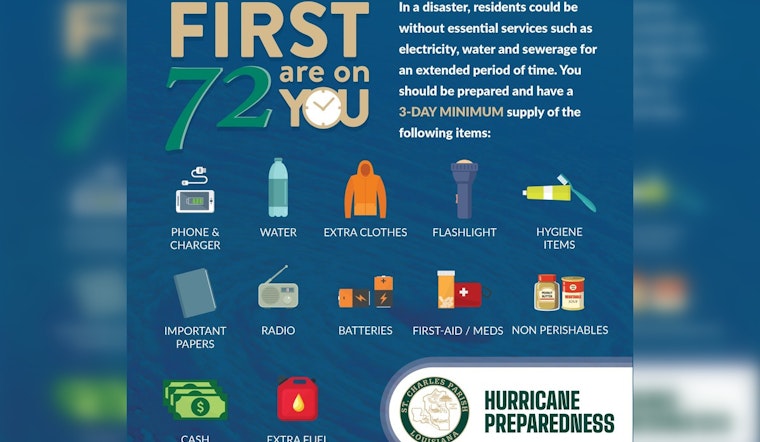
Hurricane season officially began on June 1, 2026, and St. Charles Parish officials are wasting no time telling residents on both sides of the Mississippi River to get their plans and supplies in order now. The parish is warning that some homes could lose electricity, water and sewer service for an extended period after a storm, so waiting until the first cone of uncertainty shows up on TV is not a smart strategy. Local emergency coordinators note that even a quieter forecast can still mean serious flooding and long outages.
In a June 1 Facebook post, St. Charles Parish urged residents to revisit family emergency plans and to have at least 72 hours of supplies on hand. The post points residents to St. Charles Parish for the official hurricane guide and to SCP Alerts, and notes that people can text SCPAlerts to 888-777 to receive local emergency messages.
What to pack for the first 72 hours
Federal guidance calls for a basic emergency kit that can carry you through at least three days on your own. That means water, at one gallon per person per day, nonperishable food, prescription medications, a battery powered or hand crank radio, flashlights and extra batteries. According to Ready.gov, households should plan to be self sufficient for at least 72 hours and adjust their kits to cover pet needs and medical requirements.
Why preparation still matters
The National Oceanic and Atmospheric Administration reminds residents that the Atlantic hurricane season runs from June 1 through November 30, and forecasters have projected a below normal 2026 season. That does not mean residents are in the clear. Even a single storm can bring life threatening storm surge and inland flooding. According to NOAA's Climate Prediction Center, category ratings do not capture inland flood or surge risk, so planning ahead remains essential.
Evacuation basics and local alerts
According to St. Charles Parish, the parish hurricane guide explains evacuation routes, sheltering tips and assisted evacuation procedures, and notes that evacuations typically begin roughly 40 hours before tropical storm force winds arrive. The guide also lists the parish Emergency Operations Center phone number and other key contacts to use during a storm, and it urges residents to secure important documents and fuel vehicles before any evacuation order is issued.
Emergency planners suggest starting with one grab and go bag per person and making sure fuel tanks, prescription refills and phone chargers are topped off. If your kit has not had a spring checkup, this is the time to pull it out, restock the basics and avoid scrambling when the first warning shows up.





