

























































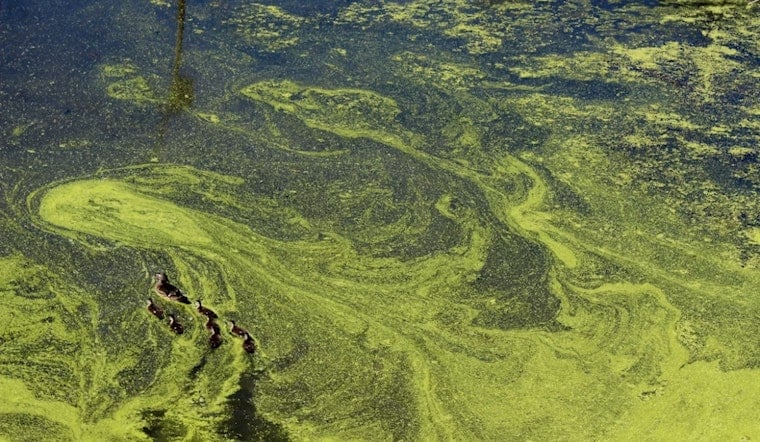
McLeod Lake, the downtown Stockton basin that turns a startling shade of blue-green every summer, is about to get a serious cleanout. City port officials and state water scientists are moving ahead with a targeted dredging project designed to knock back the toxic algal blooms that keep returning year after year. The focus is on scooping out the muddy lakebed where cyanobacteria hunker down through the winter, though officials say they are still dialing in total costs and the exact footprint of the work.
What officials plan to do
Port of Stockton documents filed with CEQAnet describe a maintenance dredge across about 11.2 acres of McLeod Lake, down to a maximum depth of 3 feet. Roughly 54,900 cubic yards of sediment would be removed and hauled to Roberts Island. The idea, according to the filings, is to physically strip out the benthic cyanobacteria "seed stock" in the muck before it can float up and fuel the dense surface blooms that follow. Project paperwork lists Jason Cashman as the Port of Stockton point person.
Who is funding the effort and why
The California Department of Water Resources (DWR) has been sampling algae throughout the Delta for years. As CBS Sacramento reported, DWR received a grant that is fully funded by the U.S. Army Corps of Engineers to back the McLeod Lake work.
DWR environmental manager Ellen Preece told the outlet that hot temperatures, paired with sluggish water movement, create ideal conditions for cyanobacterial blooms to take off. Port deputy director Jeff Wingfield put it more bluntly, describing the downtown water as so blue and green from the algae. Officials say they will compare water and sediment samples taken before and after dredging to see whether overwintering seed stocks drop and summer blooms become less intense.
What dredging hopes to change
Supporters of the plan say this is a different playbook than simply skimming off the surface scum once it appears. By targeting the benthic seed bank, they argue, dredging goes after the source of recurring blooms instead of just the visible mess.
The Central Valley Regional Water Quality Control Board has already logged multiple monitoring and pilot projects across the Delta to track cyanobacterial harmful algal blooms, along with their impacts on oxygen levels and aquatic life, according to the Central Valley Water Board. Researchers say the McLeod Lake dredge will function as a field experiment, with sediment and toxin testing built in to gauge how well this kind of cleanup works.
Permits and the review process
The Port of Stockton filed a Notice of Exemption for the McLeod Lake dredge on April 21, 2026, and the California Department of Fish and Wildlife has signed off with a Lake Alteration Agreement for the project, according to CEQAnet. Those state documents classify the work as a categorical exemption under the California Environmental Quality Act and state that dredged material will be sent to an existing Port disposal site.
Regional water quality requirements and conditions from other agencies will still apply before any in-water construction can actually start.
Local risks for people and pets
Health officials warn that cyanobacterial blooms can generate toxins that damage the liver and make both animals and people sick if they swallow contaminated water or come into contact with scum. The standing advice is simple but strict: stay out of affected water and away from visible scums, and do not let pets wade in or drink from those areas.
The State Water Resources Control Board has urged the public and pet owners to pay attention to posted harmful algal bloom advisories and shoreline signs, especially during hot stretches when water is stagnant. Officials say the McLeod Lake dredge plan includes toxin testing and public health monitoring to see whether risks decline once the work is done. Anglers are also reminded to check local advisories, since some Delta waterways already carry fish consumption warnings.
What comes next
Port and state partners say they expect to refine cost estimates and the final work area by September and are aiming to start the pilot dredge in November, according to CBS Sacramento. If the pilot shows a clear drop in overwintering seed stocks and produces smaller, less toxic blooms, officials say the U.S. Army Corps of Engineers may look at adapting the strategy for other waterways around the country.



