

























































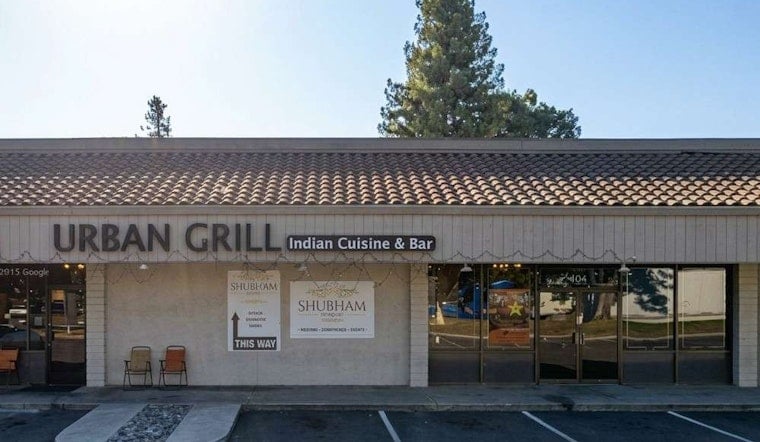
Urban Grill Indian Cuisine, the well-reviewed North Indian buffet spot tucked into a Sunnyvale office park at 1214 Apollo Way, has been shut down a second time in three months — this time for a live mouse spotted in a bar area bait station, widespread rodent droppings throughout the restaurant, dangerously unsafe food temperatures, and a sewage pipe actively leaking wastewater onto the kitchen floor. Santa Clara County Department of Environmental Health inspector Kathy Vo closed the facility on June 23, 2026, assigning a score of 43 out of 100 — a number that should make even the most devoted regulars wince. The follow-up inspection is scheduled no earlier than June 30.
What the Inspector Found
The five-page inspection report, available via Santa Clara County's SCCDineOut portal, documents a facility in pronounced distress. Inspectors observed a live mouse inside a bait station on the bar counter and numerous rodent droppings on shelving throughout the bar area and inside planter boxes in the front service area. The county's California Health & Safety Code is unambiguous on this point: a facility cannot operate when a vermin infestation risks contaminating food contact surfaces, packaging, utensils, or equipment.
The sewage situation was arguably just as serious. The three-compartment sink and its drainpipe were found to be actively leaking during use, with wastewater overflowing directly onto the floor beneath the sink. State code prohibits any food facility from operating when liquid waste or sewage is overflowing — so between the mouse and the sewage, the inspector had two independently sufficient grounds for immediate closure, and acted on both.
Then there was the food temperature picture, flagged as a repeat violation. Multiple items in the two-door preparation unit and a countertop cooler measured between 58–60°F, well above the required 41°F ceiling — and per staff, the food had been sitting there for more than four hours. On the prep counter, fried chicken came in at 98°F and paneer at 88°F. At the self-service buffet, yogurt sauce clocked in at 62°F. Potentially hazardous foods must be held at 41°F or below, or 135°F or above — everything in between is the danger zone. The facility was ordered closed during the inspection and all food was to be discarded.
The restaurant was also cited for failing to time-mark biryani rice as required under its own documented time-as-a-public-health-control procedures, a broken dishwasher sanitizer dispenser delivering just 25 ppm chlorine against a required 50 ppm, unapproved buffet holding units of unknown origin with labels written in Chinese, an open back door propped wide (a direct invitation to pests), improperly stored bulk rice and spice bags, food stored on the floor, grease-caked ventilation hoods and cook line equipment, and bowls without handles used as scoops inside biryani and bulk ingredient bins. The facility lacked a valid food safety manager certification — also a repeat violation — and no food handler cards were available for review. Chef AJ Ravi signed the closure notice.
This Is the Third Strike in Less Than a Year
What makes this closure particularly difficult for Urban Grill ownership to explain away is that it is not a first offense, or even a second. According to inspection records on SCCDineOut, the restaurant received a Conditional Pass with a score of 67 during a routine inspection on July 31, 2025. Then on March 19, 2026 — just three months ago — a limited inspection triggered another immediate closure, also for vermin. That time, inspectors documented rodent droppings throughout the cook line, warewashing area, side storage, and on top of the mechanical dishwasher and shelving holding onions and clean dishes. Two dead cockroaches were found near the electrical panel. A hole in the wall near a disconnected plumbing fixture and gaps in the electrical panel were cited as likely entry points. The restaurant received a follow-up pass on March 20, 2026 and was allowed to reopen — only to land back in closure three months later with a score nearly 25 points lower.
Critically, the March report noted that the facility's pest control provider at the time, Banner, had stated in its own service report from March 2, 2026 that "facility sanitation needs to be improved." This time around, the June 23 report noted that the restaurant had switched to a biweekly service through 360 Pest Management — but that provider's report from June 19, just four days before the closure inspection, itself documented "entry points and mice activity in the facility." Management knew mice were present four days before the health inspector walked in. That's a hard detail to move past.
Context: Rodents Are a Documented Problem Across Santa Clara County
Urban Grill's troubles sit inside a larger and well-documented pattern. As reported by NBC Bay Area last year, over 120 food establishments across Santa Clara County had closed through mid-2025, with roughly two-thirds of those closures driven by vermin issues. That investigation highlighted the extended closure of the Cupertino Whole Foods and multiple Walgreens food departments over rat infestations. Dr. Marilyn Underwood, Director of Environmental Health for Santa Clara County, noted that most violations are cleared within days — but "in severe cases," cleanup and structural repairs can drag on considerably longer. Repeated closures, like what Urban Grill has now experienced, suggest a structural pest problem rather than a one-time lapse.
California has also tightened the rules around rodent control in ways that complicate remediation. As noted by Attic Repair Guys, the state's Poison-Free Wildlife Act (AB 2552), which took effect January 1, 2025, expanded an existing ban on second-generation anticoagulant rodenticides to cover virtually all anticoagulant rat poisons. Restaurants can no longer rely on the strongest commercially available rodent baits — which means pest proofing through exclusion (sealing entry points, fixing plumbing gaps, closing back doors) becomes even more critical. Urban Grill's inspection reports across multiple visits consistently flagged open doors and structural gaps as ongoing, unresolved problems.
The Restaurant
Urban Grill is part of Urban Indian Flavors, a multi-brand Indian dining enterprise, according to the company's website. The Sunnyvale location at 1214 Apollo Way has cultivated a devoted local following — boasting a 4.6/5 on Google and 4.5/5 on Yelp, with fans particularly praising the daily lunch buffet and weekend dinner buffet. The restaurant serves an ambitious North Indian menu including tandoori specialties, biryanis, curries, and the kind of shareable spread that makes it a go-to for the tech-worker lunch crowd in the surrounding office park. Owner Sriniva Vejalla is named on the inspection report.
Given the repeat violations and the relatively low score of 43, the path back to full operation will require more than a quick pest control visit and a signature on a checklist. Management will need to demonstrate to the county's district specialist that rodent activity has been genuinely eliminated — not just treated — before a follow-up inspection will be scheduled. Any subsequent reinspections after the first will be billed at $282 per hour during business hours, and $645 for a minimum of two hours outside normal hours. The costs of repeated non-compliance add up fast.
What It Needs to Do to Reopen
Before Urban Grill can request a reinspection, the county requires it to complete and sign a provided reopening checklist, obtain a pest control report from a licensed provider, and submit both to district specialist Kathy Vo or the DEH main line. A minimum of 24 hours must pass after the inspection before the restaurant can even request the follow-up — pest treatments need time to work. Under California Health & Safety Code Section 114409, as cited in the closure notice, operating while the permit is suspended risks a penalty of three times the operating permit fee, plus reinspection fees, all of which must be paid before a new permit can be issued. For a restaurant that has now closed twice in three months and whose own pest contractor flagged active mouse activity days before the latest closure, the road back is going to take more than a mop and some bait traps. Anyone with questions can reach the Santa Clara County Department of Environmental Health at (408) 918-3400.



