

























































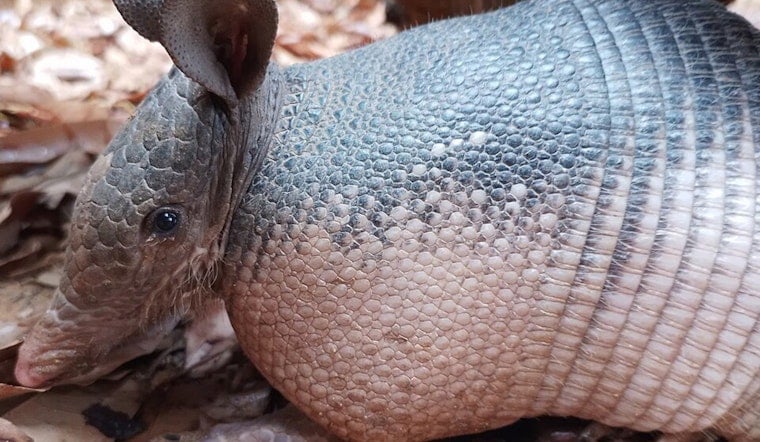
Those little armored tanks that used to be a strictly Southern roadside oddity are now turning up in central Indiana like they own the place. Armadillos are moving from rare curiosities to established breeding populations around the Indianapolis area, and Hoosiers are starting to see the evidence. Instead of just the occasional flattened surprise on the highway, residents are finding crescent-shaped holes in their lawns where the animals root around for insects. For some neighborhoods, the armadillo is officially part of the local wildlife lineup.
A peer-reviewed study in the journal Diversity reports that occurrence records and species-distribution models now show the nine-banded armadillo’s range pushing north and west into Indiana. In a companion dataset, the USGS pulled together camera studies, wildlife databases and citizen reports to map where the animals are already on the ground and where they are likely to stick around as viable breeding populations.
Where They Are Showing Up
The Indiana Department of Natural Resources has tallied roughly 230 confirmed armadillo observations since the early 2000s, with reports reaching as far north as Porter County. Nearly 90 percent of those sightings have come in since 2017, which strongly suggests this is no longer just a once-in-a-while visitor to Indiana but a regular presence in the state.
How You Might Notice Them Around Indianapolis
Local reporting points to Marion County and much of southeast Indiana as places where armadillos are no longer just passing through. The The Cool Down notes that the Wabash and White rivers may be acting as natural corridors, helping the animals quietly work their way north and west. USGS mapping work lines up with that picture, indicating that areas around Indianapolis are now suitable for armadillos to dig in as breeding populations.
What does that look like on the ground? Marion County residents may notice more small, crescent-shaped holes in lawns, gardens or along roadsides where armadillos have been feeding on insects. The animals usually steer clear of people and do most of their wandering at night, so seeing one out and about during the day is still relatively rare, even if they are your new neighbors.
Why They Are Moving
Scientists point to a familiar trio of forces behind the armadillo’s northward march: milder winters, changing habitats and human-built infrastructure. An analysis from the USGS that combined occurrence data with environmental predictors found that when cold snaps lose some of their bite and river corridors line up with roads, development and other disturbed areas, armadillos can expand beyond their historical, warmer range.
That mix of climate and habitat is now showing up in southern Indiana and in pockets around Indianapolis, which helps explain why the species is no longer just brushing the state’s southern border but establishing a foothold farther north.
What To Do If You See One
The DNR’s advice is simple: look, do not touch. The agency asks residents to avoid approaching or handling armadillos and instead to send in sightings, ideally with photos, through its online “Report A Mammal” form. According to the Indiana Department of Natural Resources, armadillos are protected under state rules and should not be trapped or killed unless they are causing substantial property damage.
If a particular armadillo is turning your yard into a personal excavation site and the problem is ongoing, homeowners can contact a permitted wildlife control operator rather than trying to handle the animal themselves.
What Researchers Will Watch Next
Wildlife managers are leaning on species-distribution maps and occurrence records to decide where to focus monitoring, public outreach and any future nuisance control efforts. The Diversity study highlights both the importance of river corridors for armadillo expansion and the need for continued citizen reporting to refine the map of where the animals are breeding and where they might pop up next.
For now, experts expect most new reports to come from low-lying, wooded and riverine areas rather than the densest parts of the urban core. Still, if you start seeing unexplained little craters in your yard or along a nearby trail, it might be time to grab your camera, file a report and welcome one more Southern transplant to central Indiana.





