

























































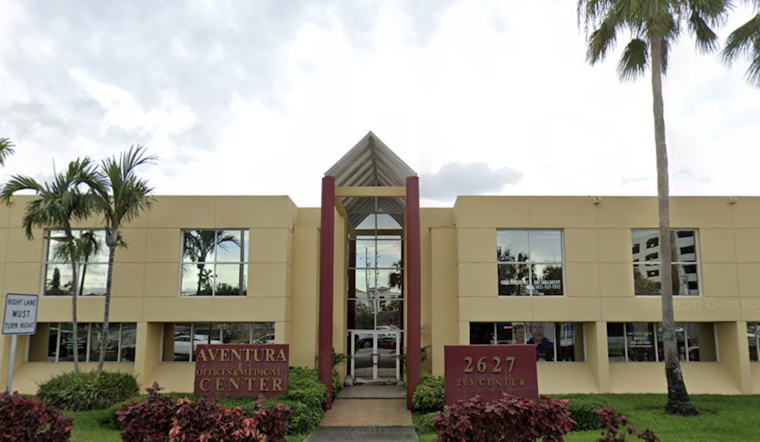
A two-story office and medical complex near Aventura could be traded in for a 14-story apartment tower, as an Aventura-based developer tests Florida’s Live Local Act on a roughly 1.8-acre site off Northeast 203rd Street.
The proposal, which arrives as a pre-application, would knock down the existing Aventura Offices and Medical Center and replace it with a 376-unit building. In return for extra height and density through the Live Local trade-off, about 40 percent of the apartments would be reserved as workforce rentals.
According to The Real Deal, the project is dubbed The Gateway 2 and is planned for 2627 and 2691 Northeast 203rd Street in unincorporated Miami-Dade County. Plans outline a 14-story structure with 376 units stacked over a parking podium, ground-floor co-working space and a pool deck perched on the 10th floor. The development would replace a roughly 37,000-square-foot office and medical center and fits into a broader regional push to transform aging suburban office properties into housing. The Real Deal also notes that state lawmakers this year expanded Live Local eligibility to land owned by school districts, counties and religious organizations, enlarging the universe of sites that can chase the statute’s perks.
The Faith Group lists its headquarters at 2627 Northeast 203rd Street, Suite 202 in Aventura and names Kevin and Victor Faith as co-founders on the company website. Public materials describe investments across office, retail and residential properties.
How the Live Local trade-off works
Florida’s Live Local Act is designed to sweeten the pot for multifamily builders that include workforce housing. Projects that qualify can secure by-right approvals for greater height, density and floor-area if at least 40 percent of the units are rented to households earning up to 120 percent of area median income for a set stretch of time. As outlined by Florida Housing, qualifying developments may also tap into property-tax exemptions and refunds of sales taxes on construction materials.
Miami-Dade County planning documents peg the county’s area median income at $89,800, a figure that serves as the baseline for Live Local rent limits in this market.
Office conversions are picking up across South Florida
Developers and investors across South Florida have been circling older office buildings, with Live Local and other incentives making residential conversions look more enticing on the spreadsheet. HawkinsCRE reported that Midtown Capital Partners paid about $44.5 million in January for a Pembroke Pines office complex with potential to be repositioned as rentals, and an Edgewater office buy by Valoro Capital in April came in at roughly $19 million and leaves room for redevelopment. Firms such as Related Group, BH Group and Pebb Enterprises have also been tied to large multifamily plays at former office campuses, signaling a larger shift in how these properties are viewed.
Neighbors and affordability
Supporters of Live Local argue that it speeds up delivery of workforce housing in markets where supply has lagged far behind demand. Critics counter that letting rents go up to 120 percent of area median income can still put these units out of reach for many local workers, especially in pricier neighborhoods.
Legal analyses note that the combination of zoning overrides and tax breaks can create powerful financial incentives for builders, even as residents and local officials wrestle with questions about traffic, infrastructure capacity and how these taller projects will fit into existing neighborhoods.
What’s next
The Gateway 2 is currently in the pre-application phase, which gives The Faith Group a chance to collect feedback from Miami-Dade County staff before filing formal plans. As reported by The Real Deal, the proposal will still have to clear administrative review and permitting before any construction can start. Future filings are expected to spell out the final unit mix, parking counts and whether the developer intends to pursue Live Local’s available tax benefits.



