

























































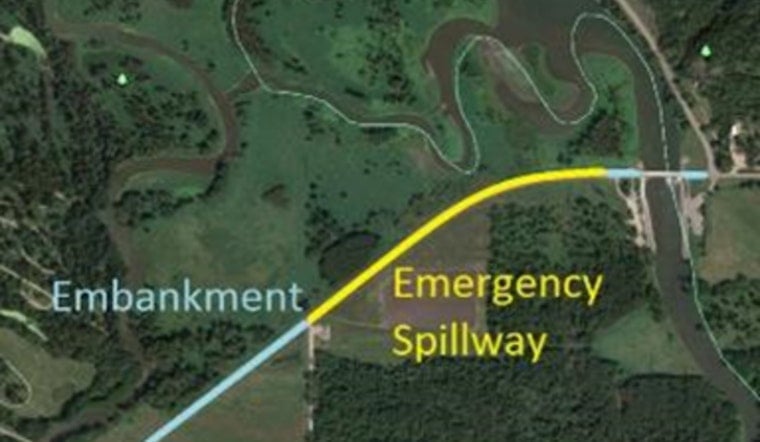
After a season that felt more like trench warfare than construction, the U.S. Army Corps of Engineers and its contractors have cleared a major hurdle at the Lac Qui Parle Dam emergency spillway near Watson. Crews have finished the first phase of repairs, reinforcing roughly half of the 2,500-foot spillway and restoring a critical relief valve for Lac Qui Parle Lake that helps shield downstream homes, roads and farmland from rapid failures.
Phase one wrapped up on Tuesday, July 14, according to the West Central Tribune. The U.S. Army Corps of Engineers reports that wet conditions and floodwaters in 2025 repeatedly stalled progress and forced contractors to install temporary flood protections before they could safely get back to work.
What crews rebuilt
Phase one work focused on the first 1,300 linear feet of the emergency spillway. The contractor installed sheet piling, constructed new concrete slope protection and placed fresh riprap along the ditch bottom, reinforcing the structure that channels overflow away from the dam when lake levels surge. Duininck notes that the contract began in May 2025, with crews forced into a roughly 90-day pause because of high water.
The Corps' project background explains that the emergency spillway is an earthen embankment with an embedded concrete I-wall. According to the U.S. Army Corps of Engineers, the work was split into two phases to juggle both flood risk and funding, so that the structure would not be left vulnerable while repairs were underway.
Seepage and flood challenges
Workers were not just battling surface water. Engineers also had to contend with persistent seepage inside the embankment itself. An underground sand vein was reportedly pushing out about 300 gallons per minute, and crews used as many as five pumps to keep the work area dewatered, according to the West Central Tribune.
Corps staff have warned that frequent, smaller failures in the spillway can quickly snowball into much larger problems, which is why they leaned on staged repairs and temporary protections throughout the season. The idea is to keep the structure functioning even while it is being rebuilt.
Funding and what’s next
The Corps lists about $1.3 million in engineering and supervision funds, phase one construction at roughly $6 million and phase two at about $8.16 million, and reports that funding is in place to carry the project through completion. The U.S. Army Corps of Engineers, St. Paul District says phase two is scheduled to begin in August, with the majority of the remaining repairs expected to be finished by the end of 2027.
Local and county officials have welcomed the milestone, saying the reinforced spillway significantly lowers the risk to downstream property and life. Residents can still expect to see heavy equipment and construction crews on-site next season, but engineers say the rebuilt sections should make overtopping events far less likely to trigger rapid, dangerous failures.





