

























































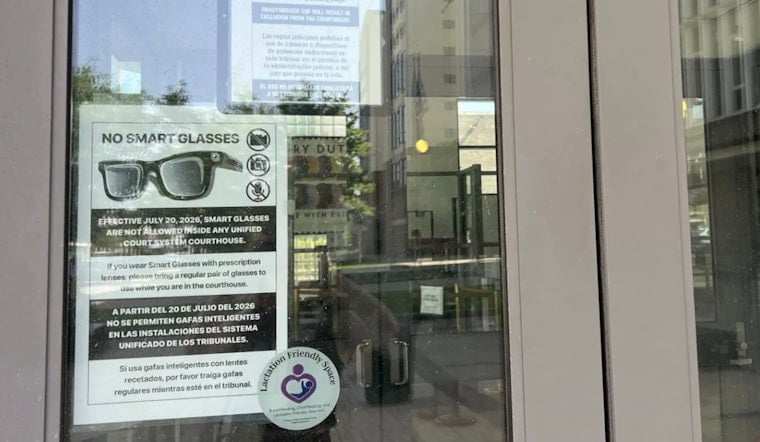
Starting July 20, anyone trying to walk into a New York courthouse with smart glasses is going to hit a hard stop at the front door. The state's Unified Court System is rolling out a new policy that bars smart glasses and any other recording-capable eyewear from courthouses statewide. Anyone who shows up with recording-ready frames or headwear will have to hand them over to uniformed court staff at the entrance, a change that will affect everyone from daily courthouse regulars to people appearing for a single hearing.
What the ban covers and who must comply
The internal memo says the ban covers any eyewear or headwear that has cameras, microphones, computers or other technology that can record audio or video. That includes prescription frames with built-in recording features, not just trendy smart shades.
The rule applies to everyone who walks into a court facility: court employees, attorneys, litigants, witnesses, family members and any other visitors. The scope of the policy and the July 20 start date were first detailed by GovTech.
How it will work at courthouse checkpoints
At security checkpoints, court officers will collect any recording-capable glasses or similar gear and keep them for safekeeping while the owner is inside the building. Some courthouses have already started posting signs to warn people the change is coming.
The memo presents the policy as a way to prevent unauthorized or secret recordings of court proceedings that could violate state law or court rules. Reporters who reviewed the internal guidance described how officers are expected to enforce the rule and noted details from a July 1 memo, as summarized by Gizmodo.
Legal backdrop
New York already puts tight limits on cameras and microphones in many courtrooms. Civil Rights Law §52 and the Unified Court System's own rules in 22 NYCRR Part 131 bar recording of party or witness testimony in most trial settings and spell out the narrow circumstances when coverage can be allowed.
The new memo leans on that statutory and regulatory framework as its legal foundation and signals that courts will use those existing rules to police any recording requests. The Unified Court System's rules outline the application process and the factors judges must weigh when deciding whether to allow audio visual coverage; see the New York State Unified Court System.
Accessibility and criticism
The policy puts tight controls on a technology that some users say can be a lifeline. This month, Meta announced a program to donate Ray-Ban Meta AI glasses to blind veterans, highlighting how the devices can read text aloud and describe surroundings for the wearer. Disability advocates point to those kinds of benefits, while privacy and civil liberties advocates stress that the same hardware can quietly record people without their knowledge.
The memo does not spell out any exemptions for prescribed or assistive eyewear, and advocates and legal observers are watching to see how courts will handle accommodations in practice, according to the Meta Newsroom.
How this compares elsewhere
Some local and state court systems around the country have already moved to clamp down on smart glasses in courtrooms, with reporting noting similar rules in states such as Pennsylvania and Wisconsin. What sets New York apart is that the memo imposes a single rule across the entire Unified Court System instead of leaving each courthouse to craft its own approach, according to GovTech.
What to expect
Court officers will begin enforcing the rule on July 20, and visitors can expect more signage and tweaked checkpoint procedures in the run-up to that date. Anyone who relies on wearable assistive technology should contact the relevant court ahead of time to ask how the new policy will apply and what accommodations, if any, are available.



