

























































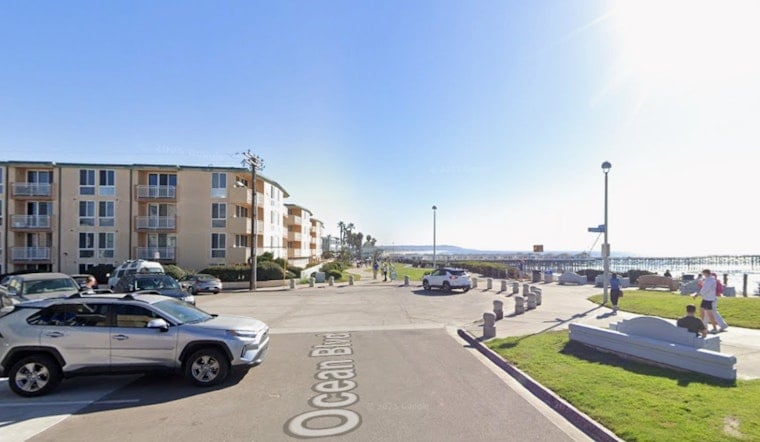
On packed sunny weekends, a one-block stretch of Ocean Boulevard in Pacific Beach already looks more like an overflow boardwalk than a street. Now a proposal to officially close that block to cars on weekends and holidays is stirring up a classic coastal fight over safety, parking and who really gets to claim the waterfront.
The idea would shut Ocean Boulevard to vehicles between Grand Avenue and Thomas Avenue on weekends and holidays, roughly from 10 AM to 10 PM under the draft plan. Supporters point to fresh sensor data suggesting the block is effectively a plaza already on busy days. Opponents counter that the closure would wipe out scarce beach parking and complicate emergency access. After presentations at neighborhood and planning meetings, the proposal is now cruising toward City Hall for deeper scrutiny.
What the data shows
A February report from community group beautifulPB, based on VivaCity sensors and prior summer counts, found that pedestrians and cyclists made up about 73.7% of roadway use on that block, while motorized vehicles accounted for roughly 26.3%. The report also highlights video-captured “near misses,” defined as a vehicle coming within about one meter of a pedestrian or cyclist, clustering on weekend afternoons and evenings when the adjacent boardwalk is jammed.
Using that evidence, beautifulPB recommends a weekends-and-holidays pilot that would reduce conflicts with temporary infrastructure and continuous monitoring, as outlined by beautifulPB.
Supporters say safety demands it
Robert "RJ" Kunysz, who walked neighborhood planners through the concept, joined other advocates in arguing that closing the block to cars during peak hours would remove vehicle-pedestrian conflicts and finally complete what they call a missing link in the oceanfront boardwalk.
They framed the pilot as data-driven and reversible, pointing to July Fourth surges and sensor readouts as evidence that the block already behaves like overflow pedestrian space when crowds spike, according to Streetsblog California. In their telling, the change is less a radical redesign and more an overdue match between how the street is used in real life and how it is regulated on paper.
Opponents flag parking and access trade-offs
Residents and several business owners see it differently. They warn the pilot would eliminate roughly 30 beach parking spaces, including three accessible stalls, in an area where finding a spot on a summer weekend is already a sport of its own.
Critics also worry that diverting westbound traffic into nearby alleyways could back things up around Fire Station No. 21, raising questions about response times. City staff have added their own cautions, noting that barricades would have to be deployed and removed on a tight schedule and that many operational details need to be ironed out before any closure could begin, as reported by The San Diego Union-Tribune.
How the pilot would work
The community proposal calls for using portable barriers to block regular traffic, adding temporary bike racks and keeping the VivaCity-style sensor monitoring in place. Emergency vehicles would still be able to get through, and a limited permit system would let essential deliveries cross the block even during closure hours.
The recommended schedule, roughly 10 AM to 10 PM on weekends and holidays, is meant to line up with the busiest crowd times while giving the city a controlled way to test the impacts before considering anything permanent. Advocates describe the approach as low-cost and reversible, saying the city already owns much of the gear needed to run the pilot, per beautifulPB.
Next steps and how to weigh in
Any formal recommendation from the planning group will head to city officials for review. Supporters and opponents alike have been encouraged to contact Council President Joe LaCava as the next step in the process. LaCava represents District 1 and oversees council business at City Hall, according to the District 1 office, City of San Diego, and any pilot would still need staff sign-off and potentially additional approvals.
City leaders are expected to schedule more public meetings and outreach as they vet the proposal and its logistics. Local feedback will likely shape whether the one-block experiment proceeds, how it is structured and how it is judged.
In the end, whether the pilot moves forward will come down to how officials weigh the sensor data and safety arguments against the loss of parking, business concerns and emergency access questions, and whether Pacific Beach residents decide they want a permanent redesign after a trial run on the sandfront street.





