

























































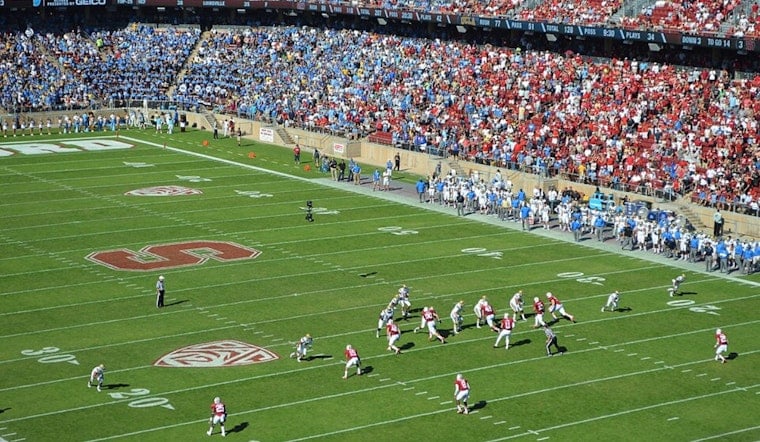
Stanford football players have quietly made a bit of college sports history. The Cardinal have launched the College Football Players Association’s first official team chapter, elected player representatives and signaled a long-game effort to organize at the conference level. Player leaders and CFBPA organizers are framing the move as a long-term, player-driven campaign to win bargaining rights and set standards on health, safety and compensation. For now, players describe the project as voluntary education and membership-building, not an immediate legal challenge.
According to The New York Times, Stanford became the first program to reach the membership threshold required to form a CFBPA chapter. After a late June informational meeting that drew more than 50 teammates, players elected linebacker Ernest Cooper and offensive lineman Fisher Anderson as their representatives. The Times also quoted defensive lineman Benedict Umeh, who said players had long wondered why college athletes did not have a players’ association similar to the NFLPA.
How the chapter formed
As reported by Front Office Sports, CFBPA founder Jason Stahl spent months talking with Stanford players on Zoom and in person before flying to Palo Alto to answer questions and make his case in the locker room. Players told Front Office Sports they vetted Stahl and the CFBPA for months before deciding to move ahead with the chapter. They said they see it as a first step toward conference-level organizing rather than an immediate petition to the National Labor Relations Board.
CFBPA’s goals and playbook
The CFBPA, which founder Jason Stahl says he launched in July 2021, treats team chapters as building blocks for conference-wide bargaining and a formal seat at the negotiating table for players, according to CFBPA. The group’s published "Platform Planks" spell out priorities that include health and safety standards, clearer rules and transparency around name-image-likeness deals, revenue sharing and tighter oversight of player agents, according to CFBPA.
Legal hurdles
The road to formal collective bargaining is anything but straightforward. In 2015, the National Labor Relations Board overturned a regional director’s ruling that had favored Northwestern football players and effectively stopped that union campaign, as reported by ESPN. More recently, Dartmouth’s men’s basketball team voted to unionize, but the petition was later withdrawn by the Service Employees International Union, a reminder of how fragile these efforts can be, according to AP News.
What this means for Stanford
Players say Stanford coaches and staff were briefed on the chapter and have mostly stayed neutral. Team leaders told Front Office Sports that members of the athletic department, including the team’s general manager and other staffers, were informed about the organizing effort. CFBPA officials describe the Stanford chapter as a proof-of-concept for future conference-level bargaining and say they will keep membership numbers under wraps while they build support. Organizers also acknowledge that many of the players driving the effort are redshirt seniors who may not see any concrete contract benefits for years, if at all.
For local fans and alumni, the new chapter is the clearest indication yet that at least some college players want a formal voice in the rules that shape their health, compensation and careers. Organizers emphasize this is a multi-year project. Whether it ever leads to enforceable collective bargaining agreements will depend on court decisions, NLRB leadership and how willing conferences are to voluntarily recognize a players’ bargaining unit.





