

























































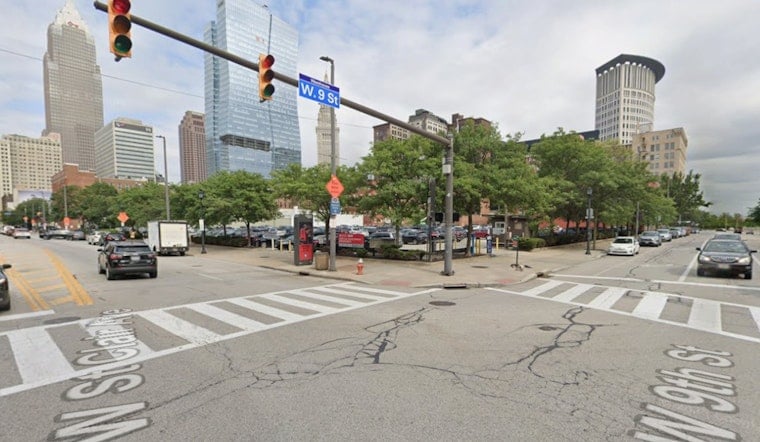
One of Downtown Cleveland’s last big blank spaces might not stay a surface lot for long. The State of Ohio is reportedly eyeing a roughly 2.3-acre parking field at West 9th Street and West St. Clair in the Warehouse District, a move that could erase one of the few contiguous blocks still open for vertical construction and reshape the next phase of the neighborhood’s skyline. Developers, brokers and nearby residents are watching closely to see whether the land winds up as a public asset or returns to private hands for housing or mixed-use development.
The state’s interest was first reported this week by Crain's Cleveland Business, which said officials had flagged the parcel as one to watch, while stopping short of describing a finalized purchase. The outlet’s story yesterday framed the site as one of the last large Downtown blocks that could still host meaningful vertical development.
Marketing materials from CRESCO | Cushman & Wakefield describe the West 9th and St. Clair block as roughly 2.27 acres with about 350 surface parking stalls and what the brokerage calls “outstanding vertical development potential.” The brochure, aimed at large commercial or mixed-use buyers, lays out parcel maps, zoning details and an underwriting summary. Those materials are hosted by CRESCO/Cushman & Wakefield.
Local project-watchers recently spotted crews on site pulling geotechnical cores, the kind of routine due diligence work that often precedes a closing. NEOtrans reported the soil sampling and noted indications that a buyer was actively pursuing the property, adding that the depth of the cores suggests spread-footer foundations more typical of low- to mid-rise construction than a heavyweight tower.
The lot is widely tagged as one of the last Downtown “parking craters” still available for redevelopment after a series of recent conversions, from the Sherwin-Williams headquarters site to other large lots that have shifted to corporate and mixed-use projects. That changing landscape has made the West 9th block unusually valuable to both private developers and, apparently, public buyers. Cleveland Real Estate Investors and other local observers have been tracking how those moves tighten the supply of big, buildable parcels.
Crain's Cleveland Business also reported that the state has not publicly said which agency is behind the inquiry and that no sale had been recorded as of its publication date. The paper noted that brokers and the listed owner did not confirm a sale when contacted.
What Zoning And Landmark Status Mean
The CRESCO marketing packet leans heavily on location and entitlements. The block sits inside the Victorian-era Historic Warehouse Landmark District, yet the materials point to zoning that could allow high-rise construction under certain conditions. A state acquisition could change the path a project would take through government, but any future design would still run into the same set of design-review expectations that come with landmark-district status. For investors and underwriters, the zoning language and landmark flag are central to any pitch involving housing, office or mixed uses, a point underscored in the parcel maps and zoning highlights included by CRESCO/Cushman & Wakefield.
Why Developers Are Watching
For investors, the appeal is simple: it is a rare, uninterrupted chunk of land in a Warehouse District that has been slowly rebuilding itself with new offices, apartments and hotel projects. The recent geotechnical work and reports of buyer interest suggest a decision point is approaching, and either outcome, a state purchase or a private deal, would likely ripple through nearby land values and the district’s broader redevelopment trajectory. NEOtrans and local brokers say the next real clues will show up in formal filings or a recorded sale.
Until then, Downtown watchers are left to speculate whether public ownership would steer the site toward civic uses or effectively put a pause on private development plans. Recorded deeds and county filings should make the direction clear once a buyer moves from quiet due diligence to a public transaction.





