

























































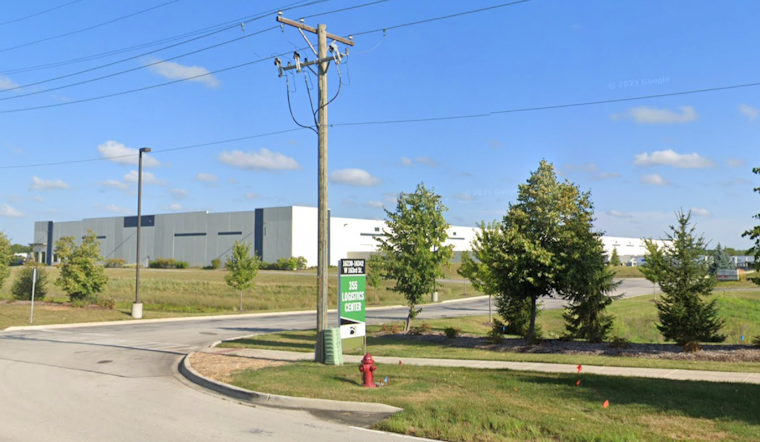
Tesla is keeping a sizable industrial foothold in Lockport, renewing its lease on nearly 309,000 square feet along the I-355 corridor. The low-profile warehouse deal gives the electric vehicle maker a continued Chicago-area base for the parts operation that keeps its service network supplied.
According to CoStar, Tesla renewed 308,988 square feet at the 355 Logistics Center, a facility owned by Ares Management. The Lockport building is used as a Tesla parts distribution center, extending the company’s commitment to one of the southwest suburbs’ most heavily trafficked logistics corridors.
Why The Lockport Warehouse Fits Tesla’s Network
The property was built for high-volume movement, not showroom theatrics. A Cushman & Wakefield listing describes a 308,988-square-foot Class A warehouse with about 302,850 square feet of industrial space, 6,138 square feet of office space, 41 dock doors and 32-foot clear heights.
Tesla’s own hiring page also recently listed a full-time process engineering technician position in Lockport under its service-distribution and supply-chain operations. That posting does not disclose the size of the local workforce, but it does offer a glimpse of the day-to-day operation behind the renewed lease.
A Big Lease In A Still-Busy Chicago Industrial Market
The renewal arrives as Chicago’s industrial market continues to absorb large blocks of warehouse space. JLL Research reported that Chicago industrial vacancy fell to 4.5% in the second quarter, while leasing activity reached 10.6 million square feet and year-to-date net absorption climbed above 12.8 million square feet.
The 355 Logistics Center has already had a notable turnaround. Its owner at the time, High Street Logistics Properties, said the two-building, 611,576-square-foot complex was just 17% occupied when acquired in 2019, before leasing one building to Tesla and expanding Berlin Packaging brought the assets to full occupancy, according to the company’s property case study.
For Lockport, Tesla’s renewal is another sign that the I-355 corridor remains valuable to companies that need fast access to customers, service centers and regional freight routes. For Tesla, it is a decidedly unglamorous but strategically important commitment: keeping the parts moving even when the warehouse itself stays out of the spotlight.





