

























































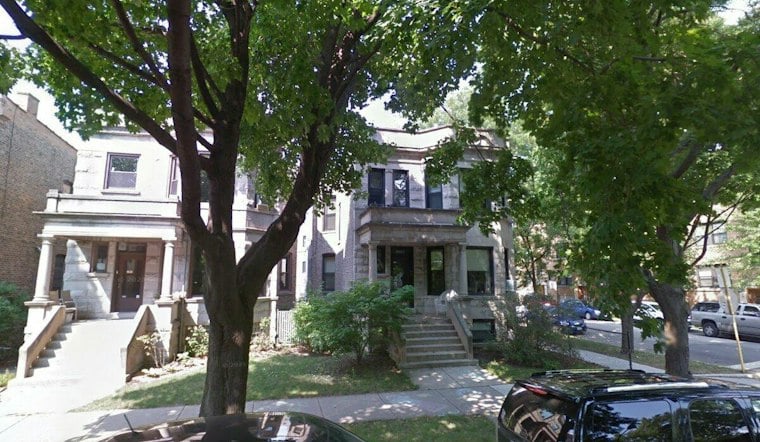
A century-old greystone on the 1300 block of West Newport Avenue came down in August 2025, and the empty lot it left behind is now driving a much bigger fight over the future of West Lakeview. Ald. Bennett Lawson is pushing for a preliminary landmark designation covering roughly 200 buildings along stretches of Eddy, Cornelia and Newport, and the proposal is set to be heard at the Commission on Chicago Landmarks' November 5 meeting.
A Demolition That Set Off a Citywide Debate
The push for a preliminary landmark designation centers primarily on the 1200 and 1300 blocks of Eddy, Cornelia and Newport, according to Ald. Lawson's ward office. The proposed district is bound by the alley south of Addison, the alley north of Roscoe, Racine Avenue and the alley east of Southport, the ward office says. The effort did not start at City Hall; it began at the request of residents on the 1300 block of Newport, a stretch known for its concentration of historic greystone and brick flat buildings, per the same source.
That block's 1910-built greystone at 1300 W. Newport Avenue was demolished and replaced with new construction in August 2025, a loss that, as Preservation Chicago reported, prompted city officials and neighbors to explore protecting a larger stretch of the neighborhood as a historic landmark district. The Chicago Department of Planning and Development's preliminary research, cited in that report, found about 200 buildings in the area, constructed mainly between 1901 and 1915.
Who Would Be Covered, and Why
Buildings likely to contribute to the district would primarily be two- and three-story brick flats and apartment buildings tied to housing built for working-class families, particularly German immigrants, according to the ward office's posting. Those structures form the backbone of the six-block area that preservationists say still presents a cohesive, early-20th-century streetscape.
But the effort covers a six-block West Lakeview area that has drawn pushback from some residents whose blocks are less architecturally uniform, Preservation Chicago noted. Ald. Lawson has said he will not push the designation through without real buy-in from the people who would actually be affected. Speaking with Block Club Chicago, he said, “I don't see myself moving forward without a lot of support from property owners.”
Residents Split Over Costs and Control
Some residents back the landmark push as a way to stop future teardowns like the one on Newport, while others have told Block Club Chicago they worry a designation could raise renovation costs, limit homeowners' flexibility and further cement the area as a wealthy enclave. One resident, cited by Preservation Chicago, said he believes landmarking the neighborhood would put a lid on the value of his home because any future buyer would be barred from tearing down its facade.
That view runs up against other data points in the broader debate. A Chicago landmarks Q&A on the city's website states that studies on the effect of landmark-district designation on property values have generally shown no negative impact, and separate research on Chicago attached-home sales in the 1990s found that landmark buildings and districts sold at a small premium. The dossier does not resolve which outcome West Lakeview property owners should expect, and no current sale-price data for the neighborhood has been verified.
What Landmark Status Would and Wouldn't Change
Ald. Lawson's ward office says being a landmark would not affect interior or rear renovations or rear additions, and residents would still be able to add coach houses, basement units and attic units. Under the city's broader designation process, outlined by the City of Chicago, the Department of Planning and Development produces a report on how a proposed district would affect neighborhood plans and policies, and the Commission then contacts each owner to seek consent.
Once a property receives a preliminary recommendation or designation, Chicago's landmark ordinance requires written Commission approval before any permit for alteration, construction, demolition, relocation or similar work can be issued, according to Chicago Landmarks. The city's owner Q&A adds that all building-permit applications within a landmark district are evaluated to determine whether the proposed work would affect significant historical or architectural features.
Echoes of Other Chicago Landmark Fights
Preservation Chicago had urged the city to narrow its initial focus to just the 1300 block of Newport Avenue, arguing the city lacked the resources to lead a successful push across a much larger area. The debate echoes a fight that played out this year in Edgewater, where City Council approved the Bryn Mawr Historic District designation on September 23 after a process that began in spring 2026, per Preservation Chicago. That district, which spans Bryn Mawr Avenue from Broadway to Sheridan Road and includes the Edgewater Beach Apartments and the Belle Shore Apartment Hotel, made property owners eligible for the Class L property tax incentive, the Adopt-a-Landmark Fund and federal historic tax credits — even as developer Harlem Irving Companies had proposed demolishing three buildings there for a six-story, 95-unit apartment building with about 6,000 square feet of ground-floor retail.
Enforcement after designation has also been a sticking point elsewhere in the city. At the Wacker House in the Old Town Triangle Historic District, extensive exterior alterations in recent years prompted preservationists to call for stronger city enforcement of landmark rules, Block Club Chicago reported, noting the Department of Buildings fielded 13 complaints about that property between 2023 and 2026, including allegations of unpermitted work and alterations to a landmark building. As West Lakeview heads toward its own November 5 hearing, as Crain's Chicago Business reports, those same tensions between preservation goals and property owners' concerns remain unresolved.





