

























































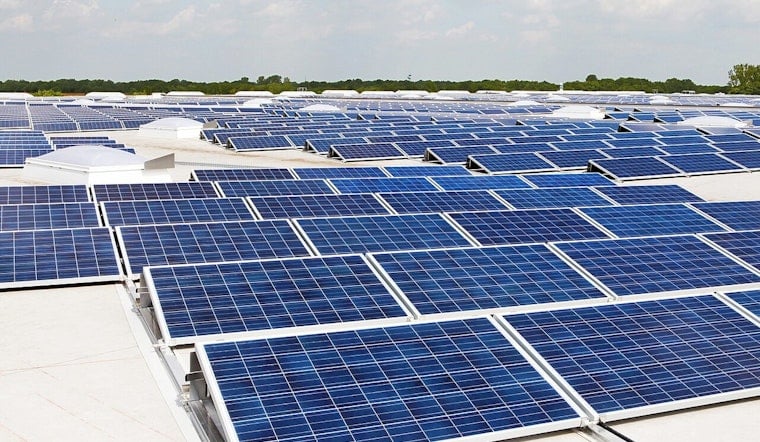
Coal country in Robertson County is getting a very different kind of power plant. Panamint Capital has broken ground on Big Rooter Power, a 1.2GWdc solar PV build at its Twin Oaks energy campus, roughly midway between Dallas and Houston. The US$1.7 billion project starts with a 491MWdc West phase and will add a 658MWdc East phase over the next three years. Panamint says the site will blend solar, large-scale batteries and new transmission corridors with the campus’s existing thermal operations.
According to PV Tech, the build will deploy NextPower’s NX Horizon tracker systems and its Hail Pro-75 and NX Navigator software. The outlet also reports that First Solar will supply roughly two million modules for the two phases, manufactured at its United States facilities in Ohio, Louisiana and Alabama. PV Tech notes that construction has begun on Big Rooter West and that Big Rooter East is slated to follow as the second phase.
In a company release via PR Newswire, Panamint CEO Apolka Totth called Big Rooter "our vision for getting more out of America’s energy infrastructure and ensuring America’s energy dominance." The release says that once complete, the Twin Oaks complex will pack about 1.5GW of combined thermal and renewable capacity, more than 20 miles of 345kV transmission, 1.6GWh of battery storage and 790MW of data center capacity under development across a roughly 10,000-acre site.
Turning a coal mine into a power campus
Panamint pitches Big Rooter as a full-on redevelopment of the historic Twin Oaks Power Station and its Calvert Mine, framing the project as a way to reuse a legacy energy site instead of carving up fresh land. The company says it is leaning on existing rights of way and previously disturbed acreage to keep new ground disturbance in check, according to Panamint Capital. Its redevelopment page lists Big Rooter Storage West and East as a pair of 200MW / 800MWh battery facilities and confirms adjacent projects that include a 700MW gas plant called Minor Oak along with other hybrid builds. Together, Panamint says, these projects are meant to preserve the site’s economic role while steadily shifting its asset mix toward renewables.
Timeline and local impact
The two-phase Big Rooter schedule targets commercial operation for the West project in August 2028 and for the East project in August 2029, with construction of Big Rooter East expected to begin in December 2026, according to Solar Power World. Panamint says the build will create more than 800 construction jobs and that Big Rooter West alone is expected to deliver roughly US$66 million in local economic benefits over its lifetime. Company materials put heavy emphasis on local hiring and regional subcontractors as part of the pitch to the community.
Supply chain and U.S. manufacturing
Panamint and its partners are also leaning into a domestic manufacturing story. First Solar will manufacture the project’s modules at its United States plants, and the developer says the build will use more than 34,000 tons of domestically produced steel, according to the PR Newswire release. That same release names SOLV Energy as the engineering, procurement and construction partner and NextPower as the tracker supplier, and notes that the project is backed by a long-term power purchase agreement with a single investment-grade offtaker. Supporters argue that high United States content should bolster local jobs and shorten delivery timelines for critical equipment.
Why this matters for Texas energy
Panamint has described Big Rooter as the largest solar project ever built at an existing coal-mining site in North America, a claim reported by PV Tech. Whether Big Rooter ends up as a one-off or a template for redeveloping other fossil-era sites, the groundbreaking shows how private capital and United States manufacturers are lining up to turn aging coal assets into new grid and digital infrastructure. Local officials and residents will be watching closely as the project moves from ceremonial shovels to heavy construction over the next year.





