

























































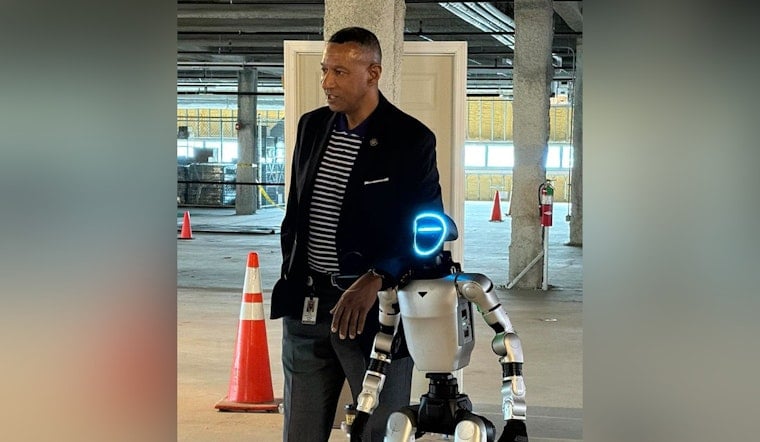
Forsyth County Sheriff Bobby Kimbrough rolled out a new kind of backup in Winston-Salem on Monday: a full-size humanoid robot that walks, talks and, yes, even dances. The sheriff framed the high-tech helper as a way to keep deputies out of harm’s way, as the roughly human-shaped machine showed off walking, running and speech during a live demonstration.
The unveiling included a bit of showmanship. After the basics, Kimbrough had the robot bust out preprogrammed dance moves, drawing laughs and raised eyebrows from onlookers who are more used to seeing blue lights than blue steel on patrol.
According to WBAL NewsRadio, the “humanoid” was developed in partnership with Artificial Intelligence Robotics Arts R&D at the University of North Carolina School of the Arts’ Center for Design Innovation in Winston-Salem. WBAL reports the robot can map a crime scene in 3D, be programmed to perform specific motions and press buttons, and that the Forsyth County Sheriff’s Office does not currently own the machine. Kimbrough estimated the price tag at about $75,000.
Demo: 'You can't push him down'
Video from WXII captures Kimbrough putting the robot through its paces, testing its balance and range of motion while telling the crowd, “you can’t push him down, and if he did fall down, he would hop back up.” As WXII documented, the sheriff triggered a series of preprogrammed routines, from spoken lines to simulated “fight” moves and dance steps, to show how deputies might send the robot into a risky call instead of going in first themselves.
WXII’s exclusive look showed the robot moving around the room under human control and running through canned responses that hinted at how it could be used for tasks like approaching a suspect, opening doors or documenting a tense scene while human officers hang back.
Police robots have a checkered history
Robots are already part of modern policing for bomb disposal, reconnaissance and scene documentation, but things get complicated when those machines edge closer to the role of frontline enforcer. That tension exploded into public view in 2016, when Dallas police used a bomb-carrying robot in a deadly standoff, a move that marked a first in American policing, as reported by The Texas Tribune.
Civil liberties groups and some scholars have since warned that departments should spell out clear policies, limits and community oversight before sophisticated robots become a routine part of patrol and tactical responses.
Kimbrough did not commit to buying the humanoid or outline any formal deployment plan, and he offered no timeline for a possible purchase. As WXII reported, the sheriff simply hinted that Forsyth County is treating the machine as a test case, adding, “It is coming to a town near you soon,” a line that landed somewhere between promise and warning for anyone watching the robot’s moves.



