

























































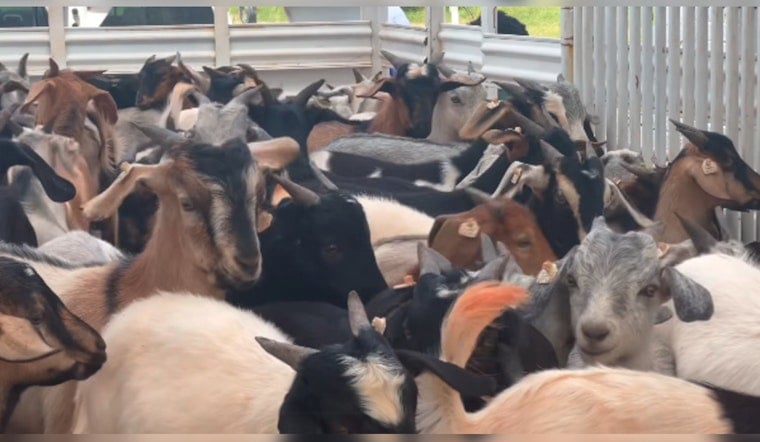
A hundred goats have been put to work chewing through thick, overgrown brush at the historic Oklahoma State Penitentiary rodeo arena in McAlester, where vegetation had grown so tall and dense that crews considered the grounds difficult and potentially dangerous to enter. The Oklahoma Department of Corrections relocated the goats from its own goat farm in Lexington to tackle the job, betting that hungry livestock can succeed where human labor crews would struggle.
The overgrowth had crept up gradually since the rodeo itself went dark in 2009, when the aging arena was deemed too far gone to keep hosting events safely. As reported by The Journal Record, facility officials say this season the brush simply got away from them. Willis Pettit, who approved the request to bring in goats, said, “the overgrowth got away from the facility this season.”
Rather than send prison staff into dense, thorny vegetation, officials turned to an approach ODOC's agriculture arm already had on hand. Justin Labor described the appeal of goats plainly: “goats are basically a lawnmower with a heartbeat. they'll eat all day long.” Tyler Dean reported that officials have had a lot of success with goats cleaning up the area in the past, reinforcing the goats as an effective alternative to dispatching workers into overgrown terrain.
A Farm System Built for the Job
The 100 goats sent to McAlester came from ODOC Agri-Services' herd at the Lexington Assessment and Reception Center, which keeps roughly 350 Spanish and Boer goats specifically for low-cost brush control, according to the National Association of Institutional Agribusiness. That herd is part of a much larger operation: ODOC Agri-Services manages more than 19,000 acres across Oklahoma facilities, running over 3,700 head of beef cattle along with dairy, pecan, and crop production, per the Oklahoma Department of Corrections. The cleanup at McAlester is expected to take about one to two months, depending on weather, vegetation growth and how quickly the goats work through the site.
Officials hope the animals' grazing will do more than tidy up an eyesore. ODOC hopes the work will uncover and reclaim more of the historic grounds surrounding the arena, and Pettit said watching the goats do their job will be a morale booster for both staff and incarcerated men at the facility. Clearing the overgrowth is described as an important first step toward making the historic site safer and more accessible.
The Rise and Fall of the ‘Greatest Show on Dirt’
The arena the goats are clearing once anchored one of the most famous events in American prison history. Oklahoma State Penitentiary hosted its first rodeo in 1940 under Warden J.F. “Jess” Dunn, who launched the tradition only to be killed ten months later during the August 1941 escape attempt remembered as Bloody Sunday, according to McAlester Prison Rodeo. The event continued in his memory and ran for 62 years, drawing thousands of spectators to McAlester and earning the nickname “the Greatest Show on Dirt.”
After a post-1949 expansion, the concrete arena could seat more than 12,500 people and historically pulled multi-day crowds as large as 65,000, making it the largest prison rodeo in the world at its peak, per the Oklahoma State Senate. Throughout its 69-year run, incarcerated competitors wore traditional black-and-white prison-striped trousers to set them apart from the professional, non-inmate cowboys who performed in exhibition events, according to The Black Wall Street Times. Incarcerated women weren't allowed to compete until 2006, a shift later documented in the 2009 film *Sweethearts of the Prison Rodeo*, per Capitol Beat OK. Since Oklahoma's rodeo ended in 2009, Louisiana's Angola Prison Rodeo has remained the only active behind-the-walls prison rodeo still operating in the country, according to the Oklahoma House of Representatives.
A Bigger Restoration Fight Behind the Brush-Clearing
The goat project is a low-cost first step toward a much larger and more contested plan. Oklahoma lawmakers co-authored House Bill 3749 and Senate Bill 1427 in March 2024 to steer $8.3 million in state funds toward an estimated $9.3 million restoration of the entire arena, with the Department of Corrections pledging an additional $1 million, per the Oklahoma House of Representatives. Municipal leaders from the City of McAlester and the McAlester Chamber of Commerce have backed the effort, pointing to the tourism and economic activity a restored rodeo site could bring to the region.
Not everyone is on board. State legislative proposals for the $8.3 million restoration have drawn pushback from prisoner advocacy groups and state representatives who argue taxpayer money should go toward internal prison safety, staffing, and rehabilitation programs instead, according to Oklahoma Watch. That tension over spending priorities sits alongside recent violence inside the facility and a walkaway security scare at Oklahoma State Penitentiary this summer, alongside newly installed body-scanner security upgrades across ODOC facilities.
For now, the goats are simply eating their way through decades of overgrowth, one patch of brush at a time. Whether their work clears the path for a full-scale rodeo revival remains an open question tied to a legislative debate that has yet to be resolved.





