

























































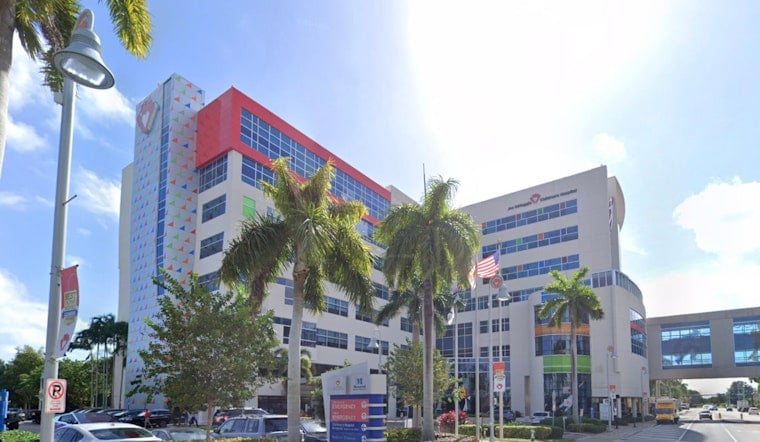
A kidney flown nearly 2,000 miles from Colorado to South Florida has given an 18-year-old Deerfield Beach resident a new shot at ordinary teenage milestones. Joe DiMaggio Children’s Hospital in Hollywood completed its first remote living-donor kidney transplant for Arianna Crockett, whose kidney failure had put her on dialysis three times a week. The operation was a medical milestone, but for Crockett, the payoff is more basic: getting her health back and eating spaghetti with tomato sauce again.
The hospital announced the procedure July 7, describing it as a coordinated cross-country transplant involving Sara Gips Goodall, a Colorado donor and wife of one of Crockett’s distant relatives. According to Joe DiMaggio Children’s Hospital, the kidney was flown to South Florida while Goodall was able to donate close to home.
Crockett’s medical history is unusually complicated. WSVN 7News reported that she was born with STAR syndrome, lost one kidney at age 8 and later developed complete kidney failure after years of urinary infections and bladder problems.
After a severe infection in January, doctors determined a transplant was her only path forward, according to the hospital’s account. She had been under the care of pediatric nephrologist Dr. Karezhe Mersha for nearly two years and needed dialysis three times weekly while a suitable donor was found.
How The Kidney Made Its Cross-Country Journey
The donor did not have to fly to Florida for the surgery. As Local 10 reported, surgeons removed the kidney in Colorado, sent it by plane to South Florida and then moved it by helicopter to Joe DiMaggio Children’s Hospital, with the transplant completed in about 12 hours.
That arrangement is the point of remote donation, not a one-off stunt. The National Kidney Registry says its program lets a donor undergo surgery at a nearby transplant center while the kidney is shipped to the recipient’s distant hospital, reducing travel and lodging burdens and allowing the donor to recover at home.
The logistics also operate under a tight clock: the federal transplant system says kidneys are usually transplanted within 36 hours of removal and cannot be frozen for later use. The same guidance notes that blood type, immune matching, pediatric status and distance all play roles in kidney allocation, which helps explain why a willing relative is not automatically a medically workable donor.
Why The South Florida Milestone Matters
Crockett’s transplant comes as the country’s kidney shortage remains severe. UNOS said in January that more than 90,000 Americans were still waiting for a kidney transplant after 27,573 kidney transplants were performed nationwide in 2025, including 6,521 from living donors.
The South Florida program has also been building its living-donor capacity locally. In January, Joe DiMaggio Children’s Hospital said Memorial’s transplant team had completed its first altruistic living kidney donation to a pediatric patient in the institute’s history, a separate case involving a 9-year-old Broward boy and a stranger who volunteered to donate.
For Crockett, the next chapter is less about the novelty of the procedure than the routine it may restore. She is recovering, will need regular lab work and long-term medication, and is looking forward to a healthier future—and to the return of a favorite plate of spaghetti, according to West Orlando News.





