

























































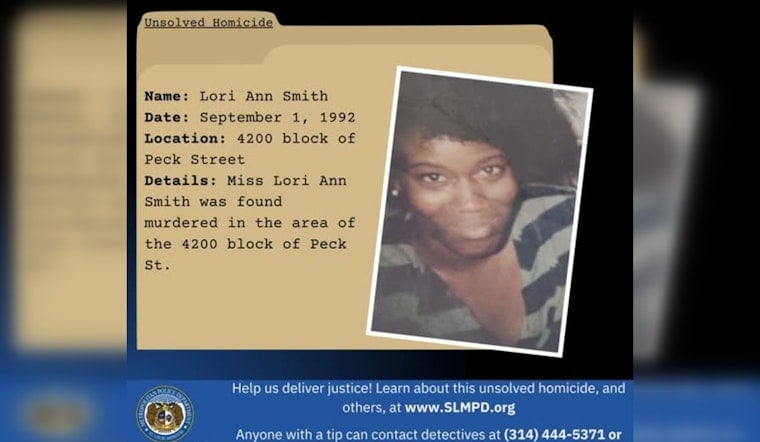
Lori Ann Smith was found murdered in the area of the 4200 block of Peck Street on September 1, 1992, and more than three decades later, her killing remains unsolved. St. Louis police are once again asking the public for help, hoping someone still remembers something from that late-summer day in the Fairground neighborhood.
The St. Louis Metropolitan Police Department shared the appeal on Facebook, listing Smith's name, the date, and the Peck Street location as part of its ongoing effort to solve homicides from decades past. The department directed anyone with information to call detectives at (314) 444-5371 or email [email protected], while tipsters who wish to remain anonymous can call CrimeStoppers at 866-371-TIPS (8477) for a possible reward. Additional details about Smith's death, gathered by victim advocacy organization Project: Cold Case from family-submitted case information, describe her as found nude and strangled, with her clothes located near her body after neighborhood residents reported last seeing her walking on Peck Street.
A Neighborhood With a Painful History
The 4200 block of Peck Street sits in North St. Louis's Fairground neighborhood, near Fairground Park, an area that has struggled for years with violence and unsolved cases. According to an analysis by APM Reports, the neighborhood recorded more than three dozen homicides between 2014 and 2023, with nearly 60 percent of them still unsolved. That pattern has continued into recent years — in March 2025, another fatal shooting happened on that same block of Peck Street, killing 44-year-old Percy Bowman during an outdoor cookout, a case Hoodline covered in its report on the Fairgrounds shooting. A suspect in that shooting was arrested and charged with first-degree murder, according to KSDK.
Smith's case now falls under the SLMPD's Cold Case Squad, a unit created within the department's Bureau of Investigative Services in February 2019 specifically to revisit unsolved homicides from the 1980s and 1990s using modern forensic testing that didn't exist at the time of the original investigations. Hoodline detailed the unit's mission and its broader backlog of roughly 1,000 unsolved St. Louis homicides in a recent report on the Norma Garrett cold case.
Clearance Numbers Don't Tell the Whole Story
St. Louis's cold case backlog is part of a much larger citywide problem. A multi-year investigation by St. Louis Public Radio, APM Reports, and The Marshall Project found that nearly 60 percent of homicides committed in the city between 2017 and mid-2023 — more than 750 cases — remained unsolved, a finding that prompted those outlets to sue SLMPD for clearance records.
Even the department's more recent progress comes with caveats. SLMPD publicized an 84 percent homicide clearance rate for 2025, but an analysis by KSDK found that 32 of those 117 cleared cases were actually older homicides solved from prior years, and formal murder charges were filed in only about 36 percent of that year's total killings. The gap between a police clearance and an actual prosecution has become a recurring theme in how the city's cold case progress gets reported.
The disparities run deeper still. Across St. Louis, Black residents made up 90 percent of homicide victims between 2014 and 2023, even though they represent 44 percent of the city's population, according to APM Reports' analysis of SLMPD data. That same analysis found police cleared fewer than half of homicides involving Black victims, compared with two-thirds of cases involving white victims.
A National Pattern, Playing Out Block by Block
The struggle to solve old murders isn't unique to St. Louis. Nationally, FBI Uniform Crime Reporting data analyzed by the Murder Accountability Project shows that nearly 340,000 homicides went unsolved across the United States between 1965 and 2021, with the national clearance rate falling from around 90 percent in 1965 to roughly 50 to 60 percent in recent years.
Smith's case has also drawn attention from Project: Cold Case, a Jacksonville, Florida-based nonprofit founded in 2015 by Ryan Backmann after his own father's unsolved 2009 killing. The organization publishes family-submitted case profiles for homicide victims nationwide, and its post on Smith's case added the crime scene and last-known-sighting details that the original police release did not include.
For now, the SLMPD says anyone with information about who killed Lori Ann Smith should come forward, whether through detectives directly or anonymously through CrimeStoppers, which assigns tipsters unique code numbers to protect their identity under its program rules. Whether that appeal reaches someone willing to talk, more than three decades after Smith's death, remains an open question.



