

























































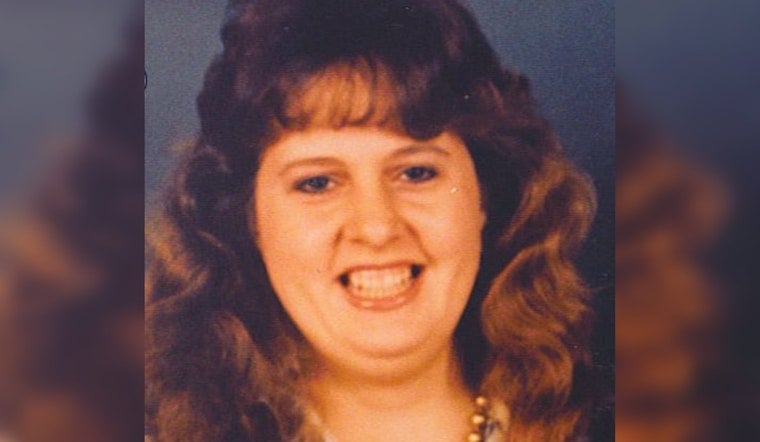
A 22-pound piece of riprap dropped from the Manhattan Road overpass onto westbound Interstate 70 outside Putnamville killed 28-year-old Marsa Lynn Hacker Gipson almost instantly in the early hours of August 27, 1991. Thirty-five years later, no one has ever been charged, and investigators say the case is still open.
Gipson, an Arcadia mother of two, was riding in a 1984 Chevrolet Camaro toward Terre Haute with 29-year-old companion Stanley Hamby at around 1:15 a.m. when the rock came through the windshield, according to the Vincennes Sun-Commercial. The car had been traveling an estimated 59 mph. Hamby managed to steer the Camaro to a stop about a half-mile down the interstate before he was airlifted to Methodist Hospital in Indianapolis, struck himself by a rock that bounced through the windshield. Gipson died from a ruptured aorta, broken collarbones, and a crushed skull, and was later buried at Riverside Cemetery in Spencer. She would be 63 years old today; her daughters, who were 9 and 10 at the time and whom she had been on her way to pick up, are now 44 and 45.
The Indiana State Police official cold case portal lists the killing under Case Number 53-8856, placing the exact crime scene at the 33-mile marker on westbound I-70 beneath the Manhattan Road overpass in Putnam County, according to Indiana State Police. The bridge itself, a four-span continuous steel beam structure the Indiana Department of Transportation designates Structure No. I70-46-05172 located 3.92 miles west of State Road 243, still carries traffic over the same stretch of highway.
A Night of Escalating Danger on the Overpass
Gipson's car was not the only vehicle targeted that night. After the fatal rock struck, the throwers hurled two more rocks at a passing semi. That truck was driven by 23-year-old Kimberly Schutler, who was uninjured when a rock struck the metal frame, but her 29-year-old passenger, James Polites, suffered a shattered leg when a rock crashed through the truck's sleeper compartment and was also airlifted to Methodist Hospital in Indianapolis, per the Sun-Commercial's account.
Witnesses reported seeing two suspects in silhouette on the overpass and a dark-colored pickup truck fleeing the scene afterward. One potential suspect reportedly left traveling south while the other went north. Investigators say witnesses also spotted a similar vehicle near a nearby resident's yard, from which the rock throwers are believed to have taken the riprap used in the attack. Two young men who matched witness descriptions and possibly matched the pickup seen on the overpass were brought to the Putnam County jail as potential suspects but were released before ever being charged.
Eight Incidents Before the Fatal Throw
Gipson's death did not come out of nowhere. Indiana State Police documented at least eight overpass rock-dropping incidents along I-70 between April and August 1991, six of them centered at the Manhattan Road overpass, according to WTHR. All of the throwing stopped abruptly the day after Gipson was killed, on August 28, 1991.
In 2008, a former local teenager confessed to participating in the Manhattan Road throwing spree back in July 1991 and cooperated with state police alongside three other former group members, all of whom identified the same two suspected ringleaders, the station reported. The witness said he was not present on the overpass the night Gipson died but described the group's earlier activity to investigators. Suspects were described in 1991 as being in their late teens to early 20s; today, they would be between 50 and 60 years old.
Internal Friction Stalled an Arrest
The case nearly reached an arrest in the late 1990s. A former Indiana State Police detective revealed in 2008 that an internal dispute erupted in 1997 over a probable cause affidavit drafted by another detective seeking to arrest the rock-throwing suspects, with colleagues raising concerns about alleged inaccuracies in the document. That friction, per the same account, hampered efforts to secure a warrant. Indiana State Police officials also attempted to surveil one suspect in Evansville but failed to maintain that surveillance.
Denny Bridges, chief of detectives at the Indiana State Police Putnamville post in 1991, worked the case alongside troopers Jeff Herron, Brian Smith, and Todd Smith. Bridges called the incident an unintended prank that went horribly awry, theorizing that the perpetrators intended the rock to simply bounce off a vehicle rather than kill someone. He has said he has not given up hope that the case will one day be solved.
Forensic Testing Came Up Empty
Investigators attempted to pull suspect DNA from the rocks recovered at the scene but were unsuccessful, and Putnam County prosecutors submitted the archived physical evidence for updated forensic testing in 2011 without generating a suspect match, according to the Terre Haute Tribune-Star. Former Putnam County Prosecutor Tim Bookwalter said as of 2021 that nothing new had emerged on the case for several years. The Indiana Department of Correction has periodically distributed specialized Cold Case Homicides playing card decks to state prison inmates in hopes of generating tips on unsolved murders statewide, including Gipson's.
Current Putnamville State Police Det. Brian Maudlin said the case remains active and open despite 35 years without resolution, describing what happened to Gipson as a senseless act. He noted investigators still receive occasional tips, and said new technology can allow old evidence to be re-evaluated as forensic science advances. Maudlin has also said the fact that the perpetrators apparently did not know their victims makes the police work more difficult, since there is no personal motive to trace. Authorities say they have circumstantial evidence but have lacked enough to prosecute, though dna and ancestry websites have helped crack many other cold cases in recent years.
Why the Case Can Still Be Charged
Time is not a legal obstacle. Under Indiana Code § 35-41-4-2, murder carries no statute of limitations, meaning prosecutors can file charges at any point no matter how many decades pass, according to Justia Law. Overpass rock-throwing deaths elsewhere have led to serious convictions: prosecutors in a 2017 Michigan case and a 2023 Colorado case secured second-degree and first-degree murder convictions against teenagers and young adults who dropped heavy stones onto moving traffic, per True Crime News.
Gipson's family kept a wooden cross memorial along I-70 beneath the Manhattan Road overpass for years. At one point, her father discovered that an unknown individual had carved a smaller secondary cross into the wood, a quiet, unexplained gesture the family never solved either. Her parents visited the site regularly to maintain the memorial until her mother passed away without ever seeing the case resolved.




