

























































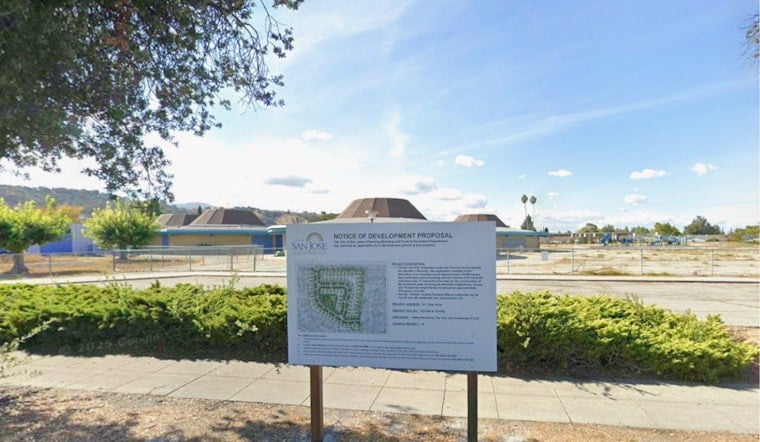
The former Glider Elementary School at 511 Cozy Drive has sat empty since 2018, and now it's at the center of a fight over housing, money, and the future of South San Jose. A proposal to build 80 homes on the 9.5-acre campus cleared the San Jose Planning Commission last Wednesday, setting up a city council decision that could hand the Oak Grove School District a $26.6 million cash infusion while reshaping a quiet residential pocket of the city.
The project, spearheaded by San Ramon-based developer True Life Companies, would replace the shuttered campus with 64 detached single-family homes and 16 attached homes, according to The Mercury News. Detached homes would range from 1,896 to 2,234 square feet, while attached units would start at 1,233 square feet, with proposed lots ranging from 1,980 to 7,603 square feet. The homes would come with three or four bedrooms, 2.5 or three bathrooms, and the attached units would feature two stories, one-car garages, and private backyards. About 13 percent of the units would be designated affordable housing, and the developer has requested a waiver from the city's standard 5,000-square-foot lot minimums.
True Life filed the proposal as a builder's remedy project, a designation under California's Housing Accountability Act that lets developers bypass certain local zoning standards and bureaucratic requirements as long as at least 20 percent of units are reserved for low-income households, according to Hoodline's prior reporting on similar filings elsewhere in Santa Clara County. Under that provision, the project cannot be turned down over zoning conflicts alone, though it still must navigate the city's public hearing process before final approval.
A School District Banking on a Sale
Glider Elementary once served between 450 and 600 students before Oak Grove School District closed it along with two other schools in 2018, as declining enrollment eroded the district's ability to secure state funding tied to average daily attendance. The district now faces projected annual deficits of around $11 million over each of the next three years, and officials say the $26.6 million sale could offer a lifeline. Educators told the Planning Commission the proceeds could fund music and arts electives, libraries, counseling programs, and classroom technology updates.
Oak Grove School District trustee Ivan Chaidez said the resource could modernize schools, retain educators and staff, strengthen student support services, and preserve opportunities for children, per the same Mercury News account. In the meantime, the district has been paying $13,000 per month in security fees to guard the vacant site, which officials say faces growing risk of blight and security issues. Resident Edgar Dueñas said he met with San Jose police after a break-in at the property.
Neighbors Fear Traffic, Strained Utilities
Not everyone at the hearing was on board. Andrew Bryan told commissioners that city staff relied on flawed data collected while the school was closed and argued the local power grid and sewer lines are already overburdened. He claimed daily neighborhood traffic would triple if the project moves forward as proposed, and said it would make residents miserable. Some residents asked commissioners to cap the project at 62 units instead of 80, while others raised concerns about strain on electric and sewage infrastructure.
Not all nearby residents oppose the plan. Luis Arguello said housing affordability is urgently declining in San Jose and told commissioners he could not afford to repurchase his own house at today's prices. He urged the city to move housing projects forward quickly and voiced support for the Glider proposal. Some residents have separately proposed converting the site into a public community center instead, an idea that has not been adopted into the current plan. The developer, meanwhile, contends the residential plan would distribute traffic throughout the day rather than concentrating it, and points to plans to plant 159 new trees on the property.
Housing Quotas Loom Over the Decision
The debate over Glider Elementary is unfolding against a backdrop of intense state pressure on San Jose to build. The city faces a mandate to produce more than 62,000 new homes by 2031, a target established when the state certified San Jose's 2023-2031 Housing Element. As of December 2024, the city had issued just 5,190 housing permits toward that goal, according to SV@Home — roughly 8.3 percent of its eight-year target. San Jose zoning proposals under consideration could also increase allowable density from eight to 32 units per acre by 2027, a shift that would make projects like Glider easier to approve outright.
Housing costs in San Jose add urgency to the debate. The city had a median home sale price of $1.42 million as of June, and an average two-bedroom rent of $3,325 per month that same month, per the Mercury News report. District officials say the 80 new homes could also help bolster declining student enrollment at nearby schools, which officials say can accommodate potential new students from the development. The proposal has not yet been placed on the city council agenda, and if approved, the council will finalize conditions such as construction hours and traffic mitigation before any groundbreaking begins.
What a Nearly Four-Year Build Would Look Like
Beyond the political fight, the physical scope of the project is significant. Plans call for demolishing six existing school buildings totaling roughly 56,644 square feet and removing 48 trees, 18 of which are ordinance-protected, according to Realtor.com. The plan also includes a 0.68-acre privately owned but publicly accessible park. True Life has asked to subdivide the property into 81 lots under California's State Density Bonus Law and is seeking a waiver to eliminate the city's Transportation Demand Management plan requirement.
Construction is estimated to take approximately 44 months, nearly four years, from groundbreaking to completion, with the applicant requesting extended Saturday work hours from 8 a.m. to 5 p.m. That timeline echoes long-standing resident frustration dating back to when the district first moved to sell the campus. In January 2022, the Oak Grove School District Board of Trustees voted unanimously to approve the $26.6 million sale to True Life Companies, a decision that followed years of organized opposition from the Save Glider School Committee, which had raised $15,000 for legal representation after an advisory committee's 2020 recommendation to lease rather than sell the site was overridden.
District leaders have pointed to their 2007 sale of Calero Elementary School as a precedent for using surplus property sales to shore up finances amid enrollment declines. When Oak Grove marketed the closed Glider campus in 2021, it received four purchase offers and one lease proposal from a private school, but officials concluded no viable long-term leasing option existed to resolve the district's structural budget deficits. Whether the city council ultimately approves the 80-home plan, trims it down, or sends it back for revisions will determine both the district's financial future and the character of a South San Jose neighborhood that has watched its old elementary school sit empty for eight years.




