

























































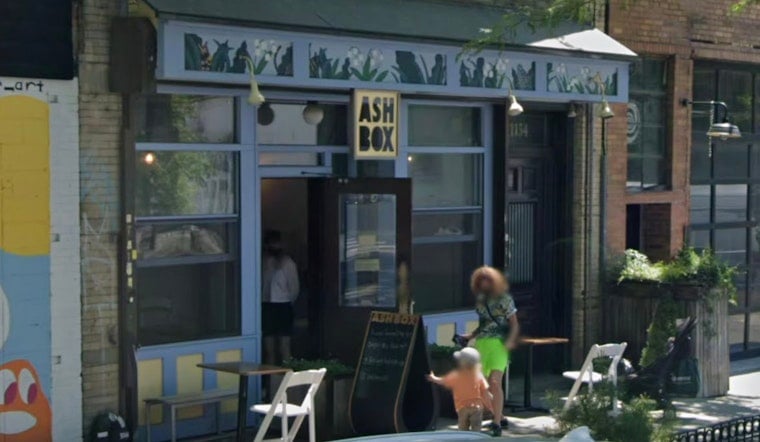
Ashbox Cafe, the tiny Japanese-leaning breakfast and lunch spot that anchored the far northern end of Manhattan Avenue in Greenpoint for 18 years, has closed its doors. Owner Yoko Kubo announced she is prioritizing her health amid a worsening battle with arthritis, ending an operation she ran almost entirely by herself since the cafe first opened its doors.
Kubo confirmed the closure in an Instagram announcement, telling customers the cafe had already stopped serving in July, according to Greenpointers. She served as both chef and server at the restaurant, a dual role that had defined Ashbox Cafe since its earliest days at 1154 Manhattan Ave.
That solo arrangement wasn't new. In an August 2023 interview, Kubo told Greenpointers that she operated the cafe entirely on her own, acting as sole proprietor, head chef, and front-of-house server with no additional kitchen or service staff. Running a one-woman restaurant for the better part of two decades meant continuous physical labor, a demand that eventually caught up with her.
An Address Baked Into the Name
Ashbox Cafe's name wasn't a marketing flourish so much as a literal description of its location: the storefront sits between Ash Street and Box Street at the northern edge of Greenpoint, near where Manhattan Avenue runs out toward Newtown Creek. The cafe officially opened at that address in early 2008, and by February 2010 it was already marking its second anniversary with a special event featuring artisanal udon air-shipped directly from Fukuoka, Japan.
Over the years, the menu built a devoted following around Japanese comfort food staples. As Brooklyn Magazine highlighted in April 2025, the cafe's hand-shaped onigiri, filled with umeboshi plum, grilled salmon, or salted kelp, were a cornerstone of the daily offerings, typically served alongside housemade pickles. The seed report from the closure describes the overall menu as Japanese-leaning healthy fare geared toward breakfast and lunch.
A Neighborhood Transformed Around It
The block that housed Ashbox Cafe changed dramatically during its 18-year run. The storefront borders the 22-acre Greenpoint Landing waterfront development, which stretches from Box Street down to Green Street and has replaced much of the area's former industrial character with thousands of new residential units and public parkland, according to real estate listings reviewed on Craigslist. Property records from PropertyShark show the 3,938-square-foot pre-war mixed-use building at the address last changed hands in December 2005 for $1.225 million, shortly before the cafe opened.
Ashbox Cafe's closure fits a pattern of long-running Greenpoint institutions shutting down in recent years. Hoodline previously reported that the Pencil Factory Bar closed after nearly 25 years on Greenpoint Avenue in July 2025, after its landlord declined to renew the lease.
Wider Pressures on Independent Restaurants
The cafe's solo-operator model insulated it from staffing overhead even as the broader industry faced tightening margins. Bureau of Labor Statistics data reported by MinimumWage.com in January found that New York State lost more than 10,000 restaurant jobs between June 2024 and June 2025, marking the first year-over-year post-pandemic decline in full-service restaurant locations amid rising operational costs.
That squeeze reflects a longer-term shift in how people eat. A 2026 foodservice market analysis cited by Nation's Restaurant News found that eat-in dining fell from 56% of U.S. dollar sales in 2011 to just 35% in 2025, a trend that has weighed heavily on traditional sit-down neighborhood cafes like Ashbox. A May 2026 economic report from the Manhattan Chamber of Commerce likewise found that small business formation across New York City had dropped to a five-year low, with independent operators confronting a high-activity, low-margin environment and billions in absorbed operational costs.
For 18 years, Ashbox Cafe offered a quiet counterpoint to those pressures: one woman, one kitchen, and a menu of onigiri and udon that outlasted much of the industrial landscape around it. Its closure leaves another gap along a stretch of Manhattan Avenue that looks less and less like the neighborhood where it first opened in 2008.



