

























































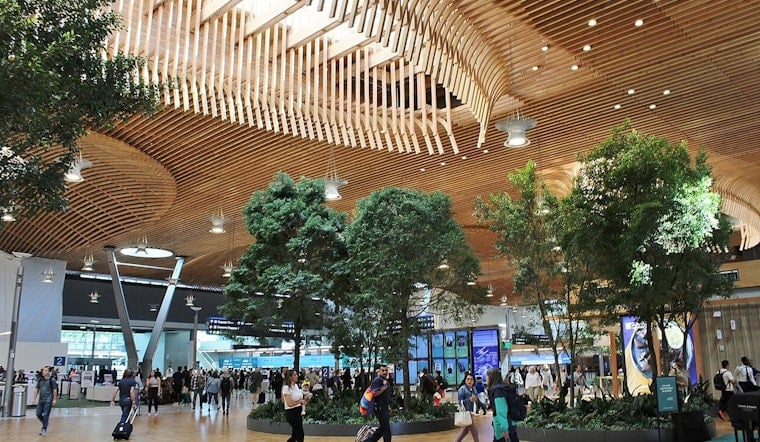
Airports across the United States and Canada are pouring billions of dollars into terminal renovations and expansions, racing to keep pace with record passenger volumes that are straining buildings designed decades ago for far fewer travelers. Portland International Airport has unveiled a soaring new terminal topped with a Douglas fir roof, Charlotte Douglas International Airport has restored its longtime landmark statue to a place of honor, and Hartsfield-Jackson Atlanta International Airport has just added thousands of parking spaces. All of it is aimed at handling a crush of flyers that shows no sign of slowing.
According to CoStar, U.S. passenger boardings are expected to climb from 819.5 million in 2023 to 1.28 billion by 2040, according to the American Society of Civil Engineers. That growth is already visible on the ground: airports in Portland, Los Angeles and Pittsburgh have completed upgrades, while projects are underway at New York's John F. Kennedy International Airport and airports in San Diego, Montreal and Houston, per the same CoStar report by reporter Andy Peters. The expansions generally aim to accommodate passenger growth, replace outdated buildings, boost security, add food and beverage options, and improve visitor flow while cutting wait times, the outlet notes.
Portland's Timber Canopy Anchors a $2.15 Billion Overhaul
Portland International Airport's new terminal features a 9-acre roof covered in a lattice of Douglas fir, built with 3.3 million board feet of sustainably sourced timber, according to ZGF Architects, which designed the project. The wood was sourced from sites within a 300-mile radius of the airport, and the roof structure is considered the world's largest mass-timber airport roof, ZGF says. Hoffman Construction and Skanska formed a joint venture to serve as construction manager and general contractor, while Timberlab handled mass-timber construction services, per CoStar's reporting; suppliers including Freres Engineered Wood, Zip-O-Log Mills, the Yakama Nation, the Skokomish Tribe and Kasters Kustom Cutting furnished the timber itself.
The redesign was intended to handle projected passenger-volume growth and improve energy efficiency, according to ZGF Architects. The Port of Portland, which serves as retail leasing agent for the project, shifted plans to include more pre-security concessions after community feedback, the CoStar article notes. Travelers can now find shops and food from Stumptown, Portland Coffee Roasters, Steven Smith Teamaker, Blue Star Donuts, Cha Cha Cha, Mo's Seafood & Chowder and Deschutes Brewery, alongside retail from Powell's City of Books, Columbia Sportswear, Pendleton, Tender Loving Empire and CCMcKenzie Shoes & Apparel.
Charlotte Restores Its Bronze Landmark
In Charlotte, the airport completed a $608 million renovation of its main terminal lobby in 2025, replacing a terminal originally built in 1982 to handle just 2.8 million passengers annually — a fraction of the 58.8 million passengers Charlotte Douglas International Airport handled in 2024, per CoStar. The lobby project marked the first completed portion of a larger multiphase overhaul at the airport, which uses blue design elements reflecting the colors of local sports teams.
At the center of the renovated space, architecture firm Gresham Smith designed a spot to restore the Queen Charlotte statue as the airport's signature visual. The 15-foot-high bronze statue, donated by a private group in 1990, had been relocated in 2013 from a prominent airport location to a space wedged between two parking decks. “Queen Charlotte greets all passengers and every arriving passenger will experience the statue,” Wilson Rayfield said, according to CoStar's report. Rayfield also told the outlet that “the arms race for airports and cities trying to attract international flights is at a peak” — a comment that speaks to why international travel growth has prompted airports nationwide to add gates capable of handling larger airplanes.
Atlanta Adds 7,000 Parking Spaces as Fees Climb
Hartsfield-Jackson Atlanta International Airport completed a $440 million, seven-level parking deck next to a terminal this past June, adding about 7,000 vehicle spaces between the new structure and an adjacent surface lot, the CoStar article states. But the building boom is coinciding with rising costs passed on to airlines and, ultimately, travelers. Atlanta's Cost Per Enplanement rose from $3.94 to $4.48 between 2024 and 2025, while the same fee climbed from $33.85 to $36.01 at JFK and from $30.16 to $33.85 at Los Angeles International Airport over the same period, according to federal data cited by Dafang Wu in CoStar's reporting. Average cost per enplanement rose year over year at some of the largest U.S. airports during that window, per the same account.
Airports typically finance these projects with tax-exempt revenue bonds, increasingly combined with federal grants, passenger facility charges, commercial revenues and private capital, CoStar reports. The financial pressure is not unique to any one hub: airports fund debt service on new terminals in part by raising the gate rents, landing fees and terminal charges airlines pay per passenger, a dynamic Hoodline previously detailed in its coverage of O'Hare's $300 million overhaul.
A National Infrastructure Squeeze
The spending spree reflects a broader capital shortfall. U.S. airports need to spend at least $174 billion between 2025 and 2029 to upgrade infrastructure, according to Airports Council International, which has said that spending should go toward expanding terminals, lengthening or adding runways, and addressing deferred maintenance. Engineering firm Jacobs has reported that air travel demand is growing faster than airport capacity, straining aging infrastructure, passenger flow and operations — a trend reflected in the firm's own business: Jacobs recorded $184.3 million in airport engineering revenue in 2024, a 36% increase from 2023, and ranked first on a trade publication's airport-revenue-work list, according to Building Design and Construction.
Retail, dining, duty-free shops and premium lounges are also playing a role, encouraging travelers to spend more time and money inside terminals, according to Guy Wilkinson, as cited in CoStar's report. On the policy side, a bipartisan measure in the U.S. House, referred to committee in May 2026, would provide financial incentives for developers using mass timber in public housing, military projects or federal buildings — an effort that dovetails with a broader surge in timber construction nationwide. U.S. construction projects using mass timber rose from fewer than 100 in 2006 to 1,500 through June 2026, according to WoodWorks/Wood Products Council figures cited by CoStar. That legislative push follows a companion Senate bill from Senators Jeff Merkley and James Risch aimed at supporting domestic forestry and sustainable construction, though forestry experts and local critics continue to examine supply-chain limits and sustainable-harvesting claims tied to high-profile timber megaprojects like Portland's.





.jpg)