

























































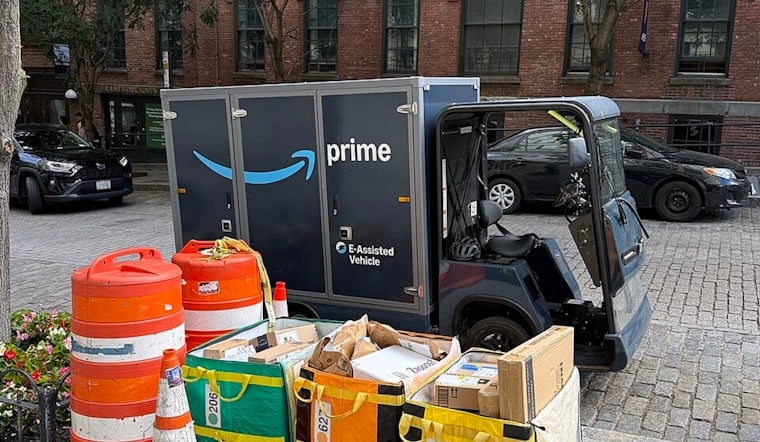
Amazon unveiled its first West Coast fleet of e-cargo delivery bikes at a news conference in Culver City on Tuesday, kicking off a program that will put more than 25 of the four-wheeled, pedal-assisted vehicles into local bike lanes starting Wednesday. Each bike is built to carry around 240 packages per shift with a single mid-shift refill stop, according to Amazon.
The bikes look more like enclosed golf carts than traditional bicycles, featuring an attached storage case and operator pedals, as reported by CBS LA. They top out at 12 mph and come equipped with rear cameras, automatic parking brakes, and regenerative braking, the outlet reports. Samantha Ciccone-Strumph, who spoke at the unveiling, said the bikes have a smaller footprint and can operate in bike lanes rather than clogging Culver City's roads with delivery vans.
Ciccone-Strumph also said Amazon wanted local residents to get used to seeing the bikes on the road before the program grows. The company plans to expand the e-cargo bike operation to Burbank soon, though no firm timeline has been announced.
Who Rides These Things, and How Are They Trained
Amazon Delivery Service Partners can hire delivery associates who don't hold a driver's license to operate the bikes, since the vehicles fall under electric bicycle rules rather than motor vehicle law. Under California Vehicle Code Section 24016, e-bikes with motors under 750 watts don't require a driver's license, registration, license plates, or auto insurance, according to the California Highway Patrol. State rules also cap Class 1 and Class 2 e-bike motor assistance at 20 mph, so Amazon's 12 mph top speed stays well within bounds for bike lane use.
Before they hit the streets, delivery members complete extensive training that includes an in-person road course, per the CBS LA report. New riders then follow condensed routes for two weeks while learning the job, easing into full routes rather than starting cold on Culver City's busiest corridors.
Local Infrastructure Built for the Moment
Culver City's timing lines up with recent bike lane investments. The city completed the MOVE Culver City Eastern Segment in May, adding high-visibility green-painted bus and bike lanes along Washington and Adams Boulevards to form a continuous 4.5-mile biking corridor, according to Streetsblog Los Angeles. The MOVE Culver City project originally launched in 2021 as a pilot before being reworked in 2024 into shared mobility lanes.
Separately, Culver City has approved conceptual plans for the Better Overland and Safer Fox Hills Project, which would add 2.5 miles of protected bike lanes and protected intersections along Overland Avenue between Venice Boulevard and Slauson Avenue, Streetsblog Los Angeles has reported. The project has city approval to pursue state and regional grant funding for construction, though it isn't yet built.
Part of a Bigger Push Toward Climate Pledge Goals
Amazon representatives said the e-cargo bikes address congestion, traffic, and noise by taking delivery vehicles off the road, and the company frames the program as support for its Climate Pledge, which sets a goal of net-zero carbon emissions by 2040. Amazon's e-cargo bikes already operate in more than 50 European cities, and the company says it and its delivery partners moved 170 million packages globally in 2024 using micromobility solutions like e-cargo bikes, e-cargo mopeds, and pushcarts, up from 125 million the year before, according to Amazon's own sustainability reporting.
That European network runs through 70 centralized micromobility hubs across more than 45 cities, including London, Paris, Berlin, and Barcelona, with Berlin alone handling over 1.5 million parcel deliveries by e-cargo bike annually, per Amazon. The Culver City bikes also carry roughly double the load of Amazon's Brooklyn e-cargo bikes, which max out around 120 packages per trip.
Other U.S. cities have tested similar concepts. In May, Amazon partnered with the District Department of Transportation to launch MicroFreight DC, a 10-month pilot deploying 15 four-wheeled, enclosed e-cargo bikes capped at 15 mph from a local microhub, as reported by Electrek. That pilot bars cargo bikes from sidewalks in order to study traffic and emissions impacts. Amazon has also been building out its electric van fleet in parallel, with its custom Rivian vans surpassing 40,000 active vehicles in service by mid-2026 on the way to a target of 100,000 by 2030, according to Fleet Management Weekly.





