

























































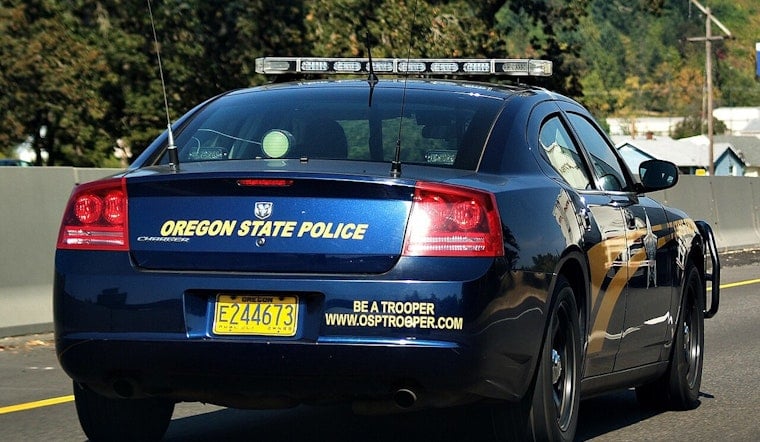
An 86-year-old Astoria man was killed Tuesday afternoon after his car was rear-ended and shoved into oncoming traffic on Highway 30 east of Astoria, triggering a chain-reaction crash that closed the highway for roughly five hours. Benny Roy Parker was stopped in his tan Chevy Malibu waiting to turn onto Valley Creek Lane when a gray Ford F-350 pickup slammed into the back of his car, according to Oregon State Police. Parker was ejected from the vehicle and pronounced dead at the scene.
The crash happened around 12:40 p.m. near milepost 80 in Clatsop County, about 16 miles east of Astoria, as reported by KOIN.com. The impact from the F-350, driven by 73-year-old Roger Dale McGilvey of Ocean Park, Washington, pushed Parker's Malibu into the westbound lane, where it was struck by a silver Honda Accord driven by 43-year-old Karl Edward Groenke, also of Ocean Park, according to The Daily Astorian. Both McGilvey and Groenke were seriously injured and taken to a local hospital.
Five-Hour Closure for Crash Reconstruction
Oregon State Police closed Highway 30 for approximately five hours while its Collision Reconstruction Unit documented the scene, per the same account. The unit relies on small unmanned aircraft systems and advanced electronic measurement tools to map fatal crash sites, and its investigators are ACTAR-accredited collision reconstructionists. The scale of the response reflected the severity of the pileup, which involved emergency crews from across the region.
On-scene work drew in the Clatsop County Sheriff's Office, Knappa Fire Department, Astoria Fire Department, Medix Ambulance, and Oregon Department of Transportation road crews, the Daily Astorian reported. Local fire and medical personnel handled care at the scene and helped manage traffic during the shutdown, illustrating the kind of multi-agency coordination rural highway crashes routinely demand.
A Familiar Hazard on a Rural Stretch
Highway 30 functions as a critical link between Portland and the northern Oregon coast, carrying heavy volumes of commuters, commercial trucks, and out-of-state drivers, according to the Daily Astorian. Stopping to turn onto rural side streets like Valley Creek Lane without a dedicated turn lane leaves vehicles vulnerable to being rear-ended and pushed into oncoming traffic — precisely the sequence investigators described in Tuesday's crash.
This is not the first deadly multi-vehicle wreck on this stretch of highway. In December 2024, a three-vehicle crash near milepost 77 — just three miles from Tuesday's site — killed one person after an unsafe pass near a fuel tanker and shut the highway down for eight hours. And in April, a head-on collision on Highway 30 near Rainier killed a driver and seriously injured two others, closing the corridor for six hours, according to Hoodline's earlier coverage.
Highways Carry Most of the County's Crash Toll
Nearly 70% of all injury crashes in Clatsop County in 2024 occurred on three state highways — Highway 30, Highway 101, and Highway 26 — contributing to 508 total traffic injuries countywide that year, according to the Seaside Signal. Clatsop County logged the highest number of injury crashes among surrounding Oregon counties that year.
Fixing known trouble spots is complicated by money. Clatsop County Public Works relies on state funding for roughly half its transportation budget, even as the Oregon Department of Transportation faces a $200 million statewide shortfall for the 2027–2029 cycle, including $79.8 million cut from road maintenance, the Seaside Signal reported. County crews maintain 217 miles of local roadway, leaving improvements like shoulder widening or turn lanes on rural highways competing for scarce state dollars.
The setbacks come against a mixed statewide safety picture. Oregon traffic fatalities totaled 539 in 2024 and an initial 487 in 2025, down from 587 in 2023, even as serious injury crashes have continued climbing, particularly at rural and local intersections, according to the Oregon Department of Transportation. Over the longer term, the state's roadway death rate has risen 51% between 2014 and 2024, reaching 1.46 deaths per 100 million vehicle miles traveled in 2024 — above the national average of 1.2, per research from TRIP.
Oregon State Police sorts high-risk crash causes into its “Fatal-5” enforcement framework, directing reconstruction teams and targeted patrols toward the primary factors behind fatal wrecks statewide, as Hoodline has previously reported. Tuesday's crash remains under investigation by the agency's Collision Reconstruction Unit.





