

























































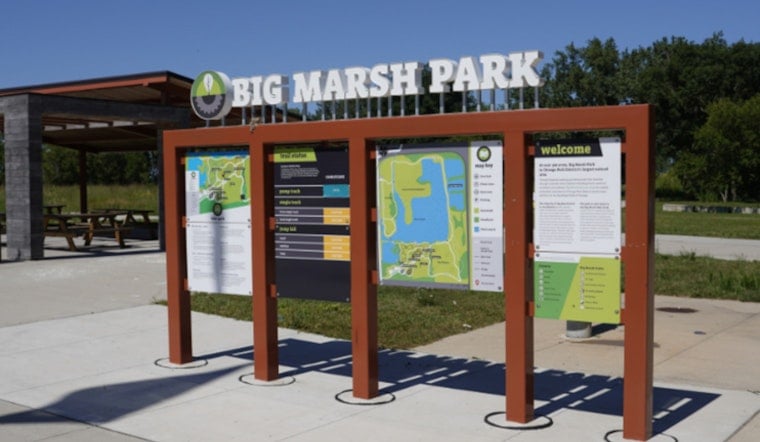
A jump line billed as the longest asphalt course of its kind in the nation opens Saturday at Big Marsh Park, finishing off a bike trail system that Chicago Park District planners first sketched out more than a decade ago. Known as Big Hill, the new feature caps a 12-year transformation of nearly 300 acres of Far Southeast Side land that was once used as a dumping ground for waste and slag from surrounding industrial operations.
The park district will officially open Big Hill along with an XL jump line built for advanced riders, according to WTTW News. The nonprofit Friends of Big Marsh raised $1.1 million to help construct the new features, and the group partnered directly with the park district to see the project through. Chicago Park District gained control of the Big Marsh land back in 2011, and the park didn't open to the public until 2016, after the site underwent environmental remediation.
A Southeast Side Cycling Hub Takes Shape
Ald. Carlos Ramirez-Rosa said the opening of the south jump hill establishes Chicago's Southeast Side as a hub for cycling culture, per the same WTTW report. Paul Fitzgerald, speaking for Friends of Big Marsh, said the organization aims to welcome more experienced bicyclists while making Big Marsh a world-class destination for riders of every skill level. The site already includes small and medium bike features designed for beginning and intermediate riders, so the new XL and asphalt jump lines fill out the range for more advanced visitors.
Visitors can bring their own bikes or rent them on site, and the completion of Big Hill marks the final project outlined in a 2014 framework plan for the park's bike trail system, the outlet reports. Big Marsh Park will mark the occasion Saturday with bike park tours running from 11 a.m. to 4 p.m., alongside pump track and single-track workshops scheduled from 11 a.m. to 2 p.m.
From Slag Heap to Marsh Restoration
Long before it hosted BMX riders and mountain bikers, Big Marsh was buried under industrial slag. Beginning in the late 19th century, neighboring steel mills dumped byproduct molten slag across the site, building up hardened, alkaline mineral deposits as deep as 15 feet that destroyed the native wetland habitat, according to the Chicago Botanic Garden. Fully excavating that slag was estimated to cost more than $200 million, so the Chicago Park District and Friends of Big Marsh instead capped it with an environmental barrier built from more than 2,500 truckloads of clean soil donated from city construction projects, as reported by REI Uncommon Path.
That engineering workaround paid unexpected dividends. In spring 2025, conservation scientists from the Chicago Botanic Garden successfully bloomed the federally threatened lakeside daisy directly in Big Marsh's nutrient-poor slag beds, demonstrating that post-industrial steel waste can host rare native plant communities. Today Big Marsh is also known as a popular birding site, and it's home to the Ford Calumet Environmental Center, a hub for the park's ecological programming.
Splitting the Land Between Riders and Wildlife
Of the park's nearly 300 acres, roughly 45 are dedicated to active eco-recreation, including 12 off-road bike trails spanning three miles, according to Chicago Park District records. The rest of the site is permanently preserved for passive wildlife conservation and marsh restoration, reflecting the dual mission planners built into the park from the start.
The Ford Calumet Environmental Center itself was constructed for $7.8 million, financed through a $3.7 million contribution from the Ford Motor Company, $2.7 million from the Chicago Park District, and $1.4 million in Chicago Tax Increment Financing funds, according to InsideHook. Architect Joseph Valerio of Valerio Dewalt Train designed the 9,300-square-foot building with 89% recycled Corten steel cladding to honor the neighborhood's steelmaking legacy, pairing it with interior Nail Laminated Timber and floor-to-ceiling windows engineered for bird safety, as detailed by ArchDaily.
Because the park sits roughly two miles from the municipal sewer grid, engineers at Biohabitats designed Chicago's first decentralized, on-site blackwater wetland treatment system for the center, capable of treating up to 4,000 gallons of wastewater per day using native marsh microbes and an elevated sand mound, according to the Illinois Green Alliance. To secure the building when staff are off site without sacrificing natural light during open hours, it also features 10-foot-square hydraulic steel hangar doors that pivot downward to fit flush against the exterior windows, per design specifications from Valerio Dewalt Train.
Gearing Up Without Your Own Bike
Riders without their own equipment can access the park's expanded trail network through the Big Marsh Outfitter shop, operated seven days a week by Friends of Big Marsh, which offers bike rentals, repair services, snacks and gear, according to the park's official site, bigmarsh.org. Big Marsh is part of a broader Chicago Park District push to reconnect Far Southeast Side communities to restored open space across the Calumet Area Reserve, which includes nearby sites like Indian Ridge Marsh, Hegewisch Marsh and the Marian R. Byrnes Natural Area.
The park's material palette is already influencing other projects nearby. Hoodline's recent coverage of the Steelworkers Park framework noted that a proposed multi-use building at that South Chicago site draws its weathered steel and earth berm design directly from the Ford Calumet Environmental Center. With Big Hill now finished, attention on the Far Southeast Side turns to long-term maintenance funding for the park's asphalt and dirt jump features and whether Big Marsh's brownfield-to-recreation model gets replicated elsewhere in the Calumet Area Reserve.





