

























































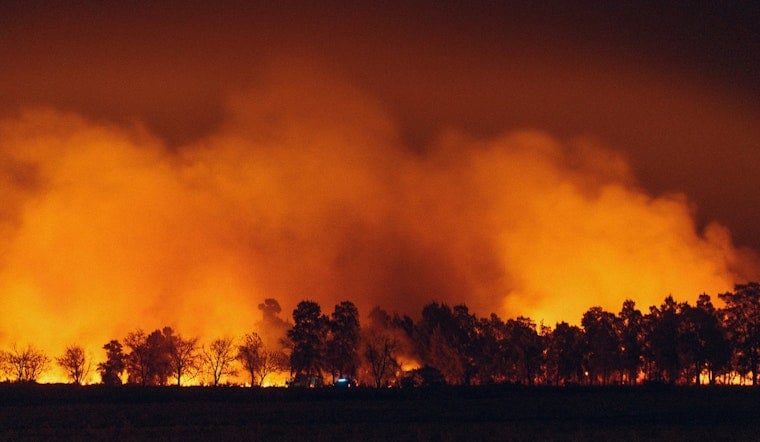
Smoke from wildfires burning along the California coast has drifted into Southern Nevada, prompting Clark County to issue an air quality advisory as particulate pollution climbs across the Las Vegas Valley. The haze arrived alongside a scorching 105-degree day, a combination that officials say raises the risk for anyone with breathing or heart trouble.
The smoke traced back primarily to the Plaskett Fire and Timber Fire burning near Big Sur, according to FOX5 Vegas. Those two blazes had collectively scorched more than 33,000 acres in Monterey County as of Sunday, per the Los Angeles Times. The Plaskett Fire ignited on August 25 and grew fast enough to force evacuations and shut down more than 40 miles of Highway 1.
What made this particular fire such a heavy smoke producer, the Times reports, is what it was burning through: vegetation that hadn't seen fire in roughly 55 years. That kind of long-unburned fuel bed tends to carry more dead material, which burns hotter and longer and throws off thicker combustion plumes capable of traveling hundreds of miles. As of Sunday, the Plaskett Fire was still just 1% contained.
A County Already Watching the Sky All Summer
The advisory itself isn't a one-off. Clark County runs a standing seasonal air quality program covering both ground-level ozone and wildfire smoke every year from April 1 through September 30, and 2026 marks the fourth straight year the county has issued combined smoke and ozone advisories under that framework. The Clark County Department of Environment and Sustainability monitors air pollution through a network of sites across the Las Vegas Valley and posts that monitoring data online.
Officials said residents should take precautions, and the county is pointing people toward its usual channels for updates: Clark County said residents can stay informed through Facebook, X and Instagram, through the AirNow mobile app, and through daily text and email alerts via EnviroFlash. Air quality forecasters reported that the smoke is increasing particulate matter pollution in the region.
Why Smoke and Heat Together Are Worse Than Either Alone
Sunday's high of 105 degrees at Harry Reid International Airport wasn't just uncomfortable — it was chemically significant, according to the National Weather Service. Wildfire smoke carries volatile organic compounds and nitrogen oxides that act as chemical precursors, and when those react with intense sunlight and summer heat, they accelerate the formation of ground-level ozone in urban desert basins, per Clark County. In other words, the smoke doesn't just reduce visibility — it can help cook up more smog once it's baked by the heat.
That matters because the Las Vegas Valley, formally known as Hydrographic Area 212, is already designated a moderate nonattainment area by the U.S. Environmental Protection Agency for the 2015 ozone standard. Persistent wildfire smoke surges complicate the county's efforts to meet those federal clean air mandates. During the 2025 seasonal advisory period, Clark County recorded 18 days when ground-level ozone exceeded EPA standards — an improvement from 25 exceedance days in 2024, but still a sign of how often this problem recurs.
Who's Most at Risk, and What the County Is Telling Them to Do
The Clark County smoke advisory lists people with respiratory problems, senior citizens, people with cardiac disease, and young children as most sensitive to elevated particulates and ozone. Smoke exposure can cause coughing, wheezing and shortness of breath, and it can aggravate existing respiratory diseases. Exercise increases the amount of particulates a person inhales, which is part of why the advisory recommends limiting outdoor exertion on days when fine-particulate levels are high.
Other recommendations include staying indoors when smoke is visible or can be smelled, keeping windows and doors closed, and changing indoor air filters when they get dirty. The advisory also recommends that residents with medical conditions that increase their sensitivity to air quality consult a physician. Smoke contains small particulates along with other pollutants, and as Hoodline previously reported, the fine particulate matter in that smoke measures 2.5 micrometers or smaller — roughly 30 times narrower than a human hair — small enough to slip past the nose's natural filtering and reach deep into the lungs and bloodstream, where it can trigger cardiovascular events as well as acute pulmonary distress.
Part of a Busy, Smoky Summer for Southern Nevada
Sunday's advisory is only the latest air quality headache for the region this season. Earlier this month, in-state wildfires — the Mouse Meadow and Quail Springs fires, which burned more than 51,000 acres on restricted Nevada military land — pushed their own smoke into Lincoln and Clark counties. On top of that, the Las Vegas Valley saw multiple dust advisories in August, including on August 10 and August 20, driven by monsoonal thunderstorm outflow winds blowing in from Arizona storms, according to the Las Vegas Review-Journal.
Taken together, the pattern points to a valley squeezed from multiple directions each summer: wildfire smoke drifting in from California, local Nevada fires, and Arizona-driven dust storms, all layered on top of the desert heat that helps turn smoke into smog. For now, Clark County's message to residents remains the same one it repeats each fire season — watch the air quality data, and take it seriously when the advisory says the smoke has arrived.





