

























































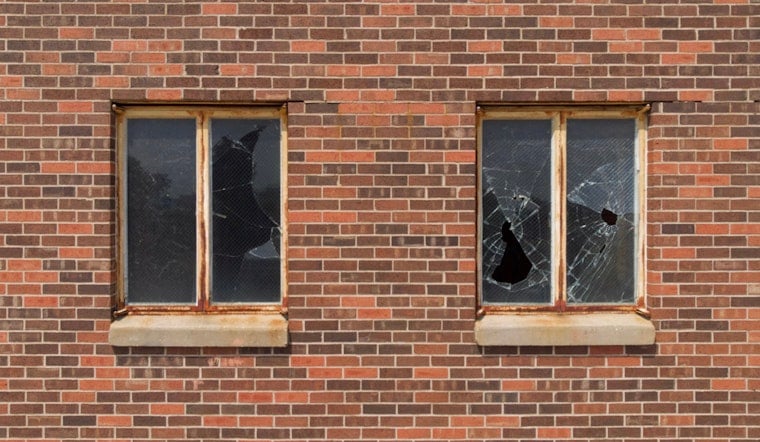
At a 335-bed men's shelter on Wards Island, windows that let in rain and cold air have gone unfixed for years, even as New York City records more people sleeping outdoors than in any of the past decade. The shelter, known as Schwartz, is run by Volunteers of America - Greater New York, and its long-pending window replacement request is one example providers point to when they say the city's shelter fix-it process is fundamentally broken.
As reported by Gothamist, the windows at Schwartz cannot be opened for fresh air or light, and they let in water and cold air when it storms. The city approved improvements to the shelter in 2016 after a decade of disrepair, and those renovations, which included dorm rooms and some common areas, are still underway; the window replacement request itself remains pending. Volunteers of America and the city are currently working out a budget and timeline for the remaining Schwartz repairs, according to the outlet's reporting.
The stalled windows are just one piece of a broader pattern described in a new report from Volunteers of America - Greater New York, authored by Kaitlin Abrams, detailing deteriorating conditions and a repair process that produces only patchwork fixes rather than addressing underlying infrastructure needs. The report recommends creating a dedicated fund for shelter renovations, conducting a citywide capital needs assessment, and transferring ownership of some city-owned shelters to nonprofit operators. Right now, the city has no dedicated pool of money for shelter repairs, and providers must request each fix individually, with the city approving both the work and the contractors who perform it.
A Repair Pipeline Providers Call Onerous
David Giffen said capital needs across the shelter system go unmet largely because the repair process itself is so onerous, per Gothamist's reporting. Jeffrey Ginsburg said even basic improvements can take months or years to win approval, and requests frequently bounce back and forth multiple times between agencies before anything gets done. In one case Gothamist described, the city emptied a family shelter entirely over fire safety concerns, and it has remained closed for two years.
The costs of delay run in both directions. Gothamist reported that replacing fire panels at one site would cost $800,000, while the city has instead hired personnel to guard against fire risk at the vacated shelter — a workaround costing $3 million a year. Providers argue that patchwork fixes like these end up costing taxpayers more in the long run than addressing the underlying infrastructure problems outright.
Not every fix is stuck in limbo. Help USA installed air conditioning at one of its Wards Island men's shelters this year, and the outlet reported that the upgrade led to a sharp decline in incidents at the site. Volunteers of America has also found small ways to make conditions more livable within the system's constraints — the outlet described the organization providing a side table and lamp for a mother whose child was sleeping, which let her keep working and apply for a job while her child rested nearby.
Decades-Old Buildings, a Modern Mandate
New York's shelter system traces its legal roots to the 1981 Callahan v. Carey consent decree, which established a constitutional obligation under Article XVII of the New York State Constitution to provide emergency shelter beds, according to the Legal Aid Society. Courts later expanded that right to cover women in 1983 and families with children in 1986. What began as an emergency response more than 40 years ago, in the 1980s, led the city to convert institutional buildings — including former schools, prisons and psychiatric wards — into congregate shelters, many of which remain in use today.
Those aging facilities often mean noisy, smelly conditions with little space for children to do homework or for residents to decompress, featuring fluorescent lights, metal bunk beds, ceiling tiles and large congregate dormitories, Gothamist reported. Nicholas Jacobelli said the Mamdani administration inherited a shelter system built largely from these older, often repurposed buildings. Dan Lehman said the city needs to focus on shelter quality as much as on raw capacity, since the two goals have historically been in tension — the city has long prioritized adding beds as its shelter population grew, sometimes at the expense of the buildings' physical condition.
Record Homelessness Meets a Slow Fix-It System
The stakes of that tension have only grown. New York City's shelter population is at a record high, and Gothamist reported that more people are sleeping outdoors than in any of the previous 10 years. Advocates for Children of New York found that a record 154,000 NYC public school students experienced homelessness during the 2024–2025 school year, with roughly 65,000 living directly in city shelters — the tenth consecutive year the figure has topped 100,000. Meanwhile, a March 2026 audit from the Office of the New York State Comptroller found the city spent nearly $368 million on unsheltered homeless services in fiscal year 2025 — more than triple its 2019 spending — as the street homeless population rose 26% to 4,504 people, averaging $81,750 per unsheltered individual. That same office's earlier 2023 follow-up audit had already found that while the Department of Homeless Services oversaw 455 shelters, it lacked tailored capital planning policies and strong project monitoring controls, resulting in chronic repair delays and shutdowns.
The Department of Homeless Services told Gothamist that it conducts regular shelter inspections and works with providers to address necessary repairs, and said the Mamdani administration has taken meaningful steps to transform the shelter system. Officials have shuttered at least one massive, decrepit shelter, and the administration has embraced construction of new trauma-informed facilities, arguing that better-designed sites help stabilize residents faster and move them out of shelter sooner. Hoodline has reported on one such intake center in Brooklyn, as well as the city's hotel shelter contract aimed at preserving emergency capacity.
Shelter providers, for their part, say those newer projects don't solve the deeper problem: the city still needs a comprehensive plan to fund and repair hundreds of existing shelters, not just build a handful of new ones. Some shelter improvement projects get pushed off for another year while requests wind through the approval process, and providers say the delays ultimately drive some people to sleep on the street rather than endure the conditions inside. Communities near proposed new shelter sites have also pushed back, delaying or suing to stop projects in their neighborhoods — a dynamic Hoodline covered in a recent Brooklyn lawsuit over a planned 200-bed conversion.





