

























































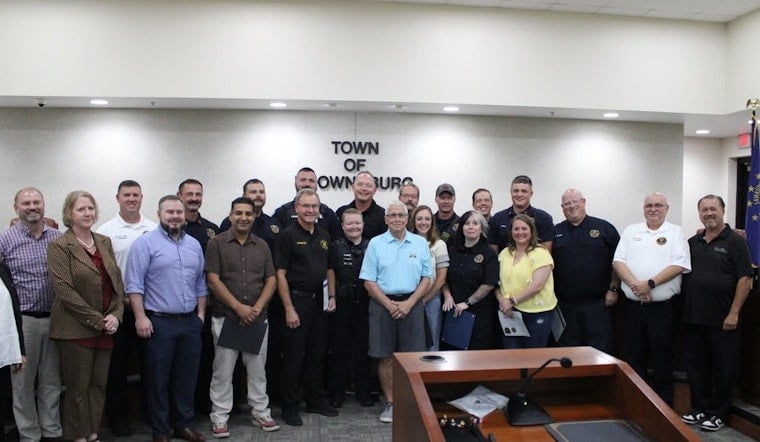
When Gary Shultz's car was involved in a crash on Main Street west of Green Street on April 14, 2026, he went into cardiac arrest — and it was four ordinary bystanders who acted first, starting CPR before Brownsburg Fire Territory crews or Brownsburg Police Department officers ever reached the scene. Months later, Shultz stood before those same rescuers and handed them lifesaving awards for what they did that day.
According to a statement from Brownsburg Fire Territory, witnesses Howard Stermer, Kristin Burton, Malorie Ward, and Dr. Ashwani Sharma recognized something was seriously wrong with Shultz and immediately began CPR before any responders arrived. Brownsburg Police Department officers arrived shortly after dispatch and continued lifesaving efforts, including deploying an automated external defibrillator, with Officer Heather Foote and Officer Eustace Mlagan recognizing the need for the device. When fire territory crews arrived, they took over care from the officers, continuing resuscitation and providing advanced life support.
A Pulse Returns, and a Medical Director Steps In
Dr. Jim Nossett, the Brownsburg Fire Territory's medical director, was on scene to provide what the department's statement called crucial on-scene medical direction, assisting the paramedics and firefighters caring for Shultz. Through the combined efforts of everyone involved, Shultz regained a pulse and spontaneous circulation and was transported emergently to a local hospital for further care, the fire territory said.
The department framed the outcome as proof of what happens when citizens, police officers, firefighters, EMTs, and paramedics work toward the same goal. Tonight, because of the selfless efforts of Howard, Kristin, Malorie, Dr. Sharma, Officer Foote, Officer Mlagan, Dr. Nossett, and the crews of Brownsburg Fire Territory, Mr. Gary Shultz is here tonight to present lifesaving awards to those involved in his resuscitation, the department said in its statement.
Why Every Second Mattered
The department's statement cited American Heart Association data showing that without immediate bystander CPR, survival chances can be as low as 1.9%, but immediate bystander CPR can double or even triple that survival rate — and early defibrillation combined with high-quality CPR pushes those odds even higher. National registry data reviewed in a 2025 peer-reviewed study of the Cardiac Arrest Registry to Enhance Survival, or CARES, backs that urgency: initiating bystander CPR within the first two minutes of a witnessed cardiac arrest offers the best odds of survival to hospital discharge and favorable neurological recovery, according to research indexed on PubMed. Survival odds diminish by roughly 10% for every minute that CPR and defibrillation are delayed, per that research.
The setting of the crash may have also worked in Shultz's favor. American Heart Association data compiled by the Sudden Cardiac Arrest Foundation shows cardiac arrests in public locations like streets or roadways achieve a 21.1% survival rate to hospital discharge, more than double the 8.9% survival rate for arrests in residential settings, largely because public incidents bring faster witness recognition and quicker access to AEDs. Broader national trends point the same direction: American Red Cross reporting on CARES registry data found that 42.5% of out-of-hospital cardiac arrest victims received bystander CPR in 2024-2025, a record high since 2016, while bystander AED use in public settings reached 13.9%.
Legal Protections Behind the Bystanders' Actions
The four civilians who stepped in before help arrived were acting under Indiana's Good Samaritan framework. Indiana Code § 34-30-12-1 grants civil immunity from personal injury damages to anyone who, in good faith, gratuitously renders emergency care — including CPR — at the scene of an accident or emergency, so long as their actions do not amount to gross negligence or willful misconduct, according to Poynter & Bucheri. Those same protections extend to lay rescuers and untrained users who deploy AEDs under Indiana Code § 16-31-6.5, per legal background compiled by AED Superstore, while separately requiring AED-owning entities to maintain their equipment and notify local EMS agencies of unit locations.
A Department Built for Rapid Response
Brownsburg Fire Territory, established in 1995 as Indiana's first fire protection territory, traces its roots to a volunteer department founded in 1923 and now covers a 52-square-mile service area spanning the Town of Brownsburg, Brown Township, and Lincoln Township in Hendricks County. The agency holds an ISO Class 1 rating, the highest public protection classification issued, and operates three fire stations with more than 90 full-time personnel, staffing every dispatched ambulance with at least one state-licensed paramedic, according to the Town of Brownsburg. The department also routinely hosts public education programs, including certified CPR, First Aid, and Child Passenger Safety classes for local residents — training that builds exactly the kind of prepared bystander network that responded on Main Street.
The response comes as the agency continues to invest in its emergency medical capacity. In August, the Brownsburg Fire Territory board approved a $16,263,750 operating budget for 2027, maintaining EMS staffing investments and setting aside reserves to support future station development in Hendricks County, according to Citizen Portal. Brownsburg Fire Territory can be reached at 317.852.1190 or through its website, brownsburgfire.org.




