

























































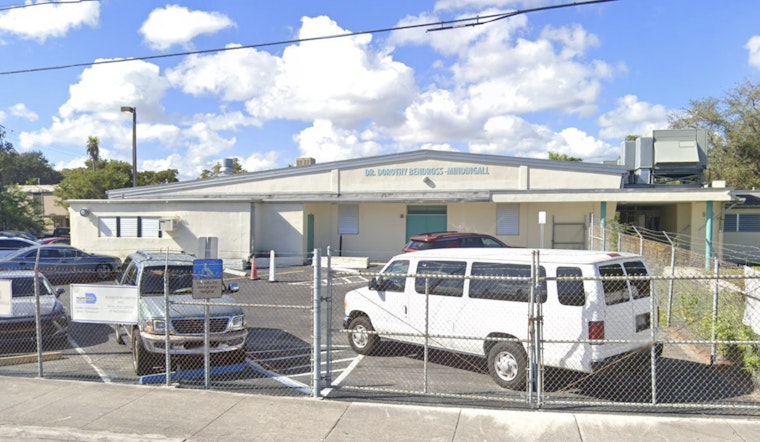
Food trucks, free Narcan, and a live hip-hop performance shared space with a pointed question at the Dr. Dorothy Bendross-Mindingall Social and Economic Institute in Brownsville last Saturday: who actually profits from hip-hop and the Black creativity that built it? The third annual S.H.E.A.R. Inc. Black Business Expo, held Aug. 8, expanded this year to include a hip-hop summit that put record labels, distributors, and the culture's own contradictions under the microscope.
The event, hosted by S.H.E.A.R. Inc. President and CEO Anthony Durden, brought together speakers, performers, community leaders, music executives, and entrepreneurs, according to The Miami Times. Durden said he planned the gathering to bring people together, share information and expertise, and promote accountability. His path to that role began after two decades battling drug and alcohol addiction and 14 years in prison, a journey he turned around in 2006 when he graduated from the Miami Rescue Mission's Regeneration Discipleship Program, according to VoyageMIA. S.H.E.A.R. Inc. — Sharing Hope, Empowerment and Reaction — was built on the belief that people who have lived through addiction, incarceration, and street life can lead others out of those same circumstances, and the nonprofit has been incorporated in Florida since August 2007, according to state corporate records.
A Panel Built Around a Trillion-Dollar Question
The hip-hop summit, moderated by Circle of Brotherhood member Faisal X. Tavernier, focused squarely on the intersection of culture and commerce. Panelists took turns confronting how a trillion-dollar industry built largely on Black creativity, struggle, and influence has also reshaped — and at times damaged — the very communities that created it, per the Miami Times report. Ruban Roberts, CEO of RER Consulting, told the panel hip-hop began as an early form of social commentary about events unfolding in Black communities, while hip-hop culture more broadly has also produced millionaires and music moguls.
Motivational speaker and life coach Derrick 2.0, who works with the Confident Voices Movement, said music was his voice and a window into community life before YouTube and Instagram existed. Author and mentor Shane “Zulu” Shepherd argued that reducing demand is necessary to reduce the supply of violent music, pointing to how music distributors and record labels have influenced misogyny and violence within the genre. Dr. Tania Guerrier, a psychiatric mental health nurse practitioner who also served as a panelist, warned that children may not know how to separate entertainment from reality.
Funding Cuts Force Layoffs Even as Turnout Grows
Behind the expo's programming sits a nonprofit under financial strain. S.H.E.A.R. Inc. has suffered millions of dollars in funding cuts under the current administration, forcing the organization to furlough staff and lay off about half its workforce, the Miami Times reported. Those cuts have hit programs that reach into jails and prisons, local schools, homeless shelters, and rehabilitation centers — the same outreach network Durden built his mission around.
The squeeze on S.H.E.A.R. Inc. mirrors a wider pattern across Miami's grassroots organizations. The Circle of Brotherhood, the group whose member moderated the summit, staged public rallies last May to protest federal budget shortfalls threatening local violence-prevention and re-entry programs, according to WLRN. That group, founded in 2013 as a grassroots organization of Black men in Miami, was previously awarded a $2 million federal Department of Justice grant in 2023 for community violence intervention, as reported by Caplin News at FIU. Durden has sought partnerships with local government and officials to direct more resources into neighborhoods like Brownsville, even as Black entrepreneurs broadly adjust to the current presidential administration's rollback of financial resources.
Vendors, Books, and a Dance Crew Fill Out the Expo Floor
Beyond the panel discussions, the expo carried the feel of a neighborhood festival. Food trucks and local vendors lined the grounds, dancers from Krump305 performed, and local hip-hop musicians played live sets. Attendees could also pick up free Narcan and browse books for sale, including Jay Thomas's “If the Walls Could Talk, Would You Listen?” The gathering doubled as the unofficial local kickoff to National Black Business Month, a designation founded in August 2004 by historian John William Templeton and engineer Frederick E. Jordan Sr. to spotlight the economic contributions of Black entrepreneurs and confront capital access disparities, according to the U.S. Black Chamber of Commerce.
The Miami Times described the combined expo and summit as a historic event, one that organizers hope will keep growing even as the nonprofit behind it fights for funding. The stakes extend well beyond one Saturday event: Miami-Dade County ranks fifth in the nation for the largest number of Black-owned employer businesses, with more than 51,000 firms generating over $2.3 billion in annual revenue, according to Miami-Dade County. Black-owned firms make up roughly 11 percent of all businesses in the county, a figure that underscores why Durden's push for partnerships and resources carries weight far beyond Brownsville.
A Neighborhood in Transition Hosts the Conversation
The venue itself carries its own civic history. The Dr. Dorothy Bendross-Mindingall Social and Economic Institute opened in June 2018 to provide youth education, job training, and grant administration for local entrepreneurs, and it now houses organizations such as the Neighbors and Neighbors Association that support small business development, according to Miami-Dade County Public Schools. That mission of economic uplift is unfolding as Brownsville itself faces rising real estate pressure, with median home sale prices hitting $474,616 in mid-2026 and at least one historic home listed for $700,000.
County officials have tried to counter that pressure with public investment, breaking ground in July 2024 on Phase V of the Brownsville Transit Village, which is adding 120 low-income units next to the neighborhood's Metrorail station as part of a multi-phase development that has delivered over 500 affordable units since 2014. Brownsville is also home to Georgette's Tea Room House, a historic 13-room guesthouse that sheltered Black entertainers during segregation and has undergone structural restoration to become a community cultural space — a legacy that echoes the expo's own questions about who benefits from Black cultural production, and who gets left behind.





