

























































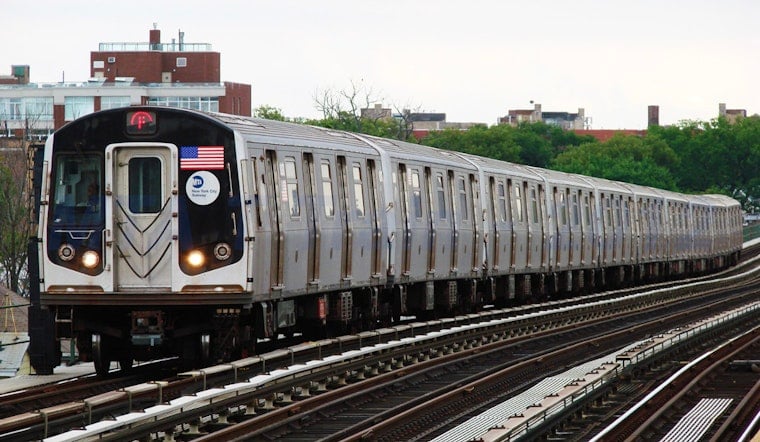
A signal problem near Carroll Street in Carroll Gardens threw Monday morning's commute into disarray, forcing the MTA to reroute F trains onto D tracks and cut G service short at Bedford-Nostrand Avenues. The agency reported that both the F and G lines were severely disrupted due to the malfunction, leaving Brooklyn-to-Manhattan riders scrambling for alternate routes during the height of rush hour.
According to the MTA, uptown F trains are running via the D line from Coney Island-Stillwell Avenue to West 4th Street-Washington Square, and running express from Church Avenue to Jay Street-MetroTech in the meantime, as reported by PIX11. Downtown F trains are turning around at 2nd Avenue for uptown service, while Church Avenue-bound G trains are stopping short at Bedford-Nostrand Avenues before heading back toward Court Square. Uptown D trains are also facing delays as they share tracks with the rerouted F trains.
Riders trying to get between Brooklyn and Manhattan are being encouraged to use the A, B, C, D, N, Q, R, J, L, and M trains instead, per the MTA. Commuters can also transfer between F trains and the B, D, and M lines at West 4th Street-Washington Square. The agency is urging riders to check its website or app for the latest updates as crews work through the disruption.
A Corridor Already Under Construction
The timing is no coincidence. The MTA had scheduled planned G train service changes and partial suspensions between Hoyt-Schermerhorn Streets and Church Avenue from late Friday night through early Monday morning to carry out ongoing signal modernization work along the Crosstown Line, according to the MTA. Crews were installing support cables and signaling hardware during that weekend work window, meaning Monday's failure landed right at the handoff between planned maintenance and normal weekday service.
Carroll Street itself is no minor stop. The four-track underground station at Smith and Carroll Streets opened in October 1933 and processed over 2.7 million riders in 2024, ranking 130th out of 423 stations citywide by annual volume, per Wikipedia. It sits on the IND Culver Line, a corridor now at the center of a $253 million effort to replace 70-year-old block signaling with communications-based train control between Church Avenue and Coney Island, according to industry outlet RITD LLC.
Why One Fault Ripples Across Brooklyn
Brooklyn's subway geometry makes a single signal fault expensive in delay minutes. An MTA planning assessment identified 27 critical Brooklyn bottlenecks, noting that interlocking junctions like DeKalb Avenue and Nostrand Junction force merging trains to hold, turning localized signal trouble into borough-wide disruptions, Hoodline previously reported. Senior transit planners noted that DeKalb Avenue merges alone force B, D, N, and Q trains to wait for crossing movements, a dynamic that helps explain why a Carroll Street glitch could push delays onto uptown D trains sharing track with rerouted F service.
Systemwide data underscores how common these failures have become. An analysis of MTA figures published by Crain's New York Business found that 1,892 signal malfunctions caused train delays in the first six months of 2025 alone, while active signal upgrade work by transit crews caused another 542 delay incidents, an 8% increase over the prior year. Every major signal modernization effort in the city is running years behind schedule, with the F line upgrade in southern Brooklyn delayed by three years and the G line project pushed to July 2029, according to Time Out.
A Modernization Marathon With No Quick Fix
The MTA's board-approved $68.4 billion 2025-2029 Capital Plan puts more than 90% of its budget toward state-of-good-repair projects, including modernizing signals along more than 75 miles of track specifically to cut down on these cascading delays. The agency has also reported cutting the cost of installing communications-based train control from $50 million per mile to $25 million per mile by adopting 5G radio connectivity and streamlining coordination between MTA Construction & Development and NYC Transit, Streetsblog New York City reported. The G line project served as the first CBTC upgrade to fully strip out legacy signal hardware.
Even new digital systems aren't a permanent fix. Communications-based train control carries a shorter operational lifespan than the 1930s mechanical signals it replaces, requiring full replacement of zone controllers, servers, and software every 20 to 25 years, according to trade publication Railway Supply. The subway's pioneer CBTC line, the L train installation from the early 2000s, is already set to reach end of life in 2028.
Monday's disruption also arrives amid a summer already crowded with maintenance elsewhere in the system. The MTA has run a monthlong series of weekend and weeknight suspensions on the 1, 2, and 3 lines from July 20 through August 24 for switch replacements north of Chambers Street, cutting off the 3 train entirely at times and scaling back 1 and 2 train service. It is unclear whether the Carroll Street signal component that failed was part of the legacy fixed-block system or newly installed CBTC hardware, and the MTA has not said how quickly crews resolved the fault on scene.
Hoodline has covered similar signal-driven meltdowns before, including a rush-hour subway meltdown across the E, F, M, and R lines in May that also forced F trains onto G tracks, and an April incident tied to signal trouble near Nevins Street and the Williamsburg Bridge. Riders navigating Monday's disruption are advised to plan for extended travel times and to monitor the MTA's channels directly as crews continue work along the corridor.





