

























































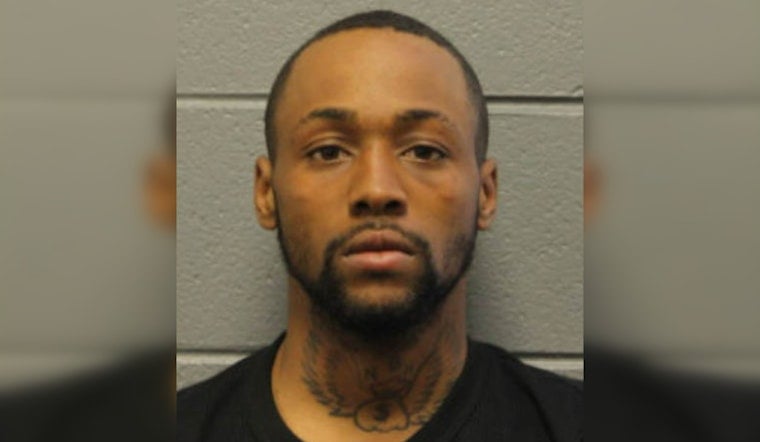
A Chicago man has been sentenced to 28 years in prison for a murder he committed while supposedly confined to his home under 24/7 electronic monitoring. Keyon Hayes pleaded guilty to killing 33-year-old Michael Corbitt, who died about a week after being shot in the head and knee during a chaotic confrontation on the 1100 block of North Massasoit Avenue in the Austin neighborhood.
According to CWB Chicago, Hayes went to a location in March 2022 where his ex-girlfriend and two friends were gathered. Court records show he had texted her a threat beforehand, telling her, “So you going to ignore me? Don't say nothing when you die.” Prosecutors said Hayes fired shots into the home from the street, and the outlet reports he fired several rounds at his ex-girlfriend and one of her friends. His ex-girlfriend was not hurt, and the other man who witnessed the shooting also escaped injury, though Corbitt was struck and later died of his wounds, per the Cook County Medical Examiner's Office, as reported by Fox 32 Chicago.
A Curfew That Couldn't Track Him
At the time of the shooting, Hayes was subject to 24/7 electronic monitoring enforced by an ankle monitor, a program then administered by the office of Chief Judge Timothy Evans. The report notes that the monitoring system relied on radio-frequency base stations connected to residential landlines or cellular networks, which only confirmed whether someone was inside their home during curfew hours rather than tracking their real-time location — a technical gap that allowed Hayes to leave undetected and travel to the shooting scene, according to the Circuit Court of Cook County.
Hayes had landed on that curfew after a November 2021 arrest for carrying a black satchel containing a handgun with an extended ammunition magazine. Bond court Judge Charles Beach II warned him at the time that possessing a weapon was “the fastest way to go down in a spiral,” setting bail at $3,000 with a $300 cash deposit that Hayes could not afford, according to court dialogue relayed by CWB Chicago's managing partner Tim Hecke. Hayes had asked to be released to enter the Job Corps; Judge Peggy Chiampas ultimately approved his release on his own recognizance with the 24/7 curfew, court records show, and Hayes still had a pending felony manufacture-delivery case when the murder occurred.
From Shooting to Foot Chase
ShotSpotter technology and 911 calls sent police to the scene of the March 2022 shooting, and officers arrested Hayes nearby after a short foot chase. Police recovered a handgun Hayes had dropped while running, and preliminary tests matched the weapon to five shell casings found at the scene, the same account states. Chicago police initially booked Hayes on aggravated battery with a firearm and three counts of attempted first-degree murder, and Judge Maryam Ahmad denied him bail on March 29, 2022, according to Fox 32 Chicago; prosecutors upgraded the charge to first-degree murder on April 5, 2022, after Corbitt died.
While awaiting trial at the Cook County Jail, Hayes picked up an additional charge — aggravated battery of a sheriff's employee — to which he also pleaded guilty. Judge Jennifer Coleman sentenced him to four years on that count, to be served consecutively to his murder sentence, per the report. Under the Illinois Unified Code of Corrections, sentences for battery against a sheriff's employee committed while incarcerated must run consecutively to any underlying felony sentence, and Hayes must serve 50% of that four-year term.
No Early Release Under State Law
The murder sentence carries no such possibility of reduction. Under Illinois' Truth-in-Sentencing statute, anyone convicted of first-degree murder must serve 100% of their court-imposed prison term and is statutorily barred from early release through good-conduct credits, according to the Illinois Department of Corrections. That's a sharp departure from the era before the law took effect in the late 1990s, when people convicted of first-degree murder in Illinois served on average less than 40% to 44% of their sentences because of day-for-day good behavior credits, according to the Illinois Criminal Justice Information Authority.
As part of the plea deal, prosecutors dropped the felony gun case and the felony manufacture-delivery case Hayes had pending at the time of the murder, CWB Chicago reported. The outlet also tracked Hayes as the 12th person in Chicago in 2022 charged with killing or shooting someone — or attempting to — while awaiting trial on a pending felony charge; those dozen cases involved at least 21 victims and five fatalities through late March of that year.
A System Still Under Scrutiny
The gaps exposed by Hayes' case have persisted into broader oversight concerns. In May, Chief Judge Charles Beach II testified to the Cook County Board that roughly 8% of the nearly 3,000 defendants in Cook County's electronic monitoring programs — 243 people — were unaccounted for or missing, a group that included 21 individuals charged with murder and 13 charged with attempted murder. The figures illustrate a pretrial supervision system still grappling with the same monitoring limitations that let Hayes slip away from his own curfew years earlier.





