

























































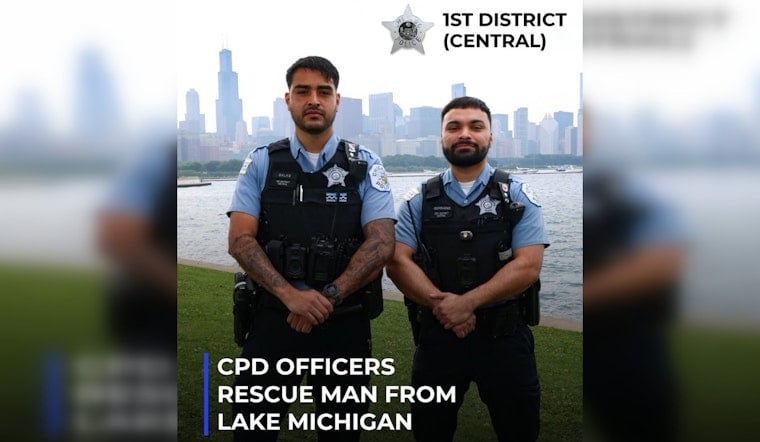
A 59-year-old man was struggling in Lake Michigan, unable to swim to shore, when two Chicago police officers reached him in less than three minutes and hauled him bodily over a concrete breakwall to safety. The rescue happened on August 4 in the 500 block of South Lake Shore Drive, a stretch of downtown shoreline where Grant Park's stone and concrete edges drop straight into deep water with no gradual beach entry.
The Chicago Police Department is now recognizing 1st District officers Orlando Salas and Armando Serrano for the rescue, according to a statement from Chicago Police. The department said the officers responded to a marine distress call and found the man unable to reach shore on his own. Salas and Serrano searched the area, located him in under three minutes, and lowered themselves over the breakwall to pull him from the water, per the same account. The man was stabilized at the scene and declined further medical evaluation, the department said.
A Breakwall With a Difficult History
The 1st District, which patrols downtown Chicago including the Loop, Grant Park, and the shoreline south to 31st Street, operates out of headquarters at 1718 South State Street and covers exactly the kind of hardened waterfront where this rescue unfolded. That stretch of shoreline near Queen's Landing has seen trouble before: in March 2019, Chicago police Marine Unit officers recovered a deceased individual from the lake just 15 feet from shore in the same 500 block, a reminder that these engineered seawalls offer little forgiveness to anyone who ends up in the water.
Water safety experts note that concrete harbor breakwalls along Chicago's lakefront are especially dangerous because their steep drop-offs into deep, turbulent water prevent a struggling swimmer from climbing out without outside help or flotation equipment, as Hoodline has reported. Sudden immersion in cold lake water can also trigger rapid muscle fatigue and panic, which helps explain why the officers' sub-three-minute response mattered so much in this case.
Beat Officers Often Arrive First
While the Chicago Police Marine Unit maintains specialized dive teams and patrol boats covering 28 miles of lakefront and 38 miles of riverways, it is typically beat officers on land who reach the scene first, before boats or divers can deploy. That dynamic played out again over the July 4 weekend, when off-duty Sergeant Christoria King rescued four boaters clinging to a sinking vessel near the 31st Street Harbor breakwall in dense fog, according to ABC 7 Chicago.
Coverage gaps compound the risk. Chicago Park District lifeguards staff designated beaches only between 11 a.m. and 7 p.m. during the summer, leaving early mornings, evenings, and stretches like the Grant Park breakwall dependent on police and fire crews or bystanders when emergencies strike, as Hoodline has previously detailed. State lawmakers addressed part of that gap in 2022, when Illinois passed a law requiring public and private entities that maintain piers and waterfront drop-off points along Lake Michigan to install accessible flotation devices and life rings, following years of advocacy for rescue gear at unsanctioned swimming spots.
Lake Michigan Remains the Deadliest Great Lake
The August 4 rescue lands within a grim statistical pattern. The Great Lakes Surf Rescue Project had recorded 23 fatal drownings in Lake Michigan as of late July, out of 46 total drowning deaths across all five Great Lakes so far this year. Lake Michigan has consistently led the Great Lakes in drownings, accounting for 44 of 77 deaths basin-wide in 2024 and 36 of 81 in 2025, according to Bridge Michigan.
Hoodline has covered a string of Lake Michigan emergencies along Chicago's lakefront this summer, including a fatal fall off concrete harbor walls near 31st Street Beach and an off-duty Aurora firefighter's rescue of a father and son from the water. Against that backdrop, the Chicago Police Department framed the August 4 rescue of the 59-year-old man as an example, in the department's words, of what it means to serve and protect when every second counts.




