

























































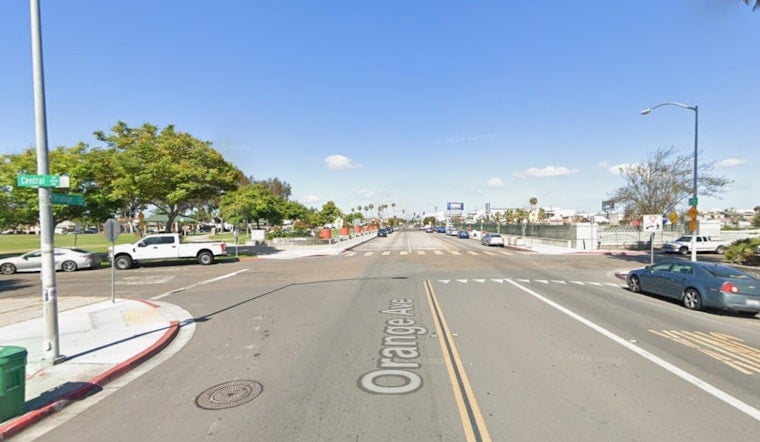
Shovels finally hit dirt this week on two long-awaited street safety projects designed to slow traffic and add protected bike lanes through City Heights, Kensington and Normal Heights. SANDAG broke ground on complete streets projects along Orange Avenue and Central Avenue yesterday, moving forward on plans that will add buffered and separated bike lanes, enhanced sidewalks, raised crosswalks and repairs to potholes and aging pavement throughout the corridor.
The 2.1-mile Orange Avenue Complete Streets project runs between 32nd Street and Estrella Avenue, connecting North Park, Normal Heights and City Heights, according to CBS 8. The project will feature median islands, traffic diverters, curb extensions and a traffic circle, and it's expected to open in 2028. As reported by FOX 5 San Diego & KUSI News, San Diego City Council President Sean Elo-Rivera, who represents District 9, said the projects focus on improving safety and creating better neighborhood connections.
Central Avenue Construction Set to Start Within Weeks
The Central Avenue Complete Streets project covers a 1-mile corridor along Adams Avenue in Kensington, continuing south along Terrace Drive and Central Avenue to Landis Street. Per CBS 8's reporting, that segment will get a separated bikeway, a cul-de-sac, curb extensions, enhanced crosswalks and traffic signal upgrades, with construction on Central Avenue expected to begin within the next month and the project scheduled to open in 2027.
Together, the two projects will add more than three miles to the region's bikeway network, part of a larger regional system that will eventually connect City Heights, Kensington, Normal Heights, North Park and La Mesa. City Heights resident Edwin Lohr told the outlet the projects will improve safety and slow cars down, echoing what neighbors have pushed for as traffic has worsened along local corridors.
A Decade in the Making
The Orange and Central avenue bikeways trace back to SANDAG's Regional Bike Plan Early Action Program, a $200 million initiative the agency's board approved in September 2013 to build roughly 77 miles of high-priority bikeways, according to SANDAG. The Central Avenue project also faced a more recent bureaucratic hurdle: in December 2025, the California Transportation Commission approved a 12-month extension through the end of 2026 for SANDAG to award the construction contract for a $2,834,000 state Active Transportation Program grant funding the bikeway, after encroachment permit delays held things up.
SANDAG says the Orange and Central avenue groundbreakings are two of seven complete streets projects currently underway across San Diego County, part of a buildout encompassing more than 21 miles of connected multi-modal corridors under construction. The scale reflects a countywide push to link neighborhood centers, transit hubs and schools with safer active transportation routes.
Why City Heights Needs the Upgrades
The urgency behind these projects is rooted in local safety data. A City of San Diego pedestrian collision analysis found that residents in dense, walkable neighborhoods such as City Heights, Downtown and Southeastern San Diego are 10 times more likely to be struck by a vehicle than residents in lower-density communities. Preliminary traffic safety data compiled by SANDAG and cited by the Times of San Diego found that 96 pedestrians and 12 bicyclists were killed on streets across San Diego County in 2025.
SANDAG's own traffic safety analysis shows just 6% of the county's road mileage accounts for 54% of all fatal and serious-injury crashes, with Mid-City arterials like El Cajon Boulevard and University Avenue consistently ranking among the highest-crash corridors, according to ThatCarHitMe.com. Orange and Central avenues run parallel to those higher-crash corridors, offering calmer alternate routes for people walking and biking.
The stakes extend beyond individual streets. A 10-year retrospective from policy advocacy group Circulate San Diego found that non-motorist traffic deaths in the City of San Diego rose from 25 in 2014 to 37 in 2023, falling short of the city's 2015 Vision Zero pledge to eliminate traffic fatalities by 2025. A San Diego County Grand Jury report on bicycle mobility also identified structural gaps in the city's cycling infrastructure, noting that bike lanes frequently end abruptly or lack physical barriers separating riders from vehicle traffic — a problem the buffered and separated designs on Orange and Central avenues are meant to address.
Part of a Bigger Mid-City Vision
The timing lines up with San Diego's broader plans for the area. As Hoodline previously reported, the draft Mid-City Communities Plan update covering City Heights, Normal Heights and Kensington-Talmadge envisions as many as 30,000 new housing units in the area and explicitly cites the Central Avenue Bikeway and a related SR-15 bike corridor as foundational infrastructure for that anticipated growth. With construction now underway on Orange and Central avenues, city and regional planners are betting that safer streets can keep pace with a denser Mid-City in the years ahead.





