

























































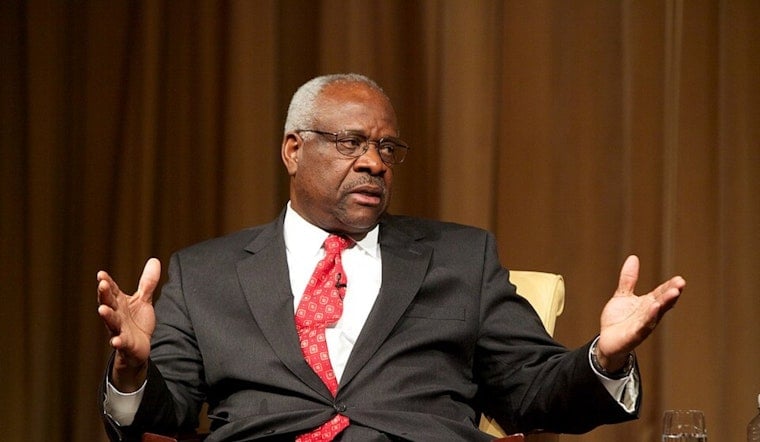
Supreme Court Justice Clarence Thomas told an audience at the Hoover Institution that elite law schools like Stanford are presumptively off limits to conservative figures like him, prompting Stanford to publicly counter that it would be honored to host him. The exchange has reignited a long-simmering fight over free speech and ideological diversity at one of the country's top law schools.
Thomas made the remarks during an August 11 interview with Hoover fellow Peter Robinson, part of a forum honoring 96-year-old conservative economist Thomas Sowell, according to the Hoover Institution. Thomas credited Sowell with giving him intellectual independence early in his legal career. He also said that while he had visited Yale Law School — his own alma mater, which he has criticized for decades over affirmative action and what he describes as hostility to conservative viewpoints — he had never set foot on Stanford's law campus, as reported by the Palo Alto Daily Post.
Stanford did not let the claim sit unanswered. The university said it would be honored to host Justice Thomas at Stanford Law School, noting that its Constitutional Law Center, directed by former Tenth Circuit judge Michael McConnell, regularly hosts members of the judiciary on campus. The university added that Stanford students and faculty would welcome the opportunity to hear from Thomas and engage with his perspectives on the court, the Constitution and the law, per the same account. The Daily Beast characterized the university's response as a direct rebuttal to Thomas's claim of exclusion.
The 2023 Incident That Still Haunts Stanford Law
Thomas's grievance traces back to March 9, 2023, when Fifth Circuit Judge Kyle Duncan was invited by Stanford's Federalist Society chapter to deliver a talk titled “Guns, Covid, and Twitter.” A group of roughly 90 law students prevented Duncan, a federal appeals court judge, from completing his speech, according to the Palo Alto Daily Post. Stanford students affiliated with LGBTQ groups backlashed against Duncan's appearance, and two of those groups had demanded he instead address students remotely over Zoom.
Tirien Steinbach, then Stanford Law's associate dean for Diversity, Equity, and Inclusion, sided with the protesters during the confrontation, though she also acknowledged Duncan's free speech rights. Steinbach became a national flashpoint after asking Duncan whether his judicial decisions were, in her words, worth the squeeze. She was placed on leave in the aftermath and officially resigned from Stanford Law in July 2023, as The SF Standard reported at the time.
Apologies, a Boycott and New Speech Rules
Both Stanford Dean Jenny Martinez and then-university president Marc Tessier-Lavigne issued written apologies to Duncan following the disruption. Martinez went further, issuing a 10-page memorandum clarifying that university policy forbids a heckler's veto and mandating a half-day educational session on freedom of speech for all law students that spring, according to The Stanford Daily. The memo affirmed that non-disruptive protest remains protected but that shouting down invited speakers is not.
The fallout extended beyond campus. In April 2023, Fifth Circuit Judge James Ho and Eleventh Circuit Judge Elizabeth Branch announced they would boycott hiring Stanford Law graduates as federal clerks, a step they had previously taken against Yale Law School, the ABA Journal reported. Separately, the Free Beacon noted the incident drew sharp criticism from legal organizations and federal judges nationwide.
In the administrative shakeup that followed, Martinez was elevated to Stanford University provost in October 2023, and corporate legal scholar George Triantis took over as the school's 15th dean in June 2024. Triantis pledged upon his appointment to foster open debate and constructive exchange across diverse viewpoints, according to a Stanford Report announcement.
A Think Tank on Campus, and a Broader Argument
The venue for Thomas's remarks adds a layer of irony to his framing: the Hoover Institution, founded on Stanford's campus in 1919 by future president Herbert Hoover, is itself a conservative-leaning public policy think tank, though it operates with an independent board and separate funding from the university. Thomas used the platform to argue that digital tools like YouTube now let younger audiences discover conservative thinkers such as Sowell directly, without relying on university gatekeepers, according to a report from CrowdBlue. He suggested elite universities no longer hold a monopoly over public intellectual discourse.
Thomas's Stanford comments follow a pattern of tightly managed or scuttled campus appearances. He spoke at UT Austin under wraps this spring under tight security, and in February he canceled an in-person appearance at American University's Washington College of Law over security concerns, opting to speak remotely instead. Whether he will take Stanford up on its offer remains unclear.





