

























































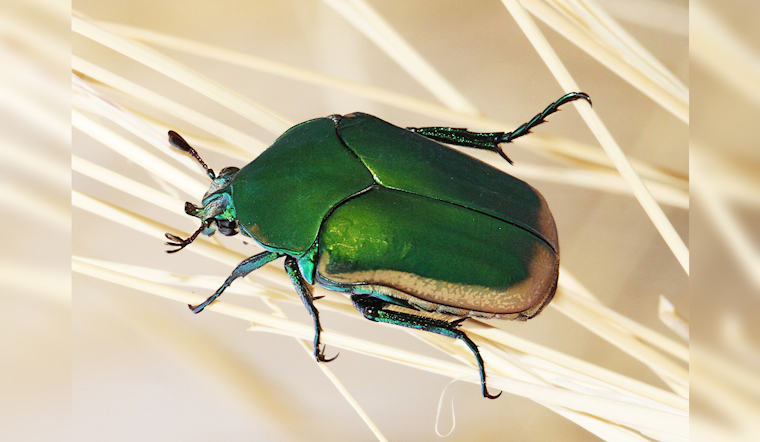
If a fat, metallic-green bug the size of a thumb has smacked into your porch screen or buzzed past your ear like a tiny lawnmower this month, you are not imagining an invasion. Figeater beetles are hitting their yearly peak across parts of Los Angeles, and their famously bad flying is sending them careening into unsuspecting bystanders all over the region.
The insects, scientifically named Cotinis mutabilis, belong to the scarab family and are native to Southern California, according to a report from the Los Angeles Times. Figeater beetle sightings typically begin in June, ramp up in July, and hit peak density across Southern California in August before tapering off through the fall as cooler weather sets in, the paper reports. Megan Barkdull, assistant curator of entomology at the Natural History Museum of Los Angeles County, told the outlet that the population has likely increased in Southern California this year.
Why the Beetles Fly Like They're Drunk
Part of what makes figeater beetles so startling is their flight style. Barkdull describes their aerial behavior as unusually clumsy, with the bugs often colliding directly with people rather than dodging them. That is not a design flaw exactly — it is baked into their anatomy. Unlike most beetles, which lift their hardened wing covers, or elytra, out of the way before flying, figeater beetles and their flower-chafer relatives keep those covers closed or barely raised and instead angle their flight wings out from the sides, according to the North Carolina State University Plant Disease and Insect Clinic. That hinge mechanism protects the beetle's body but limits its steering, which helps explain both the erratic flight paths and the loud, bee-like buzz that announces a figeater before it arrives.
Despite the chaos of their flying, figeater beetles do have working eyes and, contrary to what their bumbling seems to suggest, are not blind. They also will not bite, according to Karey Windbiel-Rojas, associate director with the University of California's Statewide Integrated Pest Management Program, who spoke to the Los Angeles Times about her own run-ins with the insects. Windbiel-Rojas recounted one figeater flying directly into her hair at UC Irvine, at which point she caught it by hand and released it back outside — advice she extends to anyone who finds one indoors: gently escort it back outdoors rather than smash it.
What's Actually Drawing Them Into Backyards
Figeater beetles are generally around one inch long and are often mistaken for a very different insect: the Japanese beetle, a major pest that consumes the leaves of crops and ornamental plants and remains uncommon in California, per the Los Angeles Times. That confusion matters because the two species are treated very differently under the law. The California Department of Food and Agriculture maintains a strict statewide exterior quarantine and eradication framework against invasive Japanese beetles under Title 3 CCR § 3280, and officials actively seek to eradicate them whenever they turn up in the state, while native figeaters carry no such regulatory restrictions because they pose no threat to agricultural crops or turfgrass. Adult figeaters do feed on soft-skinned fruit, including figs and grapes, and generally favor decaying produce, with fruit trees providing key sustenance during their short adult lives.
Homeowners are, in a sense, feeding the swarm without realizing it. Moist landscapes benefit figeater beetles, and everyday suburban habits — compost piles, heavy mulch, planted fruit trees, and regularly irrigated lawns and greenery — create ideal breeding conditions, according to Garden Betty. The beetles' larvae, known as grubs, can grow to the size of a pinky finger and move across soil by crawling upside down on their backs, a trait that has earned them the nickname “crawly backs,” per A-Z Animals. Those grubs often feed directly on organic matter inside compost piles, and despite the unsettling image, they play a beneficial ecological role by helping break down decaying material into rich soil.
A Bug on the Move
Figeater beetles have also been expanding their geographic range in recent years, according to the Los Angeles Times. The species was first spotted in Utah in 2009 and turned up in Colorado by 2012, a northward creep that scientists believe climate change is helping enable by making more areas hospitable to the beetles. It's a slow-motion range expansion, but one more data point in how a warming climate is quietly redrawing where familiar backyard insects can live and thrive.
For anyone hoping to beetle-proof their yard, Windbiel-Rojas advises against reaching for pesticides. Chemical sprays are largely ineffective against adult figeaters, since new beetles keep flying in from surrounding areas regardless of what gets sprayed. Instead, the UC Statewide Integrated Pest Management Program recommends physical controls: netting over fruit trees, picking ripe fruit promptly, or hand-picking beetles into soapy water if they become a nuisance around soft produce.
Ultimately, the message from entomologists is one of tolerance rather than alarm. Figeater beetles are generally considered not pests, in Windbiel-Rojas's assessment, and their presence — however loud and clumsy — signals a functioning backyard ecosystem rather than an infestation. As August winds toward its close and temperatures eventually cool, Angelenos can expect the buzzing and the occasional face-first beetle encounter to fade on its own by fall.





_(7-8-11)_78_circulo_montana,_patagonia_lake_ranch_estates,_scc,_az_-01_(5916124009).jpg)