

























































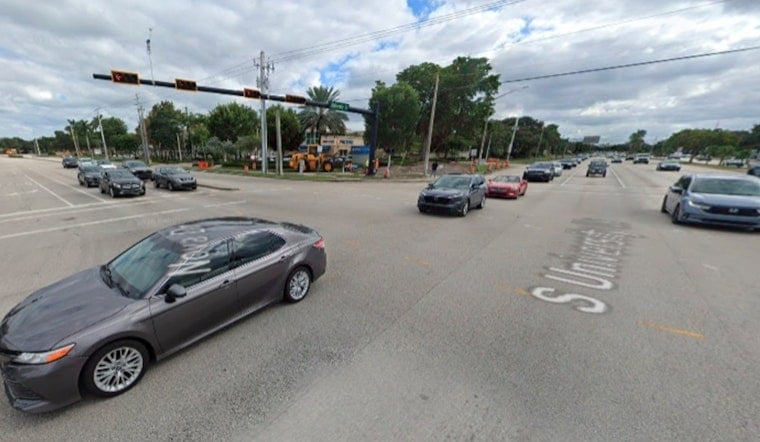
Activists gathered at the intersection ofC at 6:30 p.m. Saturday to demand that town officials cancel automated license plate reader contracts and tear out the cameras altogether. Organizers say the rally targets a surveillance system they claim was quietly built out over years without a single public vote.
The protest was organized by groups including Hope & Action, the Florida Digital Rights Association, OccupyFlorida, and 50501, according to WLRN. Activists say the cameras, which allow police departments to search for specific license plates and tap into a nationwide surveillance database that tracks vehicle movements, amount to a mosaic surveillance system when combined with other police information tools — one they argue disregards Fourth Amendment protections.
Central to the activists' anger is a demand that Davie officials explain why Flock Safety, the surveillance technology company behind the cameras, appears to have no registered contract with the town. That question lines up with what local records researchers have already found: according to public records compiled by Deflock Broward, Davie spent more than $695,000 on a multi-vendor automated license plate reader program between 2019 and 2025 without a single recorded vote or public deliberation by the Davie Town Council. Civic researchers documented 13 separate purchase orders spanning two vendor ecosystems, the group says, all without formal council discussion.
A Countywide Pattern of Quiet Spending
Davie is not alone in this pattern, per Deflock Broward's records. Fort Lauderdale has spent over $5.1 million on ALPR infrastructure since fiscal year 2011, Hollywood has committed $5.5 million over 11 years, and Pembroke Pines approved $1.3 million largely through consent agendas rather than standalone votes. Several Broward cities, the group notes, enrolled in national commercial plate databases from day one without explicit commission approval.
Activists argue that law enforcement agencies can search and share Flock data across jurisdictions and that this data crosses state lines and reaches federal agencies without residents' consent, per the WLRN report. They also contend that ALPR systems are inaccurate, insecure, prone to data breaches, and capable of producing wrongful arrests. Underscoring the accuracy concern, data cited by civil liberties advocates and reported by the ACLU indicates that roughly one in ten automated license plate reader scans misidentifies a vehicle's state of registration.
Misuse Cases Fuel the Backlash
The rally comes amid mounting evidence that plate-reader systems have been misused by the very officers meant to operate them. The Washington Post reported in August that nearly 50 instances of police officers being charged or accused of unauthorized camera use have surfaced, with officers in some cases using the cameras to track current or former romantic partners or family members. In Florida specifically, a Haines City Police officer was arrested this month after investigators found he used Flock Safety's camera database to run unauthorized searches on his estranged wife's license plate more than 700 times, according to FOX 13 Tampa Bay. Court records showed the officer repeatedly submitted false search justifications, such as claiming narcotics investigations.
Facing that scrutiny, Flock Safety announced a nationwide policy overhaul on August 13 that cut its default data retention period from 30 days to seven and now requires case-code entries for every plate database search, per WTSP. The company operates automated license plate readers across more than 120,000 locations nationwide in 49 states, servicing over 5,000 law enforcement agencies along with 1,000 corporate clients and homeowners associations, according to the same report.
What Florida Law Actually Allows
Florida law draws some boundaries around how these systems can be used, though those boundaries are narrower than many residents assume. Under Florida Statute § 316.0777, automated license plate recognition systems installed on state highway rights-of-way cannot be used to issue traffic citations, and personal identifying data collected from scans is exempt from public records disclosure under state privacy exemptions. A Florida Senate legislative analysis further notes that while the state's Criminal and Juvenile Justice Information Systems Council has established statewide ALPR guidelines, local police departments are not statutorily required to follow them — though agencies must maintain formal agreements with the Department of Highway Safety and Motor Vehicles to link plate scans with driver identities in the DAVID database.
Davie's activists want two concrete outcomes: an explanation from officials about the missing Flock Safety contract, and a vote by the Davie Town Council and Community Redevelopment Agency board to cancel the existing ALPR program entirely. That demand echoes a broader wave of local pushback happening across the country. East Bridgewater, Massachusetts, and the Kansas towns of Wellsville and Gardner all moved to terminate their Flock Safety contracts this month following community opposition, with Gardner residents highlighting that more than 1,200 outside vendors had access to their local camera data.
The pushback is also reaching Congress. In July, U.S. Representative Tim Burchett introduced House Bill 9800, the Protection Against Mass Surveillance Act, which would bar federal agencies from accessing mass automated surveillance systems and prohibit local police from using federal grants to fund ALPR networks. Whether Davie's Town Council will place the town's ALPR funding on a future agenda for public debate remains an open question, as does how the department manages cross-jurisdictional data sharing and whether officials plan to audit search logs to guard against unauthorized use by officers.
The Associated Press contributed to the original WLRN report on the rally.



