

























































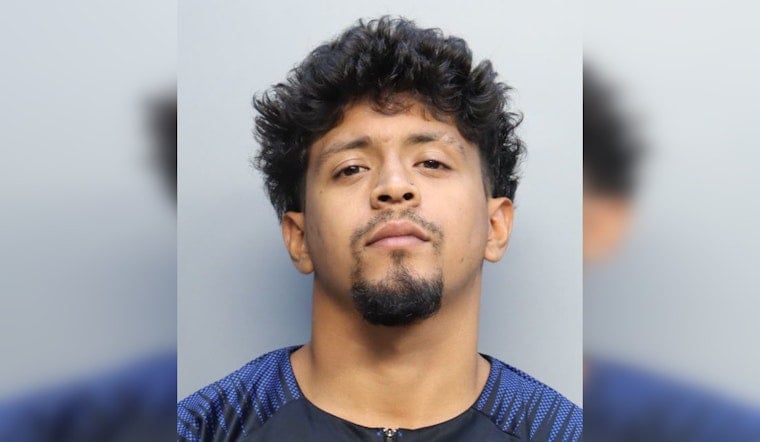
A man accused of killing three young people in a high-speed, alcohol-fueled crash outside a Miami gas station is finally back in Miami-Dade County custody, nearly two years after he was mistakenly deported to Honduras before he ever stood trial. Erwin Rommel Recinos Zúñiga, 30, was extradited back to Miami-Dade on July 23 and booked into the Turner Guilford Knight Correctional Center, where he is now being held on an immigration hold while facing three counts of DUI manslaughter along with related charges of reckless driving causing serious bodily injury, DUI causing serious bodily injury, and vehicular homicide.
The case dates back to February 13, 2022, when investigators say Recinos was behind the wheel of a red Kia Forte traveling 126 mph in a 40 mph zone before slamming into a light pole and a gas station sign near a Valero station along West Flagler Street and Southwest 48th Avenue, according to WPLG Local 10. The crash happened at roughly 3 a.m. and killed three of the five passengers riding in the car: 19-year-old Paola Sabillon, her boyfriend Jason Meza, and Meza's cousin Giselle Reyes, as reported by CBS News Miami. Investigators determined from the vehicle's electronic data recorder that Recinos was driving at that extreme speed, and toxicology results reportedly showed a blood alcohol concentration double Florida's legal limit along with a positive test for THC, per NBC 6 South Florida.
An Arrest, House Arrest, and a Vanishing Defendant
Miami police arrested Recinos on March 24, 2022, roughly a month after the crash. He was later placed on pretrial house arrest with a GPS ankle monitor while awaiting trial in Miami-Dade. But in 2024, when he reported to have the monitor's battery changed, corrections officers instead remanded him into ICE custody, a sequence of events later detailed by Univision. A federal judge signed the final deportation order on September 6, 2024, and Recinos was deported to Honduras that same day, according to ICE.
Circuit Judge Laura Shearon Cruz and Miami-Dade prosecutors reportedly didn't learn Recinos had been deported until six days later, when he failed to show up for a scheduled court hearing. The revelation infuriated the victims' relatives, who said the sudden transfer to federal custody violated their rights under Florida's Marsy's Law, which guarantees crime victims advance notice before a suspect's release or custody transfer, per the same CBS News Miami account. Hoodline previously reported on the deportation fallout in the days after it came to light, including the anger from families who had waited more than two years for a trial that never happened.
What Recinos Faces Now That He's Back
Online jail records indicate Recinos is expected to be deported again only after his trial and sentencing are completed, should he be convicted. Local 10 reports he is now accused of killing three people in the Miami crash, and Florida law leaves little room for leniency if that case proceeds to conviction.
Under Florida Statute § 316.193(3)(c)3, DUI manslaughter is a second-degree felony carrying a mandatory minimum of four years in prison and up to 15 years per count, plus mandatory permanent revocation of the defendant's driver's license, according to the Law Office of Michael Mirer, P.A. Because Florida's Criminal Punishment Code adds 120 victim injury points for each death in a DUI crash, the recommended sentencing floor climbs well above that four-year minimum — meaning Recinos could theoretically face up to 45 years in state prison across the three second-degree felony counts, per an analysis from Blake & Dorsten, P.A. Florida law also bars judges from withholding adjudication of guilt in any DUI conviction, meaning a felony DUI conviction becomes a permanent public record that cannot be sealed or expunged, according to Thompson Law, P.A.
A Broader Pattern of Premature Deportations
Recinos's case isn't an isolated glitch in the system. Reporting in early 2025 identified his deportation as part of a national pattern in which noncitizens facing serious state charges were mistakenly deported before trial because of communication breakdowns between county jails and federal immigration authorities, according to Between Community News. Florida lawmakers have also been tightening penalties around fatal impaired driving more broadly — in October 2025 the state enacted House Bill 687, known as Trenton's Law, which elevates repeat DUI manslaughter offenses to first-degree felonies carrying up to 30 years per count with no look-back window limiting how old a prior conviction can be, per Blake & Dorsten, P.A.
Following the 2024 deportation, the Miami-Dade Department of Corrections and Rehabilitation opened an internal administrative investigation, projected at the time to take up to six months, to examine officer actions and the notification failures surrounding prisoner transfers to federal immigration custody. It remains unclear from available records whether that review resulted in any protocol changes to prevent similar transfers in pending felony cases going forward. For now, Recinos remains held on an immigration hold in Miami-Dade as the long-delayed case against him moves forward.



