

























































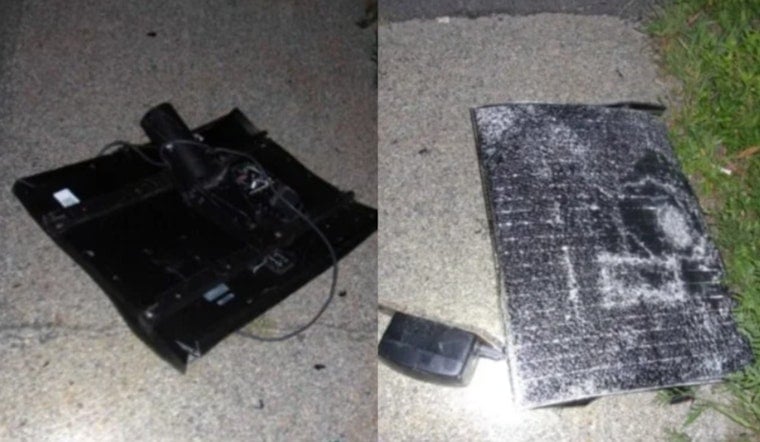
The Douglas Police Department has deactivated and removed all of its Flock Safety license plate cameras, effective immediately, citing a divisive atmosphere that has grown around the technology. The decision comes just days after someone intentionally drove over one of the department's cameras on Gilboa Street, destroying it, and amid a wave of Massachusetts towns severing ties with the surveillance company this month.
According to WHDH, police investigated the August 15 incident after finding the solar-powered camera's mount shattered, with evidence indicating a vehicle had been driven directly over it. As reported by Boston 25 News, the Douglas Police Department said Flock cameras capture vehicle license plates and other identifying information, and that the system had helped officers solve several serious crimes, according to the department's own statement. The department described the technology as an effective investigative tool but said it was ending the program regardless, pointing to the divisive atmosphere surrounding camera use as the reason.
A Wave of Camera Shutdowns Across the Commonwealth
Douglas is far from alone. Boston 25 News's report notes that Flock camera technology has come under scrutiny statewide following allegations involving police misuse of the system, with officers in Stow, Lynn, and New Bedford all placed on leave amid allegations that the cameras were used improperly. The same report states that Grafton and East Bridgewater have also removed their Flock cameras in recent days.
In Grafton, Police Chief Neil A. Minardi announced on August 21 that the department was deactivating and removing all 12 of its Flock Safety cameras after only about a month of operation, according to the Shrewsbury Post. The cameras had only recently gone in during July, and the outlet reports that rising community privacy concerns drove the reversal. That same day, East Bridgewater Police Chief Michael Jenkins said his department would terminate its Flock Safety contract and remove its single camera following strong opposition voiced by residents at a packed Select Board meeting — even though, per the East Bridgewater Police Department, no internal officer misuse had been found there. Jenkins said maintaining public trust outweighed the investigative benefits of the system.
Misuse Allegations Fueling the Backlash
The scandals driving much of this pushback are serious. In Stow, Detective Jason Rogers was placed on unpaid leave on July 31 and faces potential termination and criminal charges after an internal investigation found he used state databases and Flock cameras multiple times in 2024 and 2025 to track an ex-partner who had fled an abusive relationship and changed her identity, according to Boston 25 News. The victim reportedly discovered the searches after running her own license plate through a public database logging site.
In Lynn, two police officers were placed on paid administrative leave in August after an internal audit using Flock Safety's newly implemented Audit Assist tool uncovered a concerning pattern of unauthorized vehicle searches, the same outlet reported. Lynn Police subsequently restricted system access exclusively to officers holding the rank of lieutenant or higher. And in New Bedford, the entire Flock camera network was temporarily suspended after Patrol Officer Emily Pacheco was accused of misusing the technology to track her ex-girlfriend, a case that led a judge to extend a six-month protective order requiring Pacheco to surrender her firearms, according to CBS News. Court testimony in that case revealed the officer accessed the Flock database daily during her routine duties.
Legal Questions and a Statewide Advocacy Push
Not every town's exit has been driven by scandal. Hopkinton ordered Flock Safety to deactivate and remove its license plate readers by September 30 after an internal legal review determined the town's procurement contract violated state law, Hoodline previously reported. That decision stemmed from procurement non-compliance layered on top of the broader privacy debate. Framingham took a similar step in June, ending its Flock Safety contract entirely after months of resident activism over warrantless mass surveillance, following an earlier period in which the city had restricted its data-sharing permissions to Massachusetts agencies only.
Civil liberties groups have moved to formalize the resistance. The ACLU of Massachusetts released a Get The FLOCK Out community advocacy toolkit on August 14 to help residents challenge automated license plate readers, noting that more than 80 Massachusetts police departments maintain active contracts with Flock Safety. The toolkit includes template public records requests and model municipal ordinances aimed at limiting mass surveillance.
The Massachusetts cases fit into a larger national pattern. An August Washington Post investigation found that at least 50 law enforcement officers nationwide have been accused of or charged with misusing Flock surveillance systems, predominantly to monitor current or former romantic partners or personal acquaintances, a trend Hoodline detailed in its coverage of a Colleton County lieutenant fired over thousands of unauthorized searches. That national report highlighted systemic gaps in real-time oversight across the more than 100,000 Flock cameras now operating around the country.
For Douglas, the calculus mirrors what East Bridgewater's chief described: even where a department credits the technology with solving serious crimes, sustained public backlash and a string of neighboring misuse scandals have proven enough to shut the cameras down. Whether other Massachusetts towns follow suit, or whether departments try to rebuild trust with tighter access controls like Lynn's rank restriction, remains an open question as the statewide debate continues.




