

























































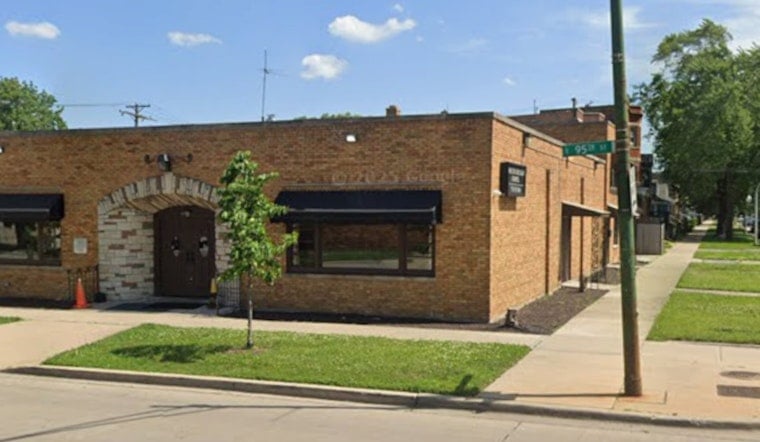
More than four dozen decomposing bodies were recovered from the basement and attached garage of a funeral home on Chicago's Southeast Side, according to law enforcement sources. The discovery at South Chicago Chapel, in the 2900 block of East 95th Street in the South Deering neighborhood, shut down a stretch of one of the area's busiest corridors Thursday as police and city officials descended on the property.
Law enforcement sources told the Chicago Tribune that the bodies, found in various stages of decomposition, were recovered Thursday. Chicago police sergeants and South Chicago District officers accompanied authorities during an inspection of the chapel, and Chicago Department of Buildings officials were also on scene, according to the Tribune. Authorities had received a tip about the funeral home before the search, per the same report.
95th Street was open to traffic as of about 11 a.m. Thursday but was closed by roughly 11:45 a.m., as police blocked the road from South Escanaba Avenue to South Commercial Avenue. The chapel had reportedly held a funeral as recently as the previous week, according to the Tribune's reporting, and the business appears to have opened roughly two years before the discovery.
Neighbors Noticed the Smell for Months
Janice Skylas, an 80-year-old neighbor of South Chicago Chapel, told the Tribune she had smelled an odor akin to a dead animal in the area for around two months but had not thought anything of it. Another neighbor, 53-year-old Maria Paniagua, described the same lingering smell, which the paper reports was intermittent but potent enough at times to make going outside difficult.
Skylas and Paniagua both told the Tribune they saw workers associated with the funeral home lay new white gravel outside the business last month. Skylas did not mince words about the property, saying it was not a place she would take somebody.
How Illinois Regulates Funeral Homes and Body Storage
The case, still under investigation, sits at the intersection of overlapping city, county and state oversight. The Illinois Department of Financial and Professional Regulation licenses individual funeral directors and embalmers, while the City of Chicago notes that state-licensed directors are exempt from a separate municipal business license, leaving the physical building itself under the authority of the Chicago Department of Buildings — which explains why building inspectors joined police at the scene.
Under the Illinois Funeral Directors and Embalmers Licensing Code, operating or offering funeral services without an active license can bring administrative fines up to $10,000 per violation, along with criminal exposure: a Class A misdemeanor for a first offense and a Class 4 felony for repeat violations, according to the Illinois General Assembly. State law also requires any remains not embalmed or buried within 24 hours to be kept in refrigeration at or below 40 degrees Fahrenheit to prevent rapid decomposition.
Separately, Cook County guidelines mandate that bodies can only be legally released from county custody or transported by someone holding an active Illinois Funeral Director license, paired with next-of-kin authorization forms and death certificate paperwork, according to Cook County government guidance. The Cook County Medical Examiner's Office has not released details of the investigation into South Chicago Chapel, and an Illinois State Police spokeswoman did not respond to requests for comment, per the Tribune.
A History of Body-Mishandling Cases in the Region
The discovery echoes a pattern of body-mishandling scandals that have surfaced across Illinois and beyond in recent years. In 2025, Illinois state officials shut down a Chicago Heights funeral home after finding more than 100 bodies improperly stored; the facility's owner had reportedly been operating without a funeral director's license, per CBS. More than 20 lawsuits tied to that case have since been consolidated into one still-pending lawsuit, as Hoodline reported in its earlier coverage of the Chicago Heights crematory shutdown.
The case also recalls the 2009 Burr Oak Cemetery scandal in Alsip, where forensic evidence showed cemetery workers had excavated and dumped remains from at least 29 individuals, reselling occupied burial plots, according to court records. The Tribune reports the former Burr Oak director was sentenced to 12 years in prison, and that workers dumped hundreds of old remains in an abandoned, weed-covered lot after reselling graves in July 2009. Burr Oak, the area's first cemetery to allow Black people to be interred, is the burial place of Emmett Till, Dinah Washington and Ezzard Charles.
Similar cases have surfaced outside Illinois as well. The Tribune notes that Colorado funeral home operators at Sunset Mesa Funeral Home in Montrose were sentenced to federal prison for illegally selling body parts or entire bodies without family consent, with the owner's husband sentenced to 18 years in June 2025 and the owner herself sentenced to 18 years in 2026 for mishandling nearly 190 bodies, cheating customers and defrauding the federal government, per the U.S. Attorney's Office for Colorado. Overseas, police in Hull, United Kingdom, found nearly 35 bodies and more than 100 sets of ashes at Legacy Independent Funeral Directors in March 2024, and a funeral director there was later sentenced to 20 years for failing to bury or cremate people and giving relatives strangers' ashes, according to media reports cited by the Tribune.
When families cannot be found or lack the means for burial, the Cook County Medical Examiner's Office coordinates indigent burials through partners like Catholic Cemeteries of Chicago, which has interred thousands of unclaimed adults at Mount Olivet Cemetery since 2012. County board ordinances allow the medical examiner to pursue cremation or burial for unclaimed remains once police have attempted next-of-kin notification.
The investigation into South Chicago Chapel remains active, with the exact circumstances of how the bodies came to be stored there still unclear. Details of the Cook County Medical Examiner's inquiry have not been made public, and it remains unknown how the remains were transferred to or retained by the facility.




