

























































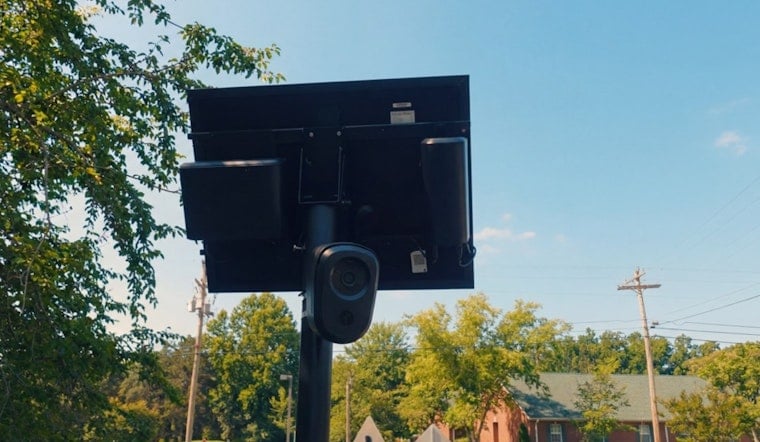
About 70 people gathered at Phoenix Park in Eau Claire on Sunday to protest the county's network of Flock Safety license plate cameras, with organizer Joshua Riedl calling for an outside agency to audit how law enforcement uses the system. Protesters said they worried police and sheriff's departments could be using the cameras for purposes beyond solving crimes rather than as advertised.
The demonstration, first reported by WEAU, comes as Eau Claire County maintains 13 active Flock cameras under a five-year, $199,950 contract locked in by the Eau Claire County Board of Supervisors in 2023. Riedl told the station that camera oversight should sit outside the sheriff's jurisdiction entirely, arguing that decisions about the technology should not rest solely with law enforcement. He also called Flock cameras a threat to privacy, per the station's report.
Riedl went further, identifying Chippewa and other small towns that help pay for the camera network as stakeholders who deserve a say, and naming the Eau Claire City Council as a local government body that should be involved in future decisions. Eau Claire County Sheriff Dave Riewestahl had not responded to WEAU's request for comment on the cameras as of the station's report.
A County Divided on Surveillance
The protest lands amid a striking split within Eau Claire County itself. In August, the neighboring City of Altoona Police Department removed all of its Flock Safety cameras and replaced them with city-owned license plate readers, adding stickers to clarify the devices are not operated by or shared with outside vendors, according to the City of Altoona. That move stands in direct contrast to the county's continued reliance on the third-party Flock system criticized at Sunday's rally.
Eau Claire is far from alone in confronting this tension. Dane County's Board of Supervisors voted 32-1 in April to strip $80,000 from its budget to end its Flock Safety program, and by June, sheriff's deputies there had covered all 26 county cameras with plastic bags after the vendor failed to remove the hardware once the contract expired, as documented by Wisconsin Watch. In Sheboygan, municipal workers wrapped all 15 of that city's Flock cameras in plastic in late August after police leadership cited contractual violations by the vendor, with a council vote to terminate the contract planned for September.
A Statewide Reckoning With Flock Safety
The backlash extends well beyond Eau Claire and Dane counties. Municipalities including Appleton, Oshkosh, Fitchburg, Verona, Monona, Stoughton, and Sturgeon Bay have moved to defund, terminate, or decline to renew their Flock contracts in 2026 over privacy concerns, data sharing practices, and a lack of public oversight, according to Civic Media. Hoodline has tracked the trend closely, previously reporting on how Two Rivers defended its cameras even as other cities moved to bag theirs, and how Sheboygan pushed to kill its contract over a trust breach with the vendor.
Protesters' fears about misuse are not hypothetical. A Milwaukee Police Department officer was criminally charged in July after internal audit logs showed he used the city's Flock Safety system nearly 180 times to illegally track his ex-girlfriend and her personal acquaintances, according to FOX6 Milwaukee. Hoodline also reported on a Porter County officer who was demoted after using Flock cameras to track a personal contact, part of a pattern of internal discipline cases surfacing nationwide as departments respond to vendor platform updates.
National Pressure Mounts on the Vendor
Flock Safety itself has responded to the wave of misuse scandals. On August 13, the company updated its nationwide platform settings to mandate AI-driven audit alerts, require case numbers for every search, and cut default cloud data retention from 30 days down to seven, according to Hoodline's reporting. The changes came as Texas Governor Greg Abbott issued an executive order on August 28 halting all state agency funding for Flock's roughly 3,200 Texas cameras after multiple officers there were indicted for using the system to stalk private citizens, a move Hoodline detailed in its coverage of the Texas funding halt.
By mid-2026, Flock's automated license plate reader network had expanded to cover more than 5,000 communities and 4,500 law enforcement agencies across 49 states, according to the Atlas of Surveillance. Yet research published by the ACLU of Indiana in July found that less than 1% of the billions of license plates scanned monthly by automated readers connect to active criminal investigations or warrants, while roughly 10% experience software misreads. That gap between the technology's reach and its documented crime-solving hit rate is central to the argument Riedl and fellow demonstrators made at Phoenix Park, where the message was less about banning cameras outright than about demanding that someone outside the sheriff's office be allowed to check how they're actually being used.



