

























































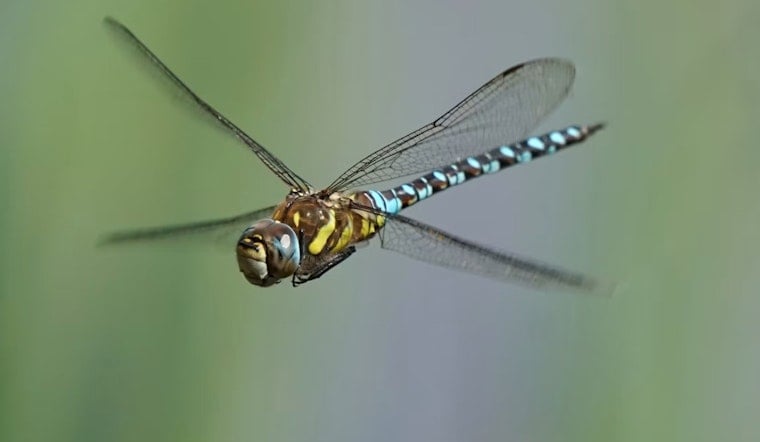
Anyone strolling through Dolores Park this month has probably noticed them: clouds of dragonflies darting low over the grass near 18th and Dolores streets, where the park's newly planted sage has become an unlikely insect hotspot. San Francisco has seen an unusually high number of dragonflies lingering this summer, and local entomologists say the swarm, while striking, is nothing to worry about.
The phenomenon isn't confined to San Francisco. As reported by NJ.com, dense dragonfly activity has stretched across Northern California this summer, and SFGATE reports the swarms have ranged from Smith River near the Oregon border to Guerneville along the Russian River, Lake Merritt in Oakland, and Dolores Park itself. San Francisco Recreation and Park Department officials told the outlet that dragonfly activity peaked over the weekend of August 15 and 16, with noticeable concentrations forming around the park's new sage plantings.
Why the Bugs Keep Coming Back
Chris Grinter, senior collection manager of entomology at the California Academy of Sciences, pointed to a combination of factors keeping dragonflies in the San Francisco area longer than usual. Per NJ.com, Grinter attributes the increase to an uptick in mosquitoes, along with wind currents and cooler weather that have all led to more dragonflies sticking around the city. Local entomologists more broadly attribute the increase to a mix of weather, wind, and a steady supply of prey, according to the same report.
Lynn Kimsey, former director of the Bohart Museum of Entomology, explained the life cycle behind the surge. Dragonfly eggs typically hatch between June and August, and the population increases during that same window, per Kimsey's account relayed by NJ.com. Kimsey noted that dragonfly nymphs leave the water once their eggs hatch, and observers have seen the insects hovering over water, hunting for food, laying eggs, and mating during this stretch.
Natural Pest Control at Work
Beyond the visual spectacle, dragonflies are doing San Francisco a favor. The insects benefit the area by eating unwanted insects, feasting on flies, gnats, and mosquitoes, as NJ.com notes. SFGATE reports that adult dragonflies can fly at speeds reaching 35 mph and consume between 30 and 100 mosquitoes, gnats, or flies per day, making them effective natural pest control agents in urban environments — a useful trait given the mosquito surge that appears to be drawing them in.
That hunting ability isn't just anecdotal. A 2023 UC Davis study on aerial prey interception found dragonflies achieve an in-flight hunting success rate of up to 95%, ranking them among the most lethal predators in the animal kingdom. Amanda Bartlett, an assistant local editor at SFGate, said she noticed the increase in dragonflies herself while traveling around the city this summer.
Part of a Bigger Seasonal Pattern
San Francisco Recreation and Park Department officials say dragonflies are drawn to sage, which helps explain why the newly planted patch near Dolores Park became such a concentrated gathering spot. The San Francisco Bay Area is home to more than 28 common dragonfly species, part of a statewide total that tops 60 species across California, per sfbaywildlife.info.
Late-summer dragonfly activity is also tied to a longer migratory tradition in the region. At least nine dragonfly species make an annual autumn migration through the Bay Area, led by the variegated meadowhawk, which travels the same coastal air corridors over the Marin Headlands used by migrating hawks and falcons, according to Bay Nature. The variegated meadowhawk is one of North America's smallest migratory species, completing multi-generational journeys stretching from Canada as far south as Honduras, per the Marin Agricultural Land Trust.
Dragonflies are ectothermic, meaning they need an ambient air temperature of at least 63 degrees Fahrenheit before they can mobilize and actively hunt, according to Bay Nature, which explains why San Francisco's famous fog can keep the insects grounded until warmer afternoon conditions set in. Sudden mass dragonfly swarms aren't unique to California, either: in July 2024, tens of thousands of the insects descended on beachgoers at Misquamicut Beach in Westerly, Rhode Island, an event that drew national attention, as reported by CBS News.
For now, San Francisco's swarm appears to be a benign, if eye-catching, seasonal event rather than an infestation. With mosquitoes plentiful and the Dolores Park sage in bloom, the dragonflies look likely to stick around for a while longer this summer.





