

























































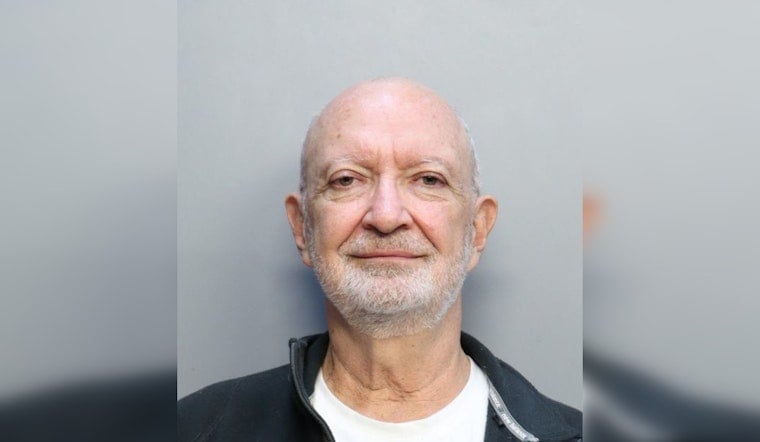
A 67-year-old Coral Gables man is facing dual felony charges after deputies say he blew through a stop sign, sped up instead of braking, and slammed his Cadillac Lyriq into a Coral Terrace home, killing an 82-year-old man as he slept inside. Allen Matis was taken into custody early Wednesday morning, more than two months after the crash that killed Henri Bezy on Palermo Avenue.
According to WPLG Local 10, the crash happened around 7:30 p.m. on June 24 in the unincorporated Coral Terrace area, when Matis ran a stop sign and struck a home in the 2900 block of Southwest 57th Avenue. Bezy was asleep inside at the time and became trapped underneath the vehicle after impact, per the arrest report cited by the outlet. Miami-Dade Fire Rescue crews pronounced him dead at the scene, and the crash left a gaping hole in the home's wall.
A deputy at the scene observed signs of impairment in Matis, according to the arrest report. Toxicology results later showed his blood alcohol content ranged from 0.245% to 0.29%, exceeding Florida's legal limit by more than three times. Under Florida Statute § 316.1934, a BAC of 0.08% or higher already creates a statutory presumption of impairment, according to the Florida Legislature, making Matis's reading, taken hours after the fatal impact, especially stark.
Vehicle Data Shows No Braking Before Impact
Deputies obtained data from the Cadillac Lyriq's onboard systems, which showed Matis accelerated to 43 mph in the seconds before the crash and never hit the brakes, per the vehicle data referenced in the arrest report. General Motors equips Lyriq models with Event Data Recorders that capture speed, throttle input, and braking activity leading up to a collision, a technology detailed by Cadillac. The Insurance Institute for Highway Safety had rated the 2024-2025 Lyriq “Good” in high-speed automatic emergency braking tests, meaning the model comes equipped with crash-avoidance technology that, in this case, was overridden by sustained acceleration rather than triggered to slow the vehicle down.
The nearly two-month gap between the crash and Matis's arrest reflects the time needed to process toxicology results and extract the vehicle's black-box telemetry, standard steps in fatal crash reconstructions. Matis was booked into the Turner Guilford Knight Correctional Center, Miami-Dade's centralized intake and detention facility, with bond listed as to be set.
Neighborhood Sits Just West of Coral Gables
Coral Terrace is an unincorporated census-designated area of roughly 24,900 residents sitting directly against the western edge of Coral Gables, according to Census Reporter. Because it's unincorporated, the neighborhood relies on county sheriff's deputies rather than a municipal police force for law enforcement response. Hoodline reported on a separate armed road rage case in the same area last December, underscoring the neighborhood's recent run of violent-crime headlines.
The Miami-Dade Sheriff's Office, the agency that took Matis into custody, only resumed operating as an independent elected sheriff's agency in January 2025 under Sheriff Rosie Cordero-Stutz, ending nearly 60 years of the county running its police force as the Miami-Dade Police Department, per the Florida Sheriffs Association. That restructuring is why the agency now identifies itself as MDSO in cases like this one rather than under its former name.
Mandatory Minimum Prison Time Looms
Matis has been charged with both DUI manslaughter and reckless vehicular homicide. Under Florida Statute § 316.193(3)(c)(3), a DUI manslaughter conviction is a second-degree felony carrying a mandatory minimum four-year prison sentence and a maximum of 15 years, along with permanent driver's license revocation, according to the Sammis Law Firm's breakdown of the statute. The separate vehicular homicide charge, under Florida Statute § 782.071, is also a second-degree felony punishable by up to 15 years and a $10,000 fine, requiring prosecutors to prove reckless disregard for public safety independent of the intoxication evidence, per Demmery Law's analysis of the statute.
Florida law also allows judges sentencing vehicular homicide offenders to order 120 hours of mandatory community service at a trauma center or hospital under medical supervision, in addition to prison time, according to the statute published by Online Sunshine. Fatal crashes like the one that killed Bezy are not isolated in Miami-Dade: the county logs roughly 60,000 traffic crashes and nearly 300 crash-related deaths each year, about 15% of all collisions statewide, according to data compiled by Alvarez Law Firm.



