

























































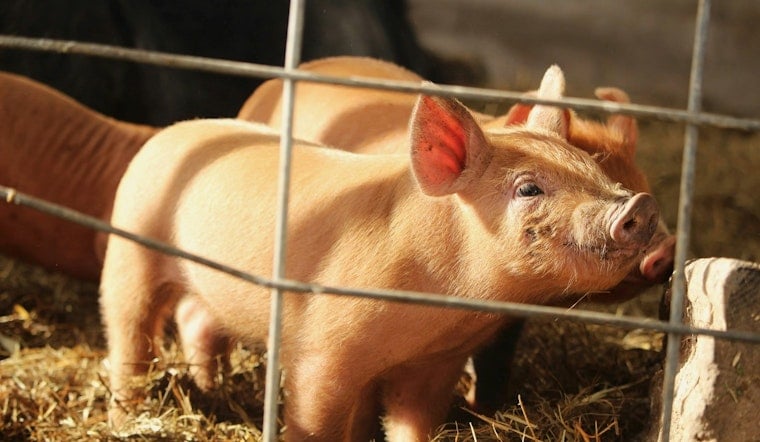
Forty juvenile female pigs from Granite Falls, North Carolina were sedated, sent through simulated scuba dives, and then either euthanized or dissected as part of a Duke University study funded in part by the U.S. Navy — research that found a gas-switching technique could dramatically cut deaths from decompression sickness, but that animal rights group PETA is now calling cruel.
The study, titled “Isobaric counterdiffusion of carbon tetrafluoride breathing gas to prevent severe decompression sickness,” was published in August in the Proceedings of the National Academy of Sciences by a team led by researchers Rachel M. Lance and Richard E. Moon, according to the PNAS paper. As reported by The News & Observer, Duke researchers were investigating whether changing divers' breathing gas mid-dive could prevent decompression sickness — a condition that occurs when bubbles form in blood and tissue after surfacing too quickly, and which can result in pain, paralysis, and death.
Pigs Switched Gases Mid-Dive, With Stark Results
The Duke study compared pigs that remained on a heliox mixture during ascent with pigs that were switched to carbon tetrafluoride and oxygen before surfacing. Pigs given only heliox developed severe gas embolism, rashes, and hind limb paralysis, with a median survival time of just 16 minutes, and more than 85% of them died within the three-hour observation period, per the News & Observer's reporting. By contrast, Live Science reported that none of the pigs switched to the carbon tetrafluoride and oxygen mix died during the experiment, compared to a mortality rate exceeding 80% among the pigs left on heliox — a difference researchers attribute to carbon tetrafluoride's larger molecules diffusing into tissue more slowly than helium escapes, reducing bubble formation in the blood.
According to the study, the experiment's ascent was made quicker and more injurious partway through because too few pigs were exhibiting decompression symptoms. Duke researchers administered naloxone in part to awaken pigs for observation, and all surviving pigs were euthanized and dissected after the experiment concluded — with animals euthanized at a humane endpoint or, in some cases, dying spontaneously. Duke researchers said the findings could enable deeper dives, longer dives, and rapid decompression while maintaining diver safety.
A Wartime Supply Squeeze Shaped the Chemistry
The choice of gas wasn't the researchers' first plan. Live Science reported that Duke lead researcher Dr. Richard Moon said the team originally intended to test neon gas, but Russia's 2022 invasion of Ukraine triggered a global surge in neon prices, forcing a pivot to carbon tetrafluoride instead. Moon was instructed by Duke not to speak with the News & Observer for its article, according to that outlet's reporting.
Researchers have acknowledged that carbon tetrafluoride's high cost and potent greenhouse-gas properties mean any practical use of the technique would likely be limited to specialized military and deep commercial diving rather than recreational scuba, per the same Live Science report — though the operational volumes required for such deep dives would be relatively small. Duke declined to comment on the experiment or on PETA's reaction, the News & Observer reported.
PETA Demands Hegseth End Animal Decompression Testing
PETA's Shalin Gala said the experiment was cruel, describing it as forcing pigs through simulated deep dives while they suffered. PETA called the experiment cruel and claimed that decades of similar animal experiments on decompression sickness and oxygen toxicity have continued for nearly nine decades without changing treatments, while also alleging the research has wasted millions of tax dollars. The group also argued that pigs' anatomy differs enough from humans that the experiments are pointless and unhelpful.
PETA is pressing Defense Secretary Pete Hegseth to end military support for decompression-sickness and oxygen-toxicity experiments on animals across all branches. The group has pointed to the Trump administration's May 2025 ban on Navy-funded experiments involving dogs and cats — a move the Department of the Navy estimated saved roughly $1.6 million annually — as a template for a broader prohibition, according to a PETA news release. PETA has also cited a 2024 case in which the Navy terminated a separate series of decompression and oxygen toxicity experiments on sheep at the University of Wisconsin–Madison two years ahead of schedule following public advocacy campaigns, and the group notes that allied militaries including the British Royal Navy and French Navy have already phased out live animal testing for decompression sickness.
Part of a Wider Network of Military-Funded Labs
Public records requests by PETA have revealed that the Navy has funded animal decompression or hyperbaric toxicity experiments at other academic institutions as well, including UC San Diego, the University of Maryland–Baltimore, and the University of South Florida, according to PETA. The group has said Duke's hyperbaric pig study fits into a broader pattern of Navy undersea medicine programs partnering with universities to develop countermeasures for deep-sea diving hazards.
Under Animal Welfare Act rules maintained by the USDA, live pigs used in non-agricultural biomedical research are a covered species subject to federal standards requiring Institutional Animal Care and Use Committee protocol reviews and veterinary oversight. The law mandates humane housing and care but permits painful research procedures if an IACUC approves them as scientifically necessary, and the Duke study met both Duke's and the Department of Defense's institutional animal care and research standards, per the News & Observer.
Duke has faced separate scrutiny over its use of pigs in recent years. The Physicians Committee for Responsible Medicine reported that 552 doctors signed a 2024 letter urging Duke to stop using pigs for medical students' surgical training, and Duke stopped that practice in 2024, according to PCRM. Decompression sickness has posed hazards well beyond the lab for more than a century — as Hoodline has previously reported, 1870s Brooklyn Bridge chief engineer Washington Roebling suffered severe bends during underwater caisson work, leading his wife Emily Warren Roebling to direct construction for the following 11 years.





