

























































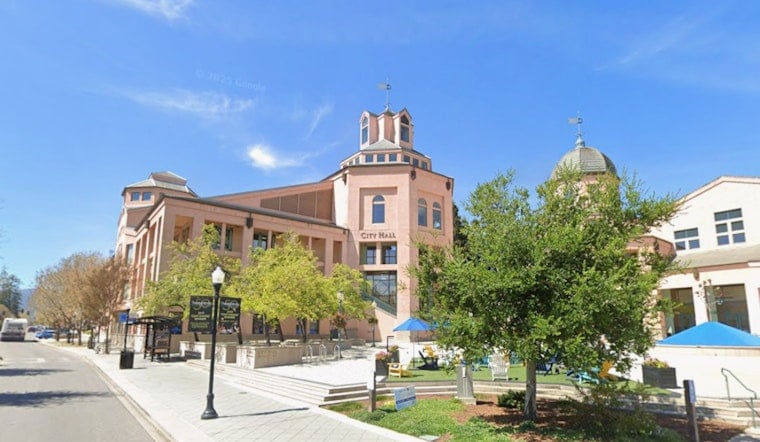
Eight candidates vying for three open Mountain View City Council seats faced off at a candidate forum last Thursday, sparring over how the city should handle a new state housing density law, downtown office growth, and a proposed hotel tax hike headed to November's ballot. More than 50 people turned out for the event, where candidates largely agreed small businesses need an easier path to opening in the city but split sharply on how aggressively to grow near transit and downtown.
The forum at the Mountain View Community Center was hosted by the Mountain View Chamber of Commerce and moderated by chamber CEO and president Peter Katz, who posed roughly a dozen questions to the field, according to San José Spotlight. All three seats up for grabs belong to outgoing Councilmembers Alison Hicks, Ellen Kamei, and Lucas Ramirez, who are stepping down in January after two consecutive four-year terms, guaranteeing entirely new representation on a council that otherwise won't face another election until 2028. Voters will elect the three candidates with the most votes on November 3.
SB 79 Divides the Field
Much of the debate centered on Senate Bill 79, the state law that took effect in July mandating by-right residential density and height increases within a half-mile of major transit stops, according to the California Department of Housing and Community Development. In Mountain View, that means the law applies to Caltrain and VTA light rail stations as well as the downtown transit center. Cities have the option to pass local alternative plans or temporary exclusion ordinances instead of following the state framework directly.
James Kuszmaul, chair of the city's Bicycle and Pedestrian Advisory Committee and a volunteer lead for Mountain View YIMBY, backed SB 79 outright, saying more people should have access to housing near public transit. He opposed pursuing a local alternative plan, arguing it might not produce better outcomes than the state law and could divert staff time and resources from other city projects. Robert Cox, who is active with Livable Mountain View, took the opposite view, expressing concern that SB 79 could hurt downtown and supporting a local alternative plan to preserve it. Paul Donahue similarly said the state law is not well-suited to conditions in Mountain View and backed the alternative-plan option, as did Silja Paymer and Idarose Sylvester. Erik Poicon described SB 79 as a one-size-fits-all approach during the discussion.
Downtown Office Growth Splits Candidates
Candidates also diverged over whether Mountain View should add more housing and office space downtown, an area with a concentration of historic properties on the first three blocks of Castro Street. Erik Poicon and Alexander Amorso both supported more downtown office development, while Samuel Ali did as well. Robert Cox and Paul Donahue opposed adding more downtown office space at this time, and Silja Paymer said she opposes it for now, too. Idarose Sylvester and James Kuszmaul each said their support would depend on the specific project, with Kuszmaul favoring only a limited amount of downtown office growth. Nearly all candidates agreed the city's permitting process should be more transparent and streamlined, and all eight said opening a small business in Mountain View should be easier than it currently is.
North Bayshore's Long Runway
The candidates' views on North Bayshore, the sprawling Google-led development slated for major housing and office growth over the next 30 years, were similarly mixed. Erik Poicon, Robert Cox, and Idarose Sylvester supported large-scale office development there, with Sylvester tying her support to building complete communities. James Kuszmaul said he'd support a limited amount, while Paul Donahue said he might support it, and Silja Paymer said her support would hinge on what else the developer offers the city. Samuel Ali backed large-scale North Bayshore office development, while Alexander Amorso opposed it. The City of Mountain View unanimously approved Google's North Bayshore Master Plan in 2023, setting up a framework for as many as 7,000 residential units and 3.14 million square feet of office space across 153 acres, with 15% of the housing reserved as affordable. San José Spotlight notes that Google's broader Mountain View plans remain unclear, and that the company has pulled back from other large projects in the city.
Hotel Tax and Vacancy Fixes
Eight of the candidates voiced support for the ballot measure that would let the City Council raise the local hotel tax from 10% up to 15%, a rate that has not budged since 1991 and now trails neighbors like Palo Alto and Menlo Park at 15.5% and Sunnyvale at 12.5%, according to the Palo Alto Daily Post. The city projects the increase could generate up to $5.2 million annually for general services. The measure emerged after officials abandoned a much larger infrastructure bond of between $480 million and $650 million once polling showed likely voter support sliding from 61% in January to 52% by May, short of the two-thirds threshold bonds require, as detailed in Hoodline's earlier report on the mayor's revenue plans. A general hotel tax needs only a simple majority to pass.
Several candidates floated their own fixes for downtown vacancies and business retention. Erik Poicon suggested a storefront vacancy tax for long-empty properties, an idea Silja Paymer also backed, along with strengthening pre-lease assistance for applicants and tracking business closure and retention rates more closely. Silja Paymer said more mixed-use zoning could help small businesses, while Idarose Sylvester called for preserving businesses in downtown's historic core and making it easier and faster for businesses to succeed. Samuel Ali emphasized that the city should partner with businesses and promote them through social media, and Alexander Amorso pointed to employee turnover as a major issue while calling for more local-business support, including workforce housing.
The forum comes as Mountain View grapples with a housing market where the median home sale price reaches $1.85 million, prompting the city's Low and Middle Income Homeownership Strategy detailed in Hoodline's report on a home-buying lifeline for $250K earners. The city's unhoused population also surged 56% between 2023 and 2025, according to Santa Clara County's Point-in-Time Count. A full recording of the candidate forum is available on the Mountain View Chamber of Commerce's website.




