

























































West Coast officials have launched a plan to let electric big rigs haul freight the entire length of Interstate 5, from Baja California to British Columbia, with a target of getting Class 8 heavy-duty electric trucks driving the full 1,381-mile route as soon as 2030. The corridor, known as the British Columbia to Baja California Zero Emissions Vehicle Corridor, or BC2BC, spans five jurisdictions and covers a highway that carries agricultural products, lumber, consumer goods and other cargo up and down the coast.
The initiative was detailed as reported by the Los Angeles Times, which notes that participating governments — California, Oregon, Washington, British Columbia and Baja California — have agreed to develop shared policies, investments and technical standards for the route. The I-5 corridor averages nearly 10,000 trucks per day and can reach as many as 35,000 trucks per day at its busiest, and it cuts through roughly 550 miles of urban areas, including Los Angeles, according to the same report. The corridor is described in that coverage as one of the world's most ambitious examples of its kind, alongside smaller green freight projects like an 800-mile route on I-95 between the ports of Savannah and New York/New Jersey, a 250-mile route between Rio de Janeiro and São Paulo, Brazil, and a 740-mile route between Bogotá and Cartagena, Colombia.
Why Long-Haul Trucks Have Been Hard to Electrify
Long-haul trucking has proven difficult to electrify because trucks need hundreds of miles of range while hauling heavy loads, and charging infrastructure along major freight routes has been inconsistent, the Los Angeles Times reports. The initial buildout phase of the corridor tackles that gap directly: it calls for establishing 20 high-power electric charging stations and three hydrogen fueling stations across the participating U.S., Canadian and Mexican jurisdictions, according to Drive to Zero.
The BC2BC effort is coordinated by state and provincial transportation agencies alongside CALSTART's Drive to Zero program and the University of California, Davis Institute of Transportation Studies, per the same organization's newsletter. It also builds on years of groundwork: a 2020 West Coast Clean Transit Corridor Initiative study led by 16 electric utilities, including Southern California Edison, PG&E and Seattle City Light, had already recommended installing high-power freight chargers at 50-mile intervals along I-5, according to Southern California Edison.
Charging Fast Enough to Matter on the Road
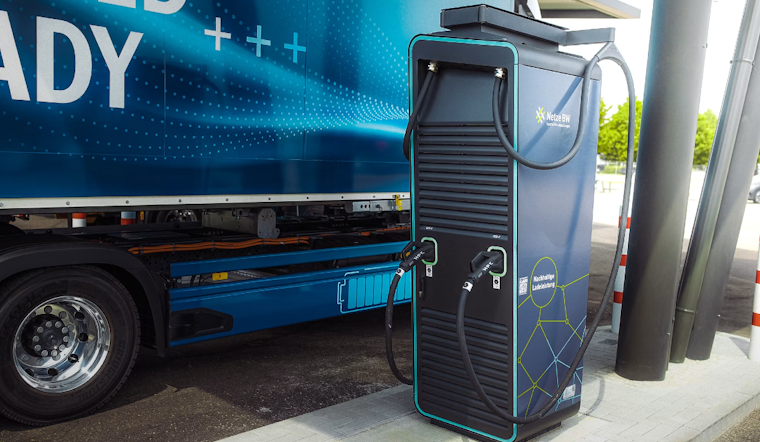
A key technical hurdle is charging speed. Standard DC fast chargers take multiple hours to charge heavy-duty batteries, which is impractical for long-haul duty cycles, but the Megawatt Charging System, standardized under SAE J3271 in March 2025, can deliver up to 3.75 megawatts, letting Class 8 trucks with 800 kWh battery packs recharge to 80% capacity in just 30 to 45 minutes during mandatory driver rest breaks, according to E-Mobility Engineering. That speed matters because Tesla's Semi trucks, now built on a dedicated high-volume production line at Gigafactory Nevada that produced its first unit in April, offer a 500-mile range, the Los Angeles Times notes.
Powering those chargers is its own challenge. Fast-charging four or five Class 8 electric trucks simultaneously at a single station requires upwards of 20 megawatts of peak electrical capacity — comparable to plugging in 100 passenger EVs at once — according to the National Renewable Energy Laboratory. That kind of demand requires substantial local substation and grid distribution upgrades before megawatt-level hubs can go operational.
Fleets Already on the Road Say They Won't Go Back
Some fleets are already running zero-emission trucks along the corridor. IMC Logistics operates about 200 trucks, including 56 zero-emission trucks that mix hydrogen fuel-cell and battery-electric technology, the Los Angeles Times reports. Khari Burton, quoted in that coverage, said drivers honestly do not want to return to conventional trucks after driving zero-emission ones, adding that the electric trucks have less rattle, fumes and exhaust.
The stakes for air quality are significant. Heavy-duty trucks make up only about 6% of vehicles on California roads, yet they account for roughly 35% of harmful nitrogen oxide emissions and about 25% of greenhouse gas emissions from vehicles, per the California Air Resources Board as cited by the Los Angeles Times. Diesel exhaust is a known carcinogen, and nationwide, medium- and heavy-duty trucks make up just 4% to 6% of vehicles on U.S. roads but produce approximately 23% of transportation greenhouse gas emissions and more than half of direct on-road nitrogen oxide and particulate matter emissions, according to ACEEE. Officials say the corridor is expected to bring cleaner air to communities near ports and along the route.
Money, Momentum and Legal Headwinds
Toks Omishakin said the partnership will deploy charging infrastructure along Interstate 5, the Los Angeles Times reports. California, Oregon and Washington could tap the national Electric Vehicle Infrastructure program, which has $5 billion in funding, to help pay for it. California has also rolled out its own $1-billion rebate program for electric trucks as of May, and Hoodline previously reported on the state's move to pour another $95 million into EV chargers even as hydrogen station plans slow. The Port of Long Beach, meanwhile, will have almost 200 EV charging stations installed by the end of the year and has already launched smaller green truck routes connecting the port to the Central Valley and Tijuana, Mexico.
Not everything is aligned, however. California lost its authority to implement its Advanced Clean Trucks rule in 2025, a rule that would have required a significant percentage of medium- and heavy-duty truck sales to be zero-emission by 2035, and the state has since sued over that revocation, per the Los Angeles Times. The Los Angeles Times also notes that regulatory friction persists between states even as Oregon and Washington maintain their own Advanced Clean Trucks rules, which both states adopted in late 2021 to require truck manufacturers to sell a rising share of zero-emission commercial vehicles from model year 2025 through 2035, according to CleanTechnica.
Federally, the Joint Office of Energy and Transportation released the National Zero-Emission Freight Corridor Strategy in March 2024, laying out a four-phase roadmap through 2040 to deploy zero-emission infrastructure along key freight routes nationwide, according to the U.S. Department of Energy. That strategy aims for 30% zero-emission medium- and heavy-duty truck sales nationwide by 2030 and 100% by 2040. Similar private efforts are already underway elsewhere in the West: joint venture developer Greenlane opened its flagship commercial charging station in Colton, California, in April 2025 as the anchor of a planned 280-mile heavy-duty electric charging corridor along Interstate 15 between Los Angeles and Las Vegas, per Mortenson, backed by Daimler Truck North America, NextEra Energy and BlackRock.
Whether the 2030 target holds will depend on all these pieces lining up at once: cross-border policy coordination, enough megawatt chargers and hydrogen stations actually built, utilities finishing grid upgrades, and manufacturers like Tesla scaling production toward a planned annual capacity of 50,000 Semi trucks at its Nevada plant. For now, the pledge marks a formal starting line for a corridor that stretches the length of the West Coast — even as the diesel trucks it hopes to replace still dominate the freeway.





